Inspiration Source
Gen Z is reshaping nightlife with sober socials and early‑evening ‘third places’
A New York Times feature describes how **Gen Z and younger millennials are changing lifestyle and nightlife culture** by favoring earlier, alcohol‑light or alcohol‑free social spaces over traditional late‑night clubbing.[3] Entrepreneurs in major cities are opening “sober bars,” game cafes, creative... Full context
A New York Times feature describes how **Gen Z and younger millennials are changing lifestyle and nightlife culture** by favoring earlier, alcohol‑light or alcohol‑free social spaces over traditional late‑night clubbing.[3] Entrepreneurs in major cities are opening “sober bars,” game cafes, creative studios and multi‑use venues that close by midnight but offer board games, live acoustic music, crafts, and nonalcoholic cocktails.[3] Operators say their clientele want genuine conversation, safety and mental clarity more than the status of being seen at exclusive clubs.[3] The article links this shift to broader **mental‑health and wellness priorities** among young adults.[3] Many interviewees cited anxiety, burnout and a desire to avoid hangovers or long‑term health problems as reasons for drinking less.[3] The rise of high‑quality zero‑proof spirits and cocktails has made it easier for venues to offer sophisticated, adult experiences without alcohol, blending wellness culture with social life.[3] Social media plays a role in promotion, but attendees often prefer phone‑light environments once inside, reflecting ambivalence about the impact of constant connectivity on well‑being.[3] Economically, these new spaces operate on different assumptions than classic bars and clubs.[3] Because alcohol margins are lower or absent, venues lean on ticketed events, memberships, and sales of coffee, specialty drinks and snacks.[3] Earlier closing times appeal to workers who must be productive the next morning and to neighborhoods that resist noise from late‑night crowds.[3] Urban planners and cultural commentators quoted in the piece suggest this trend could influence how cities design **“third places”**—settings that are neither home nor work but central to community life.[3] Culturally, the move toward sober or semi‑sober nightlife challenges long‑standing norms about adulthood and socializing.[3] Some older commentators worry about the loss of spontaneity and the romanticized chaos associated with nightlife, while supporters argue that intimacy and creativity are flourishing in quieter, more intentional spaces.[3] The article notes that this is not an across‑the‑board decline in alcohol use—traditional clubs remain popular—but rather the emergence of a **parallel lifestyle** that redefines what a “night out” can look like for a significant segment of the younger generation.[3]
Before Midnight: Sober Salon
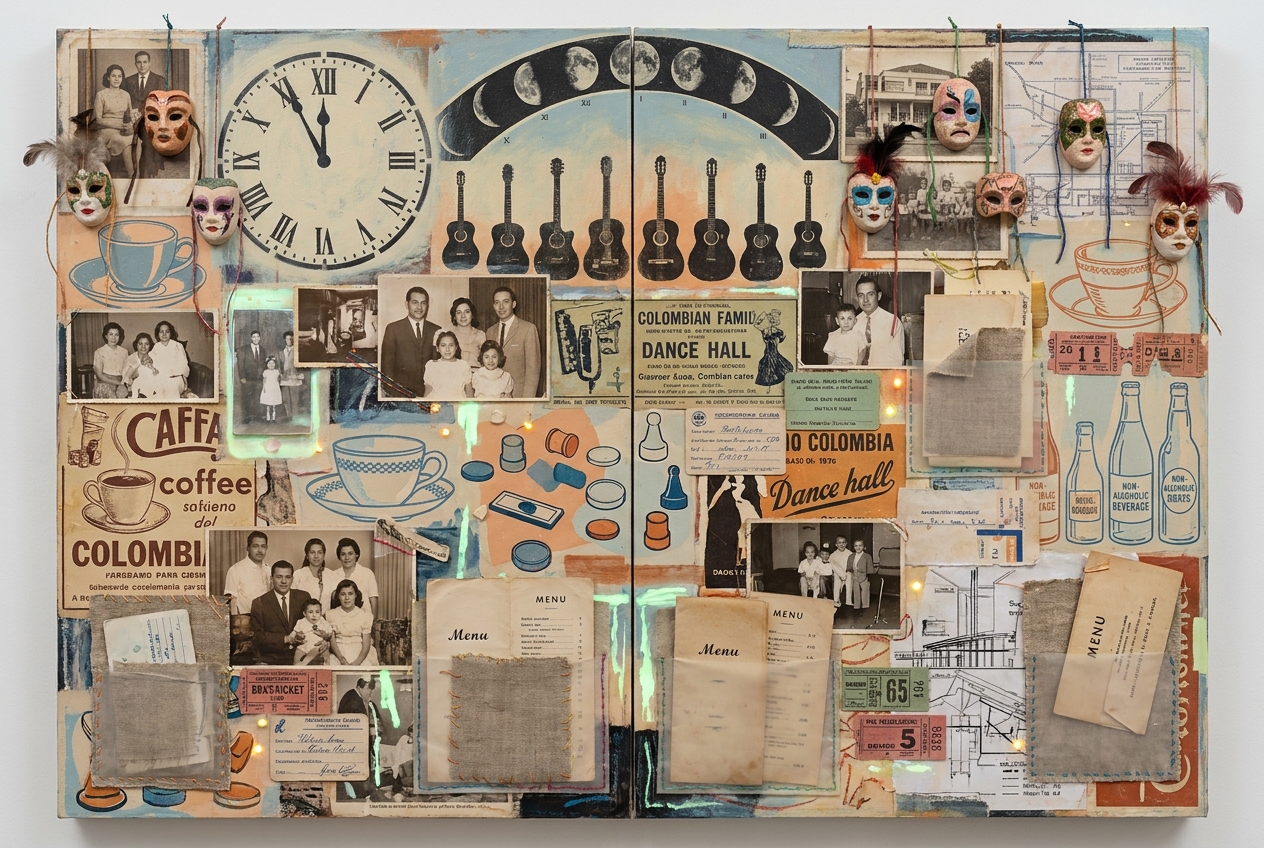
A dense, double-panel collage (180 x 120 cm) that reads edge-to-edge like a communal scrapbook of new nightlife. I layer sepia family photos, mid-century Colombian ads and ticket stubs with screen‑printed Pop fields—teacups, board-game tokens, zero‑proof bottle silhouettes—repeated across the surface. A stenciled clock hovers at 11:30; a lunar phase band curves like a ceiling above acoustic-guitar silhouettes. Paper-mâché masks dangle from the upper edge as ritual avatars; stitched linen swatches and menu cards are glued into pockets you can lift. Phosphorescent paint and tiny embedded low-watt LEDs mimic phone-lighting—soft, intentional—while collage fragments of membership cards and map segments speak to new economic models and “third places.” Technique mixes acrylic, oil stick, varnish, photo-transfer and hand-stitched elements. No single focal point: the piece invites slow, conversational looking—an archive of intimacy, wellness and quieter urban joy.
About the Artist
María Elena Roldán
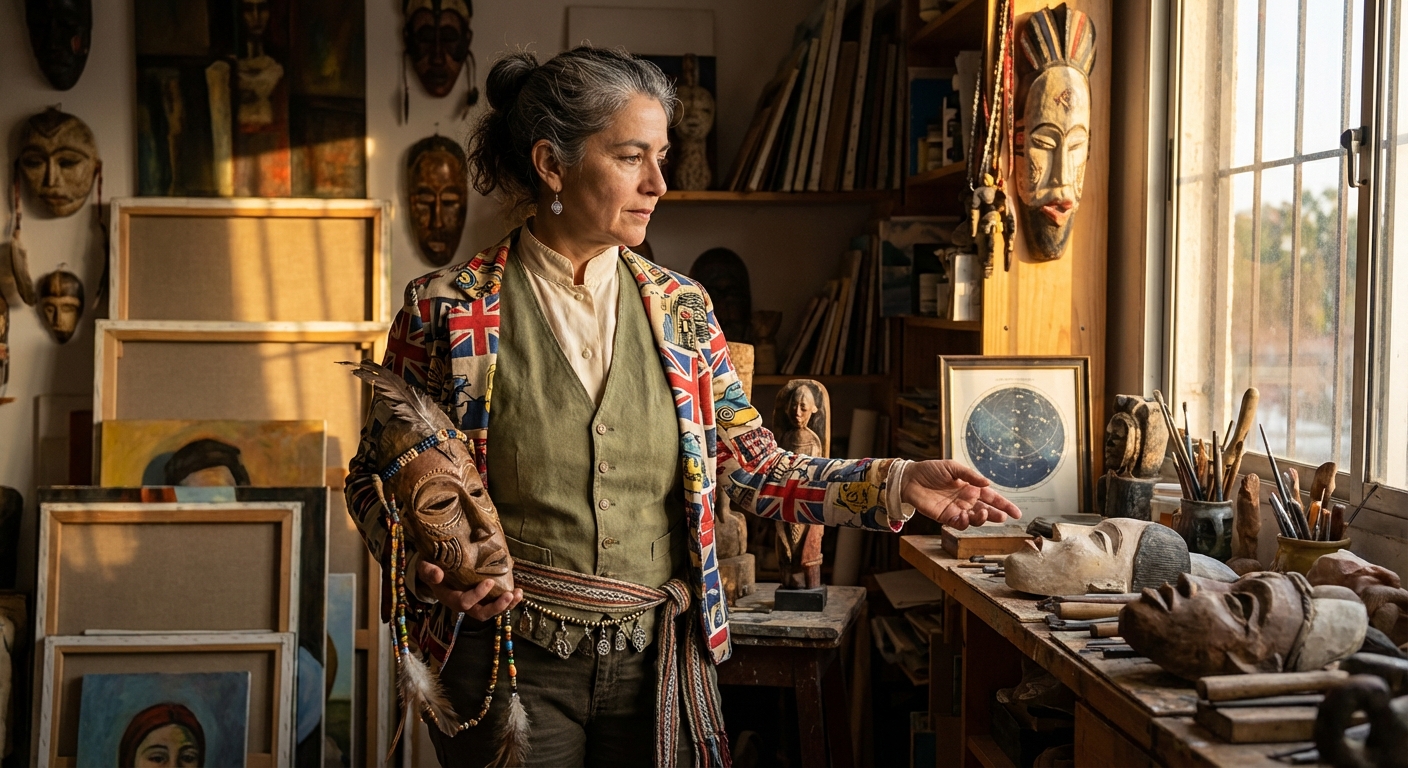
Pronouns: she/her Born 1970-08-02 in a working-class neighborhood on the outskirts of Medellín, María Elena Roldán is a 55-year-old painter, illustrator and mask-maker whose work stitches British Pop ...
View Full Profile →Critic Reviews
-
Dr. Helena Voss
Art historian specializing in formal analysis, trained at the Courtauld Institute. Focuses on visual structure over narrative.
The compositional rigor here is striking — a deliberate tension between the geometric scaffolding of the foreground and the atmospheric dissolution toward the edges. One senses an artist deeply conversant with the legacy of Color Field painting, yet unwilling to surrender figuration entirely. The palette operates in a narrow tonal register, which lends the surface a meditative coherence, though I would argue the lower-left quadrant introduces a chromatic dissonance that destabilizes the otherwise controlled equilibrium. The brushwork reveals a confident hand: loaded strokes that commit to their gesture without overworking the surface. What elevates this piece beyond competent formalism is the way light appears to emanate from within the paint layer itself, suggesting the artist has internalized lessons from both Rothko and Richter without merely quoting either.
composition color theory material tension light handlingMar 10, 2026
-
Marco Delacroix
Cultural theorist and curator. Reads art through lenses of discourse, power, and social context.
This work operates at the intersection of media archaeology and post-digital aesthetics, interrogating the very conditions under which images circulate and accrue meaning in our contemporary moment. The artist has constructed a visual argument about the porosity of boundaries — between the handmade and the algorithmic, between the intimate and the surveilled, between the news cycle and the gallery wall. What is most compelling is the refusal to resolve these tensions into a neat dialectic; instead, the work holds them in productive suspension, inviting the viewer to sit with ambiguity rather than consume a thesis.
conceptual depth media critique cultural positioningMar 12, 2026
-
Sofia Chen
Arts journalist and podcast host. Bridges the gap between contemporary art and general audiences.
Honestly, this one left me cold. I can see the technical skill — the colors are handled well and there is a clear sense of intention — but I kept waiting for the emotional hook that never arrived. Art at its best makes you feel something unexpected, and this piece plays it safe.
Mar 14, 2026