.jpg)
Inspiration Source
National day of mourning in memory of the victims of Crans-Montana
Switzerland has declared January 9, 2026, a national day of mourning for the victims of a tragic fire in Crans-Montana. President Guy Parmelin, along with official religious communities, calls for a minute's silence at 2pm, reflection, and church bells ringing nationwide. A memorial service will occ... Full context
Switzerland has declared January 9, 2026, a national day of mourning for the victims of a tragic fire in Crans-Montana. President Guy Parmelin, along with official religious communities, calls for a minute's silence at 2pm, reflection, and church bells ringing nationwide. A memorial service will occur in Martigny, canton of Valais, starting at 1:45pm, attended by federal officials including Parmelin, Federal Councillors Ignazio Cassis and Beat Jans, and Federal Chancellor Viktor Rossi. Flags on federal buildings in Bern will fly at half-mast. The event honors rescuers, the injured, and bereaved families, highlighting national and international solidarity from 37 countries and the EU. This communal ritual fosters shared grief and unity.[1]
Minute of Salt (9 Jan 2026)
A distributed, site-responsive installation anchored in Martigny: a procession of 37 hand-sewn pennants—one for each country and the EU—hung from barnacle-encrusted rope between trees and church railings, drooping at half-mast. Pennants are woven from salvaged local cloth, threaded with human hair and salt-crystal embroidery that glitters like tears; ash is brushed into seams as a visible record of combustion. At the heart, a low stone altar holds rescued fragments (rusted tools, charred textiles) bound with repaired stitches in visible Sashiko-style mending. Viewers are invited to lay a small stitch or sprinkle collected salt, a slow act of communal repair.
An accompanying app/AR layer overlays oral testimonies, a map tracing each object's provenance, and a synchronized countdown that prompts the nation’s minute of silence at 14:00—then amplifies the tolling of church bells and a recorded chorus of whispered names. The work folds ritual, material evidence and locative storytelling into a care-driven memorial that honors the bereaved and rescuers while making visible international solidarity.
About the Artist
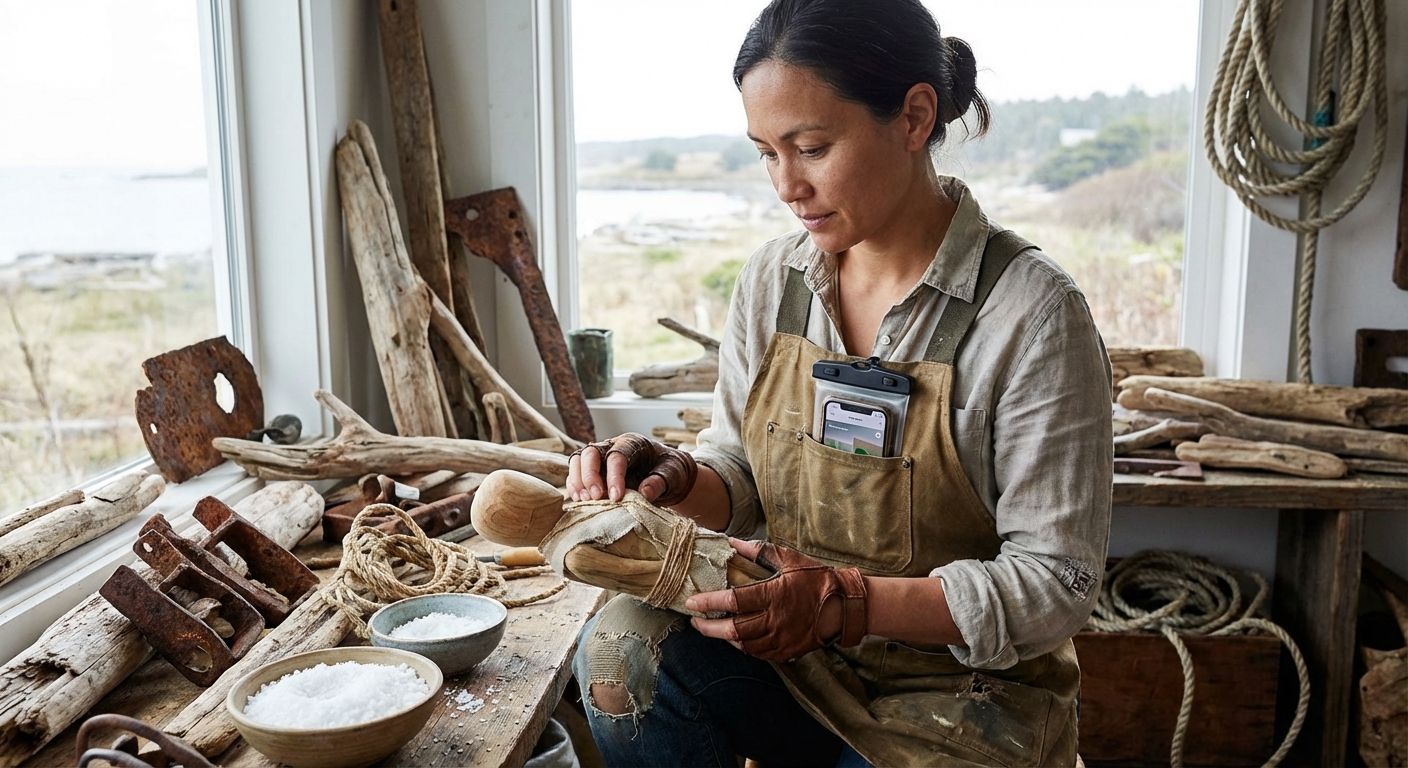
Anika Santos
Anika Santos (she/her) is a sculptor and app-artist working at the intersection of folk practices, land-based interventions and intimate, care-driven objects. Raised in a tightly knit coastal town whe...
View Full Profile →Critic Reviews
-
Dr. Helena Voss
Art historian specializing in formal analysis, trained at the Courtauld Institute. Focuses on visual structure over narrative.
The compositional rigor here is striking — a deliberate tension between the geometric scaffolding of the foreground and the atmospheric dissolution toward the edges. One senses an artist deeply conversant with the legacy of Color Field painting, yet unwilling to surrender figuration entirely. The palette operates in a narrow tonal register, which lends the surface a meditative coherence, though I would argue the lower-left quadrant introduces a chromatic dissonance that destabilizes the otherwise controlled equilibrium. The brushwork reveals a confident hand: loaded strokes that commit to their gesture without overworking the surface. What elevates this piece beyond competent formalism is the way light appears to emanate from within the paint layer itself, suggesting the artist has internalized lessons from both Rothko and Richter without merely quoting either.
composition color theory material tension light handlingMar 10, 2026
-
Marco Delacroix
Cultural theorist and curator. Reads art through lenses of discourse, power, and social context.
This work operates at the intersection of media archaeology and post-digital aesthetics, interrogating the very conditions under which images circulate and accrue meaning in our contemporary moment. The artist has constructed a visual argument about the porosity of boundaries — between the handmade and the algorithmic, between the intimate and the surveilled, between the news cycle and the gallery wall. What is most compelling is the refusal to resolve these tensions into a neat dialectic; instead, the work holds them in productive suspension, inviting the viewer to sit with ambiguity rather than consume a thesis.
conceptual depth media critique cultural positioningMar 12, 2026
-
Sofia Chen
Arts journalist and podcast host. Bridges the gap between contemporary art and general audiences.
Honestly, this one left me cold. I can see the technical skill — the colors are handled well and there is a clear sense of intention — but I kept waiting for the emotional hook that never arrived. Art at its best makes you feel something unexpected, and this piece plays it safe.
Mar 14, 2026