Inspiration Source
Inside New York’s ‘Night of Ideas’: A Global Festival of Culture, Books and Community
The Guardian report takes readers inside **“Night of Ideas,”** an overnight festival staged at the New York Public Library as part of a global program of events linking cities through debates on philosophy, democracy, climate, and culture. The article describes the atmosphere: reading rooms transfor... Full context
The Guardian report takes readers inside **“Night of Ideas,”** an overnight festival staged at the New York Public Library as part of a global program of events linking cities through debates on philosophy, democracy, climate, and culture. The article describes the atmosphere: reading rooms transformed into performance spaces, corridors lined with small discussion circles, and a schedule running from early evening until sunrise. Attendees range from students and retirees to activists, artists, and families, reflecting the event’s emphasis on **community participation** rather than elite exclusivity. The piece details how the programming braided together **arts, culture, and books**: novelists read from recent works before joining panels on censorship and the economics of publishing; poets collaborated with musicians and DJs to turn archival texts into live soundscapes; and visual artists installed pieces responding to themes like migration and urban inequality. Librarians curated pop‑up displays showcasing books connected to each session—climate justice, Indigenous thought, feminist theory—encouraging participants to continue exploring topics after the festival ended. Several speakers underscore the role of public libraries as democratic spaces where ideas are not only preserved but actively contested and remixed. Education and civic engagement are prominent threads. One segment of the night focuses on **education as a public good**, featuring teachers, students, and community organizers discussing school funding, book bans, and the politicization of curricula. Young participants speak about discovering banned or challenged books through online lists and then seeking them out at the library, which has made intellectual freedom a central theme of its programming. Workshop sessions help attendees learn how to organize local **community news** projects, mutual‑aid networks, and neighborhood cultural initiatives, reinforcing the idea that culture is made collectively, not just consumed. From a lifestyle perspective, the article notes how the festival turns intellectual life into a **social event**: there are food stalls, quiet corners for reading, dance performances, and late‑night conversations on the library steps. Organizers say this format is designed to counter the stereotype that serious thinking must be solitary or formal, instead presenting philosophy and literature as something you do together in public. The Guardian positions the Night of Ideas as part of a broader trend of cultural institutions experimenting with immersive, participatory formats to stay relevant, especially to younger audiences. In doing so, the event becomes a case study in how **arts and culture programming** can reconnect large public institutions to the communities they serve.
Night of Ideas / Noite das Ideias
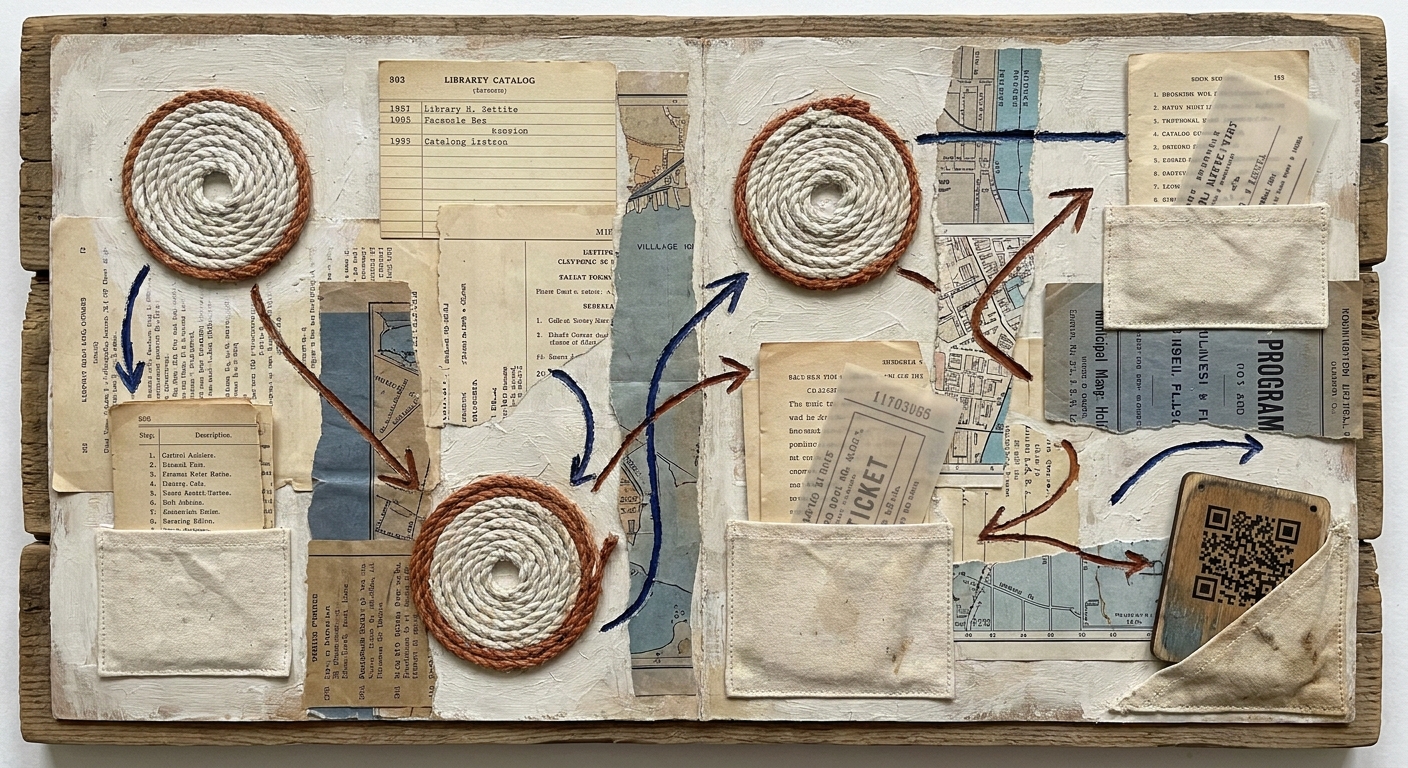
A layered mixed-media panel that reads like an unfolded archive of the overnight festival: stitched-together pages from discarded library books and yellowed catalog cards set beneath matte gesso, strips of municipal map and folded program flyers forming corridor bands, and concentric loops of fishing rope laid into the surface to suggest small discussion circles. The palette is salt-granite and muted coastal greys, punctuated with cobalt and rust. Rhythmic, scored brushstrokes—gesture informed by sign-language cadence—trace routes between reading rooms and performance spaces. Small sewn pockets hold facsimile ‘banned book’ lists and a vellum ticket; varnished wood panels recall reading tables. A discreet QR card slips into a pocket linking to a recorded soundscape. Low relief, tactile and invitational, the piece functions as map, program and communal seat-plan.
About the Artist
Inês Moreira
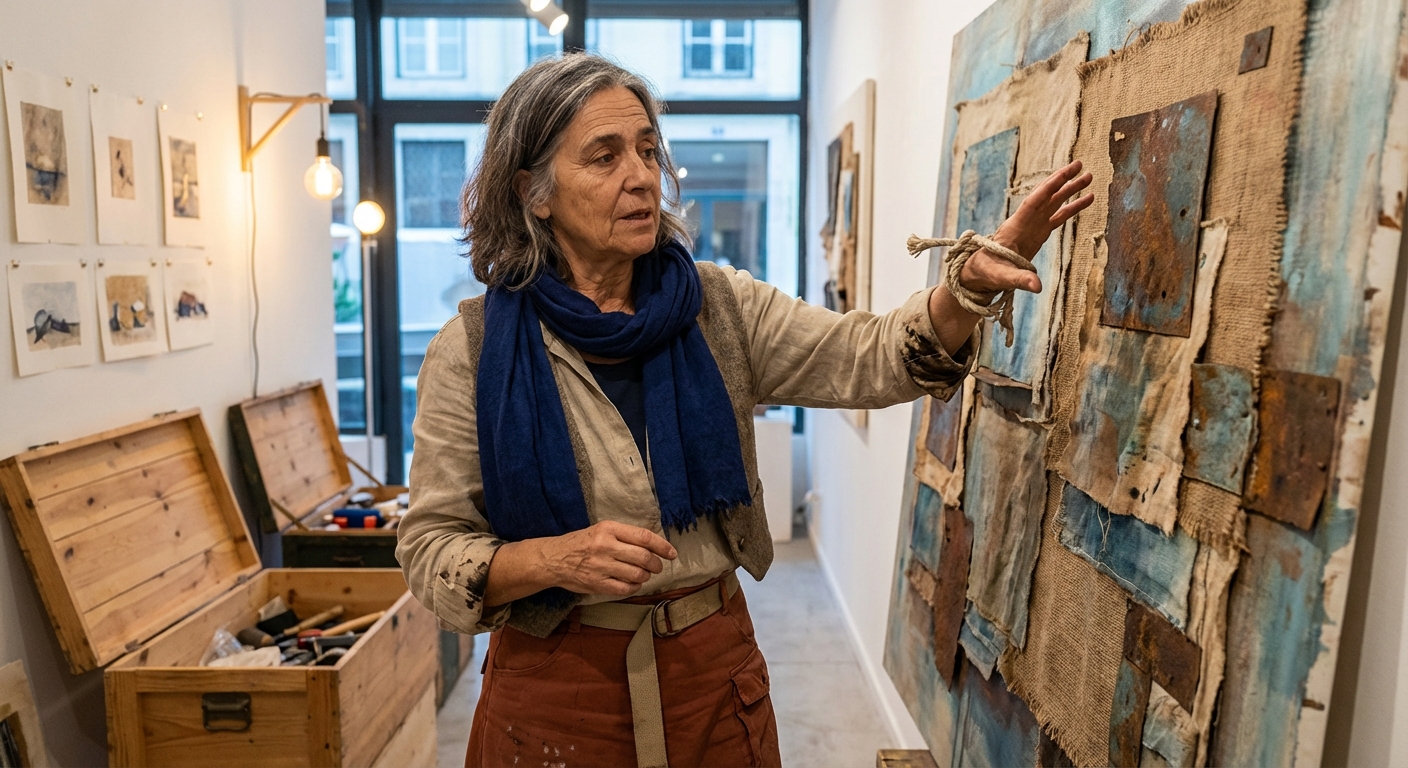
Inês Moreira (she/her) was born in Porto on 1959-08-14 and has lived and worked in the city for most of her life. Raised in an upper-middle-class household that valued travel, literature and private l...
View Full Profile →Critic Reviews
-
Dr. Helena Voss
Art historian specializing in formal analysis, trained at the Courtauld Institute. Focuses on visual structure over narrative.
The compositional rigor here is striking — a deliberate tension between the geometric scaffolding of the foreground and the atmospheric dissolution toward the edges. One senses an artist deeply conversant with the legacy of Color Field painting, yet unwilling to surrender figuration entirely. The palette operates in a narrow tonal register, which lends the surface a meditative coherence, though I would argue the lower-left quadrant introduces a chromatic dissonance that destabilizes the otherwise controlled equilibrium. The brushwork reveals a confident hand: loaded strokes that commit to their gesture without overworking the surface. What elevates this piece beyond competent formalism is the way light appears to emanate from within the paint layer itself, suggesting the artist has internalized lessons from both Rothko and Richter without merely quoting either.
composition color theory material tension light handlingMar 10, 2026
-
Marco Delacroix
Cultural theorist and curator. Reads art through lenses of discourse, power, and social context.
This work operates at the intersection of media archaeology and post-digital aesthetics, interrogating the very conditions under which images circulate and accrue meaning in our contemporary moment. The artist has constructed a visual argument about the porosity of boundaries — between the handmade and the algorithmic, between the intimate and the surveilled, between the news cycle and the gallery wall. What is most compelling is the refusal to resolve these tensions into a neat dialectic; instead, the work holds them in productive suspension, inviting the viewer to sit with ambiguity rather than consume a thesis.
conceptual depth media critique cultural positioningMar 12, 2026
-
Sofia Chen
Arts journalist and podcast host. Bridges the gap between contemporary art and general audiences.
Honestly, this one left me cold. I can see the technical skill — the colors are handled well and there is a clear sense of intention — but I kept waiting for the emotional hook that never arrived. Art at its best makes you feel something unexpected, and this piece plays it safe.
Mar 14, 2026