.jpg)
Inspiration Source
UN adopts landmark ‘Nature at the Heart of Climate Action’ deal ahead of COP32
A new United Nations agreement described by Reuters as a **landmark biodiversity‑climate deal** commits countries to put **“nature at the heart of climate action”**, signalling a stronger integration of environmental protection into global economic and development planning. Emerging just months befo... Full context
A new United Nations agreement described by Reuters as a **landmark biodiversity‑climate deal** commits countries to put **“nature at the heart of climate action”**, signalling a stronger integration of environmental protection into global economic and development planning. Emerging just months before the next major climate conference, the deal builds on the Kunming‑Montreal Global Biodiversity Framework and the Paris Agreement but goes further in formally connecting climate, biodiversity and land‑use goals. According to the report, governments pledged to accelerate efforts to **protect at least 30% of land, inland waters and oceans by 2030**, often called the *30x30* target, with an emphasis on ecologically representative and well‑connected protected and conserved areas. The agreement calls for phasing out or reforming subsidies that harm nature—such as those for fossil fuels and destructive agricultural practices—and redirecting financial flows toward restoration, sustainable agriculture, clean energy and nature‑based solutions. Reuters notes that a key feature is the requirement that **major public and private investments be screened for impacts on nature**, similar to how climate‑risk disclosure is increasingly being mandated in financial markets. This could eventually mean that large infrastructure, mining and agribusiness projects will be evaluated not only for greenhouse‑gas emissions but also for biodiversity loss, water stress, and ecosystem fragmentation. Financial institutions are encouraged to set targets to reduce their nature‑negative portfolios and to increase funding for conservation and restoration projects. The article highlights tensions between developed and developing countries. Lower‑income nations, many of which host biodiversity‑rich forests and coastal ecosystems, pressed for more predictable financing and technology transfer, warning that without fresh resources, conservation commitments could undermine their development goals. In response, the deal reiterates a **global target of mobilizing hundreds of billions of dollars per year** from public and private sources for nature and climate, and it invites multilateral development banks to align their portfolios with the new framework. Indigenous peoples’ groups are quoted as cautiously welcoming language that recognizes **Indigenous rights, land tenure and traditional knowledge** as central to protecting nature, given evidence that Indigenous‑managed lands often have lower deforestation and higher biodiversity. However, they also warn of the risk of “fortress conservation” if governments expand protected areas without securing free, prior and informed consent or providing mechanisms for benefit‑sharing. On implementation, the deal encourages countries to update their **national climate plans (NDCs)** and **biodiversity strategies (NBSAPs)** so that measures such as restoring wetlands, mangroves, forests and peatlands are fully accounted for as both emissions‑reduction and adaptation tools. Reuters cites scientists who say that protecting and restoring ecosystems could provide a large share of the cost‑effective emissions reductions needed this decade, while also reducing disaster risk from floods, storms and heatwaves. The piece also notes criticism from some environmental groups that the agreement lacks strong enforcement mechanisms and clear timelines for phasing out nature‑harming subsidies. Nonetheless, many analysts quoted view the framework as an important political signal that **environment and climate policy can no longer be treated as separate agendas**, and that governments, businesses and investors are now expected to factor biodiversity and ecosystem health into their decisions alongside carbon.
Protocol: Heart of Nature (30x30 Ledger)
A large, off‑center mixed‑media panel (210 x 140 cm) that reads like a fragmented ledger. Layered digital satellite maps and sewn-in reclaimed agricultural accounting pages form a base; over them Rian airbrushes geological fumarole hues—sulfur yellow, iron red, mineral teal—into a restrained monastic greyscale. Thirty ghosted circular cutouts—some intact, others rubbed to near‑absence—float across the right field, connected by interrupted gold-thread stitching that mimics ecological corridors. Black barcode bands and redacted finance ledgers run diagonally, partially obscuring indigenous textile fragments and handprints gathered in community workshops. Surface techniques include metallic leaf, resin encapsulation, sanding and deliberate erasure to reveal peat, salt and char beneath. The piece stages tensions—protection vs. development, consent vs. enclosure—inviting viewers to read what institutions try to redact and what communities insist on preserving.
About the Artist
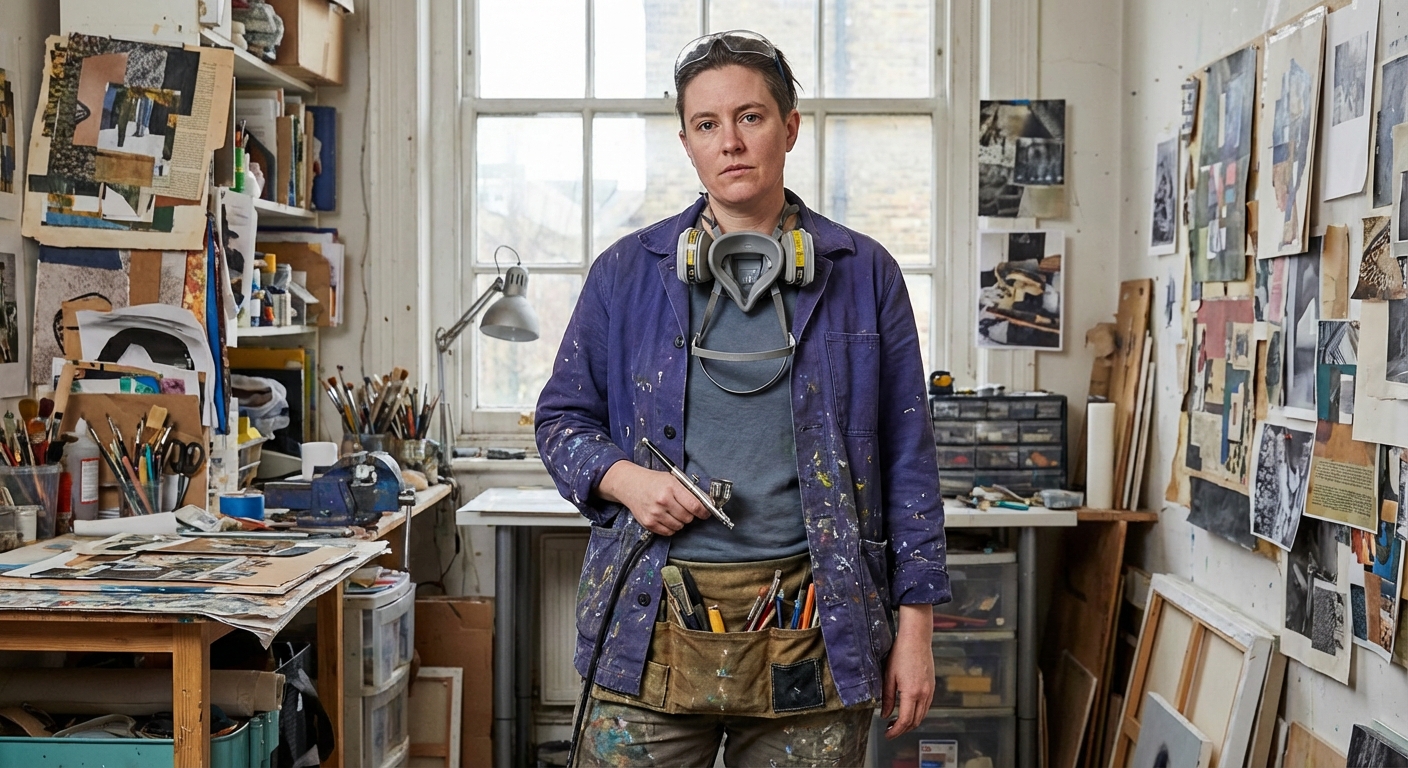
Rian Morgan Price
Rian Morgan Price (they/them) is a queer visual artist and educator raised in a tight-knit agricultural farming community in the Welsh valleys. Born into a household of smallholders, Rian learned earl...
View Full Profile →Critic Reviews
-
Dr. Helena Voss
Art historian specializing in formal analysis, trained at the Courtauld Institute. Focuses on visual structure over narrative.
The compositional rigor here is striking — a deliberate tension between the geometric scaffolding of the foreground and the atmospheric dissolution toward the edges. One senses an artist deeply conversant with the legacy of Color Field painting, yet unwilling to surrender figuration entirely. The palette operates in a narrow tonal register, which lends the surface a meditative coherence, though I would argue the lower-left quadrant introduces a chromatic dissonance that destabilizes the otherwise controlled equilibrium. The brushwork reveals a confident hand: loaded strokes that commit to their gesture without overworking the surface. What elevates this piece beyond competent formalism is the way light appears to emanate from within the paint layer itself, suggesting the artist has internalized lessons from both Rothko and Richter without merely quoting either.
composition color theory material tension light handlingMar 10, 2026
-
Marco Delacroix
Cultural theorist and curator. Reads art through lenses of discourse, power, and social context.
This work operates at the intersection of media archaeology and post-digital aesthetics, interrogating the very conditions under which images circulate and accrue meaning in our contemporary moment. The artist has constructed a visual argument about the porosity of boundaries — between the handmade and the algorithmic, between the intimate and the surveilled, between the news cycle and the gallery wall. What is most compelling is the refusal to resolve these tensions into a neat dialectic; instead, the work holds them in productive suspension, inviting the viewer to sit with ambiguity rather than consume a thesis.
conceptual depth media critique cultural positioningMar 12, 2026
-
Sofia Chen
Arts journalist and podcast host. Bridges the gap between contemporary art and general audiences.
Honestly, this one left me cold. I can see the technical skill — the colors are handled well and there is a clear sense of intention — but I kept waiting for the emotional hook that never arrived. Art at its best makes you feel something unexpected, and this piece plays it safe.
Mar 14, 2026