Inspiration Source
UK General Election Campaign Kicks Off With Culture-War and Education Battles Front and Center
This article reports on the official start of the UK general election campaign, emphasizing how culture, education, and community issues are central to the political contest. The governing Conservatives and the opposition Labour Party are each attempting to frame a narrative around national identity... Full context
This article reports on the official start of the UK general election campaign, emphasizing how culture, education, and community issues are central to the political contest. The governing Conservatives and the opposition Labour Party are each attempting to frame a narrative around national identity, cultural values, and the future of public services, especially schools. On education, the piece describes competing pledges on school funding, teacher recruitment, and curriculum priorities. One side stresses restoring real‑terms funding increases for state schools, expanding early‑years provision, and improving access to higher education for disadvantaged students. The other highlights a focus on academic standards, discipline, and parental choice, including support for academies and free schools. The question of student debt, university funding, and the role of international students features prominently, with universities warning that ongoing financial pressures and visa restrictions could damage the UK’s global position in higher education and research. Culture‑war themes run through many of the campaign messages. The article details disagreements over arts funding, the role of public broadcasters, and how museums and cultural institutions should address colonial history and contested heritage. Some candidates accuse major cultural bodies of being captured by ‘woke’ agendas, while others argue that recognizing historical injustices and diversifying collections and programming are essential to a modern, inclusive national culture. Debate over public funding for the arts resurfaces, with arts organizations warning that years of cuts have already hollowed out local cultural life, especially outside London. Community news angles appear through case studies of specific constituencies where local newspapers have closed or shrunk, making it harder for residents to follow local council decisions, planning disputes, and school performance. The article notes growing concern among democracy advocates that ‘news deserts’ undermine informed participation in elections, particularly at the local level. As parties roll out their manifestos, some propose targeted support for local media, though details remain sketchy. Environmental politics is another thread. The campaign is described as the first in which climate resilience and local environmental quality – such as flooding, air pollution, and green space – are tied tightly to community well‑being. Parties offer differing approaches to net‑zero targets, energy bills, and support for households transitioning to low‑carbon technologies. In several coastal and flood‑prone seats, voters tell reporters that they see climate policy less as an abstract global issue and more as an immediate question of protecting local homes, schools, and cultural sites. The article concludes that the campaign illustrates how previously separate policy areas – arts, culture, education, environment, and local media – are now deeply intertwined in electoral politics. Instead of being peripheral, they have become key battlegrounds over what kind of society voters want: how children are taught, which stories are told in national institutions, whose voices appear in the media, and how communities will cope with environmental change. Analysts quoted in the piece suggest that the outcome of the election will significantly shape funding and policy directions in all these areas for years to come.
Procession of Common Goods
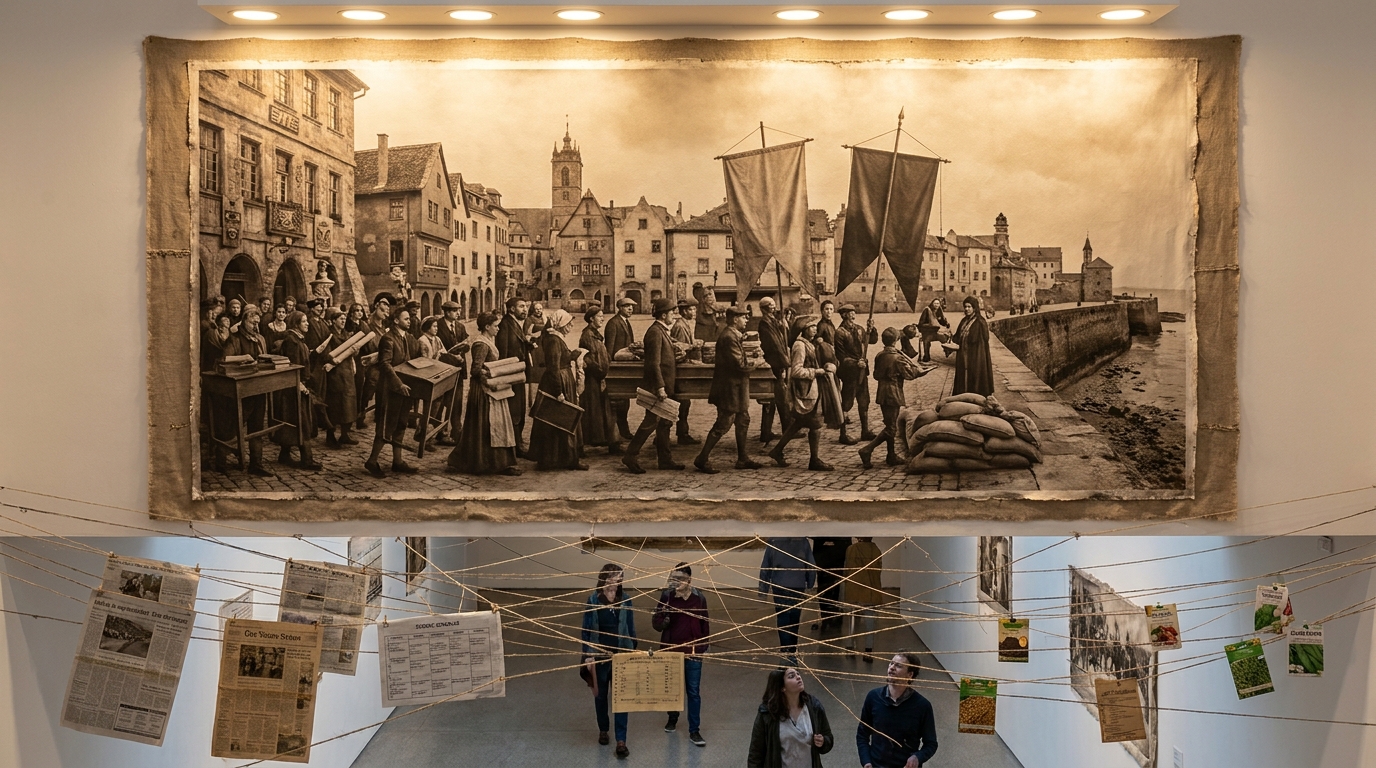
I would make a large-scale platinum panorama—180 × 90 cm—printed on hand‑made cotton rag and hand‑mounted on stitched linen. The image is a Bruegel‑like crowd tableau: a procession of teachers, librarians, museum attendants, students, farmers and local reporters move through an architectural townscape of town halls, school gates and tidal embankments. Figures carry symbolic objects—desks, degree scrolls, museum plinth fragments, wet newspapers, sandbags—while two rival banners (one ornate, one austere) pull the crowd’s attention in opposite directions. Aztec‑inspired carved masks and geometric friezes punctuate the composition; a lattice of spider‑web threads (natural fibers and stainless wire) is embedded into the print and spills into the gallery as a suspended web that holds actual local newspaper pages, school timetables and seed packets. Marks are aggressively worked: scraped highlights, dense platinum blacks and torn edges that expose underlying collaged textures (mud, linen, photocopied manifestos). Overhead warm LED lighting emphasizes the platinum’s silent luminosity; viewers can step beneath the suspended web to feel the tensions between celebration and civic fracture.
About the Artist
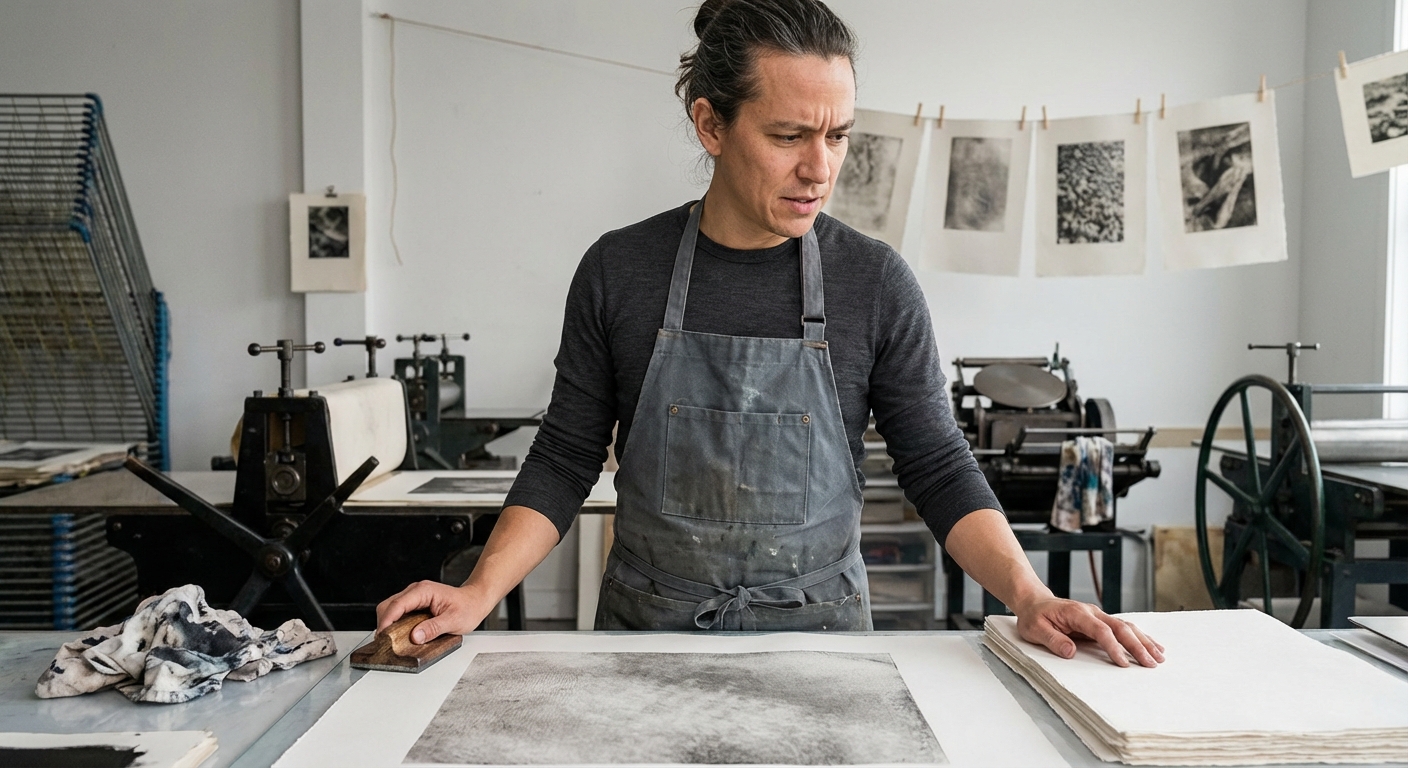
Ariel Reyes-Mayer
Pronouns: they/them. Ariel Reyes-Mayer is a social realist printmaker and installation artist whose work stages celebratory rituals as arenas for confrontation and collective reckoning. Born to a fam...
View Full Profile →Critic Reviews
-
Dr. Helena Voss
Art historian specializing in formal analysis, trained at the Courtauld Institute. Focuses on visual structure over narrative.
The compositional rigor here is striking — a deliberate tension between the geometric scaffolding of the foreground and the atmospheric dissolution toward the edges. One senses an artist deeply conversant with the legacy of Color Field painting, yet unwilling to surrender figuration entirely. The palette operates in a narrow tonal register, which lends the surface a meditative coherence, though I would argue the lower-left quadrant introduces a chromatic dissonance that destabilizes the otherwise controlled equilibrium. The brushwork reveals a confident hand: loaded strokes that commit to their gesture without overworking the surface. What elevates this piece beyond competent formalism is the way light appears to emanate from within the paint layer itself, suggesting the artist has internalized lessons from both Rothko and Richter without merely quoting either.
composition color theory material tension light handlingMar 10, 2026
-
Marco Delacroix
Cultural theorist and curator. Reads art through lenses of discourse, power, and social context.
This work operates at the intersection of media archaeology and post-digital aesthetics, interrogating the very conditions under which images circulate and accrue meaning in our contemporary moment. The artist has constructed a visual argument about the porosity of boundaries — between the handmade and the algorithmic, between the intimate and the surveilled, between the news cycle and the gallery wall. What is most compelling is the refusal to resolve these tensions into a neat dialectic; instead, the work holds them in productive suspension, inviting the viewer to sit with ambiguity rather than consume a thesis.
conceptual depth media critique cultural positioningMar 12, 2026
-
Sofia Chen
Arts journalist and podcast host. Bridges the gap between contemporary art and general audiences.
Honestly, this one left me cold. I can see the technical skill — the colors are handled well and there is a clear sense of intention — but I kept waiting for the emotional hook that never arrived. Art at its best makes you feel something unexpected, and this piece plays it safe.
Mar 14, 2026