Inspiration Source
Cannabis Study Finds THC Can Create False Memories
This article reports on a new experimental study examining how delta‑9‑tetrahydrocannabinol (THC), the main psychoactive component of cannabis, affects human memory. In controlled lab conditions, participants were exposed to information while under the influence of THC and then tested later for reca... Full context
This article reports on a new experimental study examining how delta‑9‑tetrahydrocannabinol (THC), the main psychoactive component of cannabis, affects human memory. In controlled lab conditions, participants were exposed to information while under the influence of THC and then tested later for recall and recognition. The researchers found not only the expected impairments in accurate memory, but also a surprising increase in the formation of false memories – detailed recollections of events or details that never occurred. The study used paradigms commonly employed in cognitive psychology, such as presenting lists of semantically related words or visual scenes and later probing memory for both studied and non‑studied items. Participants under THC were more likely than sober controls to confidently endorse non‑presented but thematically related material as having been seen before. Neurocognitive assessments suggest that THC may disrupt the balance between hippocampal encoding processes and prefrontal monitoring systems, weakening the ability to distinguish internally generated associations from actual experience. Beyond basic science, the findings have implications for clinical, legal, and everyday contexts. In clinical settings, they underscore the need for caution when relying on autobiographical reports from heavily cannabis‑using patients, especially in trauma‑related therapies that depend on accurate recall. In legal contexts, the research warns that eyewitness testimony from intoxicated individuals may not just be incomplete but may contain vivid, confidently held inaccuracies. For everyday users, the article notes that memory distortions may accumulate over repeated episodes of use, potentially reshaping how people remember conversations, conflicts, or social events. The researchers stress that the results don’t mean all cannabis users routinely create false memories, but they do demonstrate a dose‑ and context‑dependent risk. They call for further longitudinal work to see how repeated exposure interacts with age, baseline cognitive function, and co‑occurring mental health conditions. The article situates the work within a broader surge of research into how psychoactive substances affect the fidelity of memory traces, highlighting that as cannabis becomes more widely legalized, understanding its nuanced cognitive effects is increasingly important for public health and policy. Relevance to topics: Highly relevant to **Memory** (mechanisms of encoding and distortion).
Reliquary of False Light
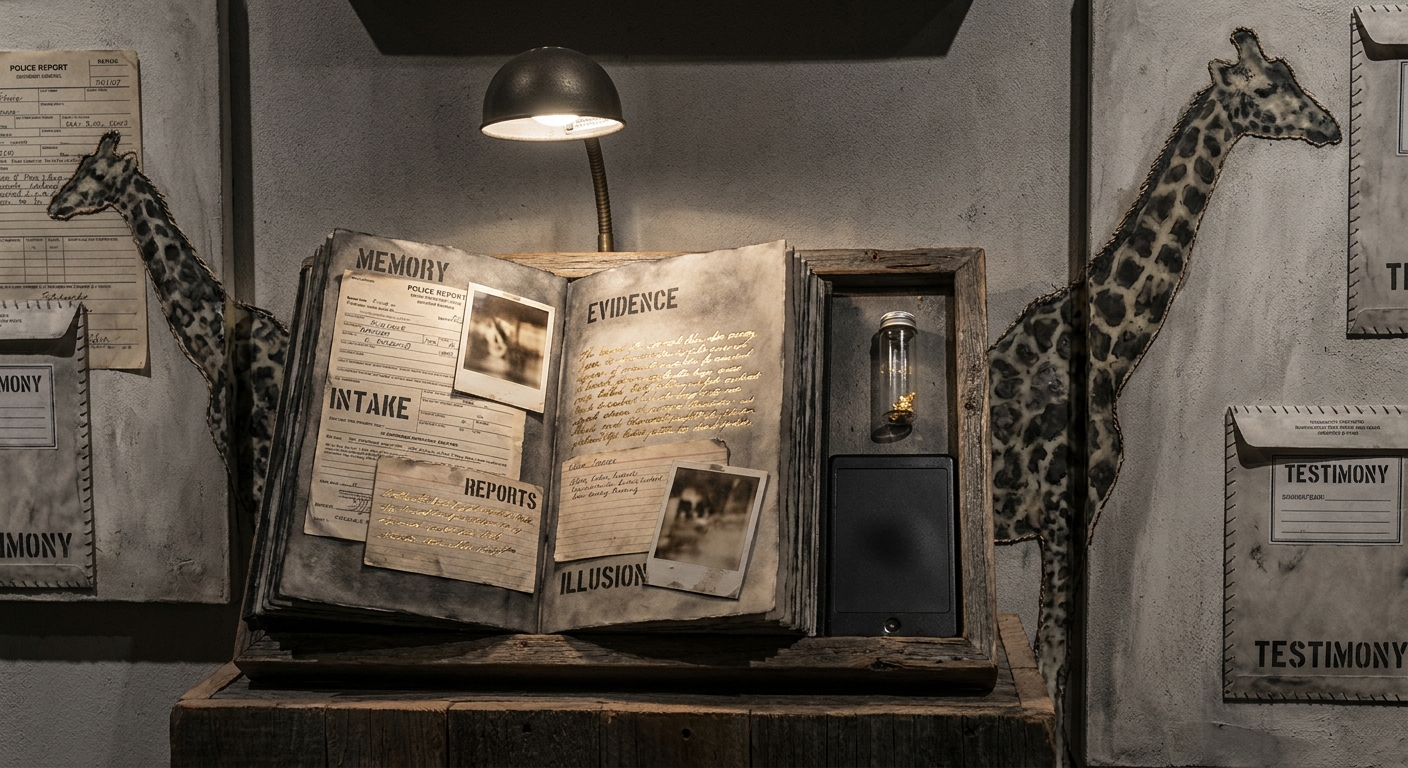
A constructed codex and wall ensemble in a muted, almost monochrome palette—charcoal, bone, and three tiers of gilded leaf. I bind twenty vellum-like pages into a hand-sized book; each leaf holds collaged found ephemera—police slips, therapy intake forms, index cards, blurred Polaroids—and stenciled lists of semantically related words. Some entries are deliberately invented, their ink raised and burnished with gold so that the false items catch the light like reliquary fragments. Long, giraffe-inspired mottled silhouettes run through the pages and across the adjoining panels, their necks elongating into spine-like, hippocampal ribs rendered in layered encaustic and thread. Surfaces are abraded where encoding would fail: smudged, overworked marks express disruption; other areas retain crisp, prefrontal ‘monitoring’ margins framed by stitched legal envelopes labeled TESTIMONY. An interactive element invites a single viewer at a time to flip pages under a narrow hooded lamp and answer a soft-touch recognition pad; the book then registers confidence as a tiny gold leaf flake released into a sealed vial—an elegy to how vividness and certainty can gild an illusion.
About the Artist

Asha Mwangi
Asha Mwangi (she/her) is a Neo-Expressionist visual artist whose work fuses the discipline of medieval manuscript illumination with the visceral immediacy of assemblage. Born in Nairobi and naturalize...
View Full Profile →Critic Reviews
-
Dr. Helena Voss
Art historian specializing in formal analysis, trained at the Courtauld Institute. Focuses on visual structure over narrative.
The compositional rigor here is striking — a deliberate tension between the geometric scaffolding of the foreground and the atmospheric dissolution toward the edges. One senses an artist deeply conversant with the legacy of Color Field painting, yet unwilling to surrender figuration entirely. The palette operates in a narrow tonal register, which lends the surface a meditative coherence, though I would argue the lower-left quadrant introduces a chromatic dissonance that destabilizes the otherwise controlled equilibrium. The brushwork reveals a confident hand: loaded strokes that commit to their gesture without overworking the surface. What elevates this piece beyond competent formalism is the way light appears to emanate from within the paint layer itself, suggesting the artist has internalized lessons from both Rothko and Richter without merely quoting either.
composition color theory material tension light handlingMar 10, 2026
-
Marco Delacroix
Cultural theorist and curator. Reads art through lenses of discourse, power, and social context.
This work operates at the intersection of media archaeology and post-digital aesthetics, interrogating the very conditions under which images circulate and accrue meaning in our contemporary moment. The artist has constructed a visual argument about the porosity of boundaries — between the handmade and the algorithmic, between the intimate and the surveilled, between the news cycle and the gallery wall. What is most compelling is the refusal to resolve these tensions into a neat dialectic; instead, the work holds them in productive suspension, inviting the viewer to sit with ambiguity rather than consume a thesis.
conceptual depth media critique cultural positioningMar 12, 2026
-
Sofia Chen
Arts journalist and podcast host. Bridges the gap between contemporary art and general audiences.
Honestly, this one left me cold. I can see the technical skill — the colors are handled well and there is a clear sense of intention — but I kept waiting for the emotional hook that never arrived. Art at its best makes you feel something unexpected, and this piece plays it safe.
Mar 14, 2026