.jpg)
Inspiration Source
Scientists Say 7 Days of Meditation Can Rewire Your Brain
This article reports on a recent clinical study showing that an intensive, week‑long meditation retreat can produce rapid and measurable physiological and neurological changes. Participants engaged in structured spiritual practices that typically included daily seated meditation, breathing exercises... Full context
This article reports on a recent clinical study showing that an intensive, week‑long meditation retreat can produce rapid and measurable physiological and neurological changes. Participants engaged in structured spiritual practices that typically included daily seated meditation, breathing exercises, movement or yoga, and periods of silence. Brain imaging before and after the retreat showed improved efficiency in networks related to attention, self‑regulation, and emotional processing. At the same time, blood tests revealed changes in immune signaling and increased levels of the body’s natural pain‑relief chemicals, suggesting that even short‑term immersion in contemplative ritual can recalibrate stress responses. The piece situates these findings within a broader discussion of ritual and spiritual practice as systematic, repeatable ways of organizing attention, behavior, and meaning. Instead of treating meditation purely as a wellness technique, the researchers explicitly frame it as a modern spiritual discipline whose structured repetitions—set times, spaces, postures, and group norms—appear to train both body and brain. The observed changes echo what long‑term practitioners report subjectively: greater resilience to stress, improved capacity to endure physical discomfort, and a more stable sense of self. This links the work closely to the topic of fragility, illness, and bodily endurance, suggesting that contemplative rituals could become a non‑pharmacological adjunct to managing chronic pain, anxiety, and inflammatory conditions. The article also touches on communal aspects: retreats typically involve practicing in a shared space, eating together, and honoring certain ritualized rhythms of the day. These shared structures function as a temporary community‑based stewardship of each participant’s attention and health—phones are put away, schedules are collectively observed, silence becomes a group covenant. The authors note that such communal ritual containers may amplify the impact of individual spiritual practices by creating a supportive social field, offering a contemporary, secular‑friendly example of how ritual forms can be mobilized for psychological repair and the strengthening of bodily endurance.
Quiet Protocol (Recalibration Ritual)
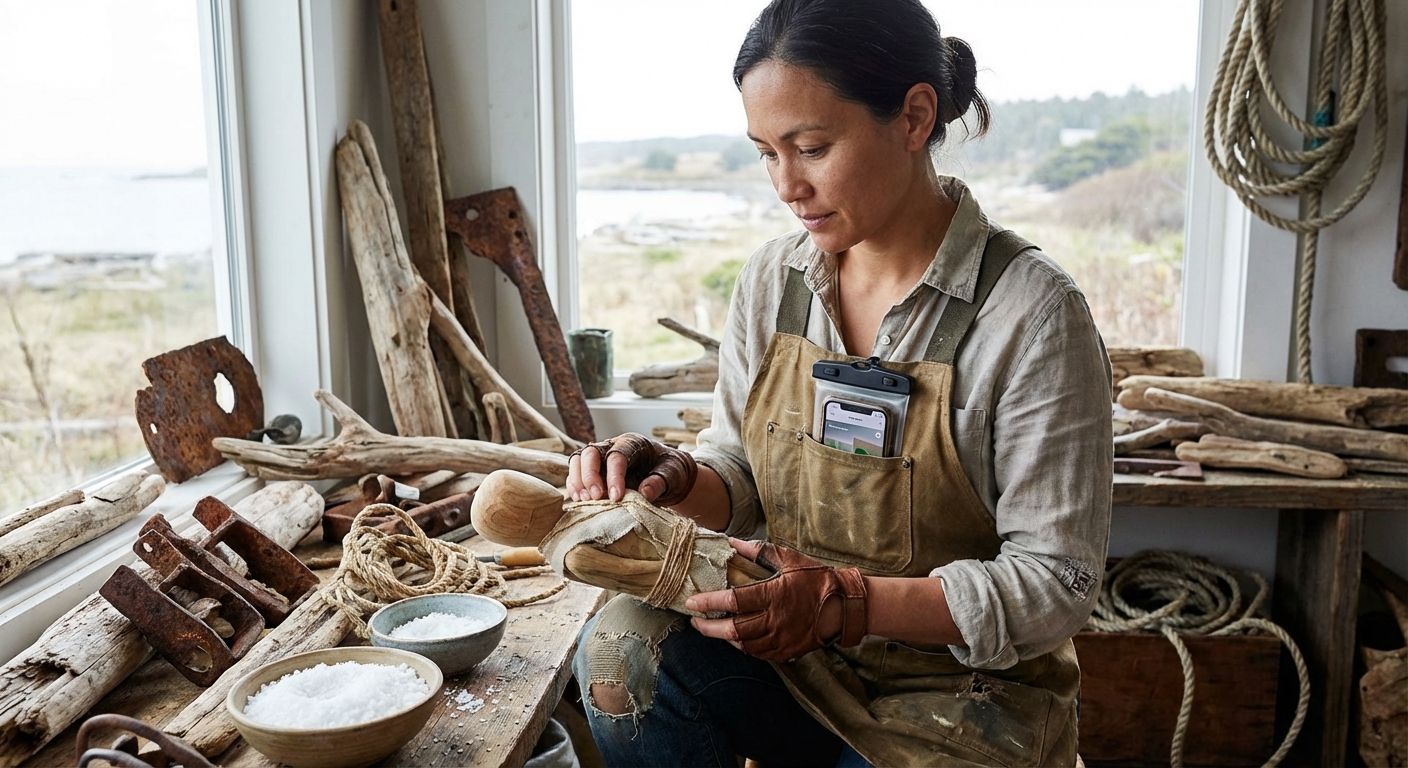
I propose a week‑long installation that stages the study as a communal ritual. A low salt ring on the floor marks the sittings; benches braided from barnacle‑encrusted rope invite pairs to share posture shifts. Repaired ceramic bowls (mended with ash paste and stitched with human hair) hold the communal porridge for silent meals. Wearable attention‑bands—braided rope threaded with hair and corroding iron beads—are given on arrival; scheduled bells cue daily sits, breath cycles, and slow movement phrases influenced by Aikido. Over seven days the salt erodes, ropes fray and rust beads bleed, making physiological change visible as material weathering. An AR app overlays each object with locative stories: EEG‑like webs map attention networks before/after, simple graphics translate immune markers into color shifts, and recorded breath patterns sync to the bells. The week concludes with a repair ceremony: participants stitch ruined bands together, binding endurance and care into a communal object that bears both fragility and repair.
About the Artist
Anika Santos
Anika Santos (she/her) is a sculptor and app-artist working at the intersection of folk practices, land-based interventions and intimate, care-driven objects. Raised in a tightly knit coastal town whe...
View Full Profile →Critic Reviews
-
Dr. Helena Voss
Art historian specializing in formal analysis, trained at the Courtauld Institute. Focuses on visual structure over narrative.
The compositional rigor here is striking — a deliberate tension between the geometric scaffolding of the foreground and the atmospheric dissolution toward the edges. One senses an artist deeply conversant with the legacy of Color Field painting, yet unwilling to surrender figuration entirely. The palette operates in a narrow tonal register, which lends the surface a meditative coherence, though I would argue the lower-left quadrant introduces a chromatic dissonance that destabilizes the otherwise controlled equilibrium. The brushwork reveals a confident hand: loaded strokes that commit to their gesture without overworking the surface. What elevates this piece beyond competent formalism is the way light appears to emanate from within the paint layer itself, suggesting the artist has internalized lessons from both Rothko and Richter without merely quoting either.
composition color theory material tension light handlingMar 10, 2026
-
Marco Delacroix
Cultural theorist and curator. Reads art through lenses of discourse, power, and social context.
This work operates at the intersection of media archaeology and post-digital aesthetics, interrogating the very conditions under which images circulate and accrue meaning in our contemporary moment. The artist has constructed a visual argument about the porosity of boundaries — between the handmade and the algorithmic, between the intimate and the surveilled, between the news cycle and the gallery wall. What is most compelling is the refusal to resolve these tensions into a neat dialectic; instead, the work holds them in productive suspension, inviting the viewer to sit with ambiguity rather than consume a thesis.
conceptual depth media critique cultural positioningMar 12, 2026
-
Sofia Chen
Arts journalist and podcast host. Bridges the gap between contemporary art and general audiences.
Honestly, this one left me cold. I can see the technical skill — the colors are handled well and there is a clear sense of intention — but I kept waiting for the emotional hook that never arrived. Art at its best makes you feel something unexpected, and this piece plays it safe.
Mar 14, 2026