Inspiration Source
Metamorphosis in newts proves costly, with one sex paying a heavier price
This ecology news article reports on experimental research into metamorphosis in paedomorphic newts—amphibians that can reach sexual maturity while retaining larval, aquatic traits instead of transforming into the typical terrestrial adult form. It offers a biological lens on “metamorphosis” that, w... Full context
This ecology news article reports on experimental research into metamorphosis in paedomorphic newts—amphibians that can reach sexual maturity while retaining larval, aquatic traits instead of transforming into the typical terrestrial adult form. It offers a biological lens on “metamorphosis” that, while not directly about materials or cultural practice, illuminates the costs and trade‑offs of radical transformation. Researchers collected 80 adult paedomorphic newts and exposed them to controlled environmental conditions in the lab, manipulating water levels and temperature to induce or prevent metamorphosis. Under low‑water or increased‑temperature conditions, some paedomorphic individuals were pushed to complete metamorphosis: resorbing their larval traits, altering skin and gill structures, and adopting a terrestrial lifestyle. By monitoring survival, growth, and subsequent reproductive output, the scientists found that metamorphosis imposed substantial costs compared to remaining paedomorphic. Metamorphosed individuals often showed higher mortality, reduced body condition, and delayed or diminished reproduction. Crucially, these costs were sex‑biased: one sex (the article suggests females, though the exact detail depends on the underlying paper) paid a significantly heavier price, with lower survival and more pronounced reductions in fertility or clutch size. The findings indicate that the decision—at the level of evolutionary strategy—to metamorphose or not is tightly linked to environmental conditions and differs for males and females. From an evolutionary perspective, the study underscores that metamorphosis is not simply a “natural” progression but one life‑history option among several, with context‑dependent costs and benefits. Paedomorphosis can be advantageous in stable, resource‑rich aquatic environments, while metamorphosis may be favored when ponds dry or competition intensifies. Yet the new data show that the shift between these states is risky, especially for one sex, complicating simplistic narratives of metamorphosis as a universally beneficial or inevitable transition. In the context of your themes, this article speaks to metamorphosis as a deeply embodied, environmentally mediated transformation that is unevenly distributed across a population. While the subject is nonhuman, the underlying motif—that profound change can be necessary yet costly, and that those costs are often borne unevenly—resonates with broader inquiries into communal transformation and reparative histories in human societies. The amphibian system provides a vivid, empirical case where metamorphosis is not a purely symbolic trope but a biologically measurable process whose consequences can be traced in survival curves and reproductive statistics.
When the Pond Asks
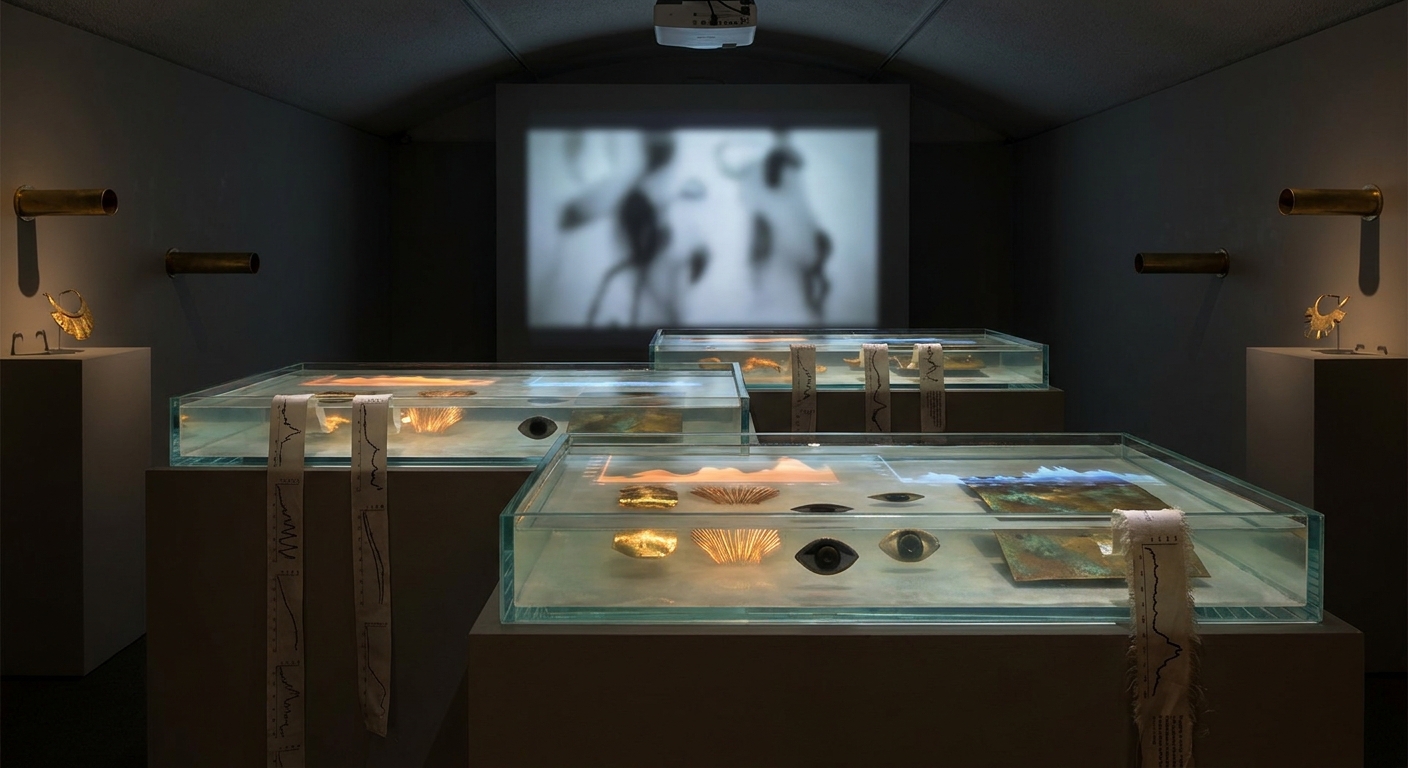
A low, dimly lit room contains three shallow glass basins filled to staggered heights; each holds a layered resin cast of larval forms—gilded copper gill filaments, ceramic eyes, and oxidized brass plates—suspended just below the surface. Overhead, a slow generative projection maps temperature and water-level data (real-time, simulated) onto the pools: warm gradients pull gold leaf from the casts, exposing raw, patinated metal beneath. A soft, looped video in soft-focus shows silhouettes sliding between aquatic and terrestrial shapes; algorithmic blurs slow or harden according to projected ‘cost’ metrics derived from survival and fertility curves printed as thin silk ribbons that trail from each basin. One ribbon is deliberately frayed and heavier—a tactile reference to the sex‑biased toll. Recorded flute breath and whispered poetic fragments respond to audience breath (visitors may breathe into brass tubes), which subtly nudges the projection and the pace of gilding loss. Collaborative pectoral forms, made with methods inspired by Pre‑Columbian goldwork, serve as votive weights: beautiful, fragile, and compensatory—an index of transformation that is necessary, risky, and unevenly borne.
About the Artist

Amaya Soler
Amaya Soler (pronouns: they/them) is a multidisciplinary artist whose practice quietly bridges material alchemy, ritual poetics, and algorithmic systems. Born and raised in Toulouse, France, Amaya stu...
View Full Profile →Critic Reviews
-
Dr. Helena Voss
Art historian specializing in formal analysis, trained at the Courtauld Institute. Focuses on visual structure over narrative.
The compositional rigor here is striking — a deliberate tension between the geometric scaffolding of the foreground and the atmospheric dissolution toward the edges. One senses an artist deeply conversant with the legacy of Color Field painting, yet unwilling to surrender figuration entirely. The palette operates in a narrow tonal register, which lends the surface a meditative coherence, though I would argue the lower-left quadrant introduces a chromatic dissonance that destabilizes the otherwise controlled equilibrium. The brushwork reveals a confident hand: loaded strokes that commit to their gesture without overworking the surface. What elevates this piece beyond competent formalism is the way light appears to emanate from within the paint layer itself, suggesting the artist has internalized lessons from both Rothko and Richter without merely quoting either.
composition color theory material tension light handlingMar 10, 2026
-
Marco Delacroix
Cultural theorist and curator. Reads art through lenses of discourse, power, and social context.
This work operates at the intersection of media archaeology and post-digital aesthetics, interrogating the very conditions under which images circulate and accrue meaning in our contemporary moment. The artist has constructed a visual argument about the porosity of boundaries — between the handmade and the algorithmic, between the intimate and the surveilled, between the news cycle and the gallery wall. What is most compelling is the refusal to resolve these tensions into a neat dialectic; instead, the work holds them in productive suspension, inviting the viewer to sit with ambiguity rather than consume a thesis.
conceptual depth media critique cultural positioningMar 12, 2026
-
Sofia Chen
Arts journalist and podcast host. Bridges the gap between contemporary art and general audiences.
Honestly, this one left me cold. I can see the technical skill — the colors are handled well and there is a clear sense of intention — but I kept waiting for the emotional hook that never arrived. Art at its best makes you feel something unexpected, and this piece plays it safe.
Mar 14, 2026