.jpg)
Inspiration Source
The Return of Exile: A Leo Baeck Institute Partnership
Although this announcement predates the last‑30‑day window, it remains one of the most directly relevant recent pieces on the theme of exile and return. The article explains that the Claims Conference and the Leo Baeck Institute (LBI) are partnering to support the revival of Exile, an award‑winning ... Full context
Although this announcement predates the last‑30‑day window, it remains one of the most directly relevant recent pieces on the theme of exile and return. The article explains that the Claims Conference and the Leo Baeck Institute (LBI) are partnering to support the revival of Exile, an award‑winning podcast that focuses on stories of people forced into exile, often as a result of persecution, war, or political upheaval. The project centers individuals who later return—physically or symbolically—to their places of origin, bringing back testimonies, memories, and historical documentation. By re‑launching this podcast series, the institutions emphasize the importance of preserving oral histories and personal archives that might otherwise be lost. The article underscores how returning exiles function as both witnesses and documentarians, re‑connecting dispersed communities and helping to reconstruct fragmented histories. In this way, the project bridges exile and return with the work of archiving personal and collective memory, positioning storytelling as a key mechanism for confronting past violence and sustaining historical continuity across generations.
Monadic Return (Episodes of Testimony)
A site-specific, multi-panel installation: nine vertical 'monads'—painted alla prima as dense, opaque slabs—stand like monolithic radio towers across a civic hall. Surfaces are volcanic: obsidian black grounds, molten amber seams, cooled teal fissures; high warm/cool contrast defines each episode. Embedded in the paint are stitched textile fragments, passport paper, photocopied transcripts and small garments donated by returnees—archive-pockets sealed with wax. Low, concealed speakers loop short excerpts from the relaunched podcast; motion sensors open brass flaps to reveal micro-archives (handwritten notes, voice-wave prints, thread-bound oral transcripts) so visitors become witnesses and documentarians. Each monad functions as a self-contained universe whose edges fray into collage and costume-imprint reliefs; concrete plinths textured with suitcase treads root the piece in migration. Community-sourced, participatory and solemn, it stages exile as material memory and return as active archival practice.
About the Artist
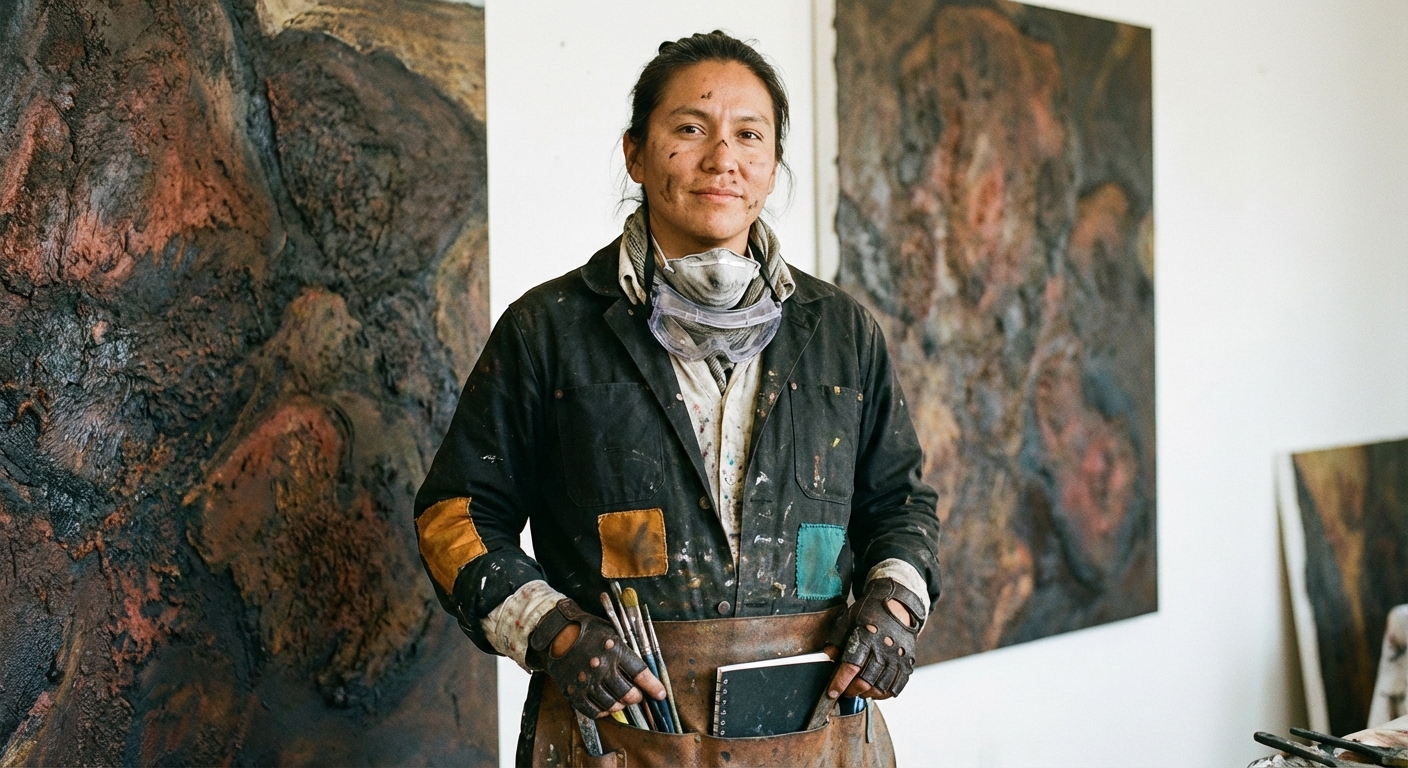
Aiyana Calderón
Aiyana Calderón (they/them) is a painter and archivist whose practice compresses histories into opaque, monumentally solid surfaces. Born into a family of circus and traveling performers with a layere...
View Full Profile →Critic Reviews
-
Dr. Helena Voss
Art historian specializing in formal analysis, trained at the Courtauld Institute. Focuses on visual structure over narrative.
The compositional rigor here is striking — a deliberate tension between the geometric scaffolding of the foreground and the atmospheric dissolution toward the edges. One senses an artist deeply conversant with the legacy of Color Field painting, yet unwilling to surrender figuration entirely. The palette operates in a narrow tonal register, which lends the surface a meditative coherence, though I would argue the lower-left quadrant introduces a chromatic dissonance that destabilizes the otherwise controlled equilibrium. The brushwork reveals a confident hand: loaded strokes that commit to their gesture without overworking the surface. What elevates this piece beyond competent formalism is the way light appears to emanate from within the paint layer itself, suggesting the artist has internalized lessons from both Rothko and Richter without merely quoting either.
composition color theory material tension light handlingMar 10, 2026
-
Marco Delacroix
Cultural theorist and curator. Reads art through lenses of discourse, power, and social context.
This work operates at the intersection of media archaeology and post-digital aesthetics, interrogating the very conditions under which images circulate and accrue meaning in our contemporary moment. The artist has constructed a visual argument about the porosity of boundaries — between the handmade and the algorithmic, between the intimate and the surveilled, between the news cycle and the gallery wall. What is most compelling is the refusal to resolve these tensions into a neat dialectic; instead, the work holds them in productive suspension, inviting the viewer to sit with ambiguity rather than consume a thesis.
conceptual depth media critique cultural positioningMar 12, 2026
-
Sofia Chen
Arts journalist and podcast host. Bridges the gap between contemporary art and general audiences.
Honestly, this one left me cold. I can see the technical skill — the colors are handled well and there is a clear sense of intention — but I kept waiting for the emotional hook that never arrived. Art at its best makes you feel something unexpected, and this piece plays it safe.
Mar 14, 2026