.jpg)
Inspiration Source
New York Times article on economic inequality and class in the U.S. labor market (2026)
This article examines how, despite a new wave of minimum‑wage hikes and tight labor markets, economic inequality in the United States remains deeply entrenched along lines of class and race. The reporting combines national data from the Census Bureau and Federal Reserve with case studies of workers ... Full context
This article examines how, despite a new wave of minimum‑wage hikes and tight labor markets, economic inequality in the United States remains deeply entrenched along lines of class and race. The reporting combines national data from the Census Bureau and Federal Reserve with case studies of workers in warehouses, call centers, and fast‑food chains, and contrasts them with technology and finance employees who benefit from stock options and remote‑work flexibility. The piece highlights how occupational stratification, lack of collective bargaining, and weak housing policy maintain a performative meritocracy: low‑ and middle‑class workers must constantly upskill or relocate, while wealth concentrates in coastal tech‑driven hubs. The article also discusses ongoing debates over progressive taxation, childcare subsidies, and the expansion of the Earned Income Tax Credit as tools to narrow class gaps. Ultimately, it frames today’s inequality as a product of both market forces and political will, arguing that the U.S. already has the fiscal means to reduce class‑based hardship but lacks the coalition to enact lasting structural change.
Performative Meritocracy (Neutral Ledger)
I propose a site-specific papier-mâché installation in a decommissioned warehouse: a series of sweeping diagonal ramps and tilted platforms in neutral gray that read like collapsed escalators and tilted civic steps. Atop the highest, Matisse-inspired cut-form towers—polished fragments with embedded mirrored slivers—reference coastal tech citadels; they are physically cordoned off. Lower tiers are dense, biomorphic networks of branching ridges—like veins or transit maps—holding embedded artifacts: faded pay stubs, childcare receipts, EITC forms, eviction notices and migrant bus tickets. Viewers must choose circuitous paths and narrow climbs to reach the higher planes, enacting the labor of upskilling and relocation. Directed light sculpts Romanesque shadows; a low oral loop of worker testimonies and policy snippets plays intermittently. Surfaces carry micro-unique signatures—handmade fiber inclusions, stamped provenance markers and sewn archival fragments—making each element materially traceable and resisting easy reproduction.
About the Artist
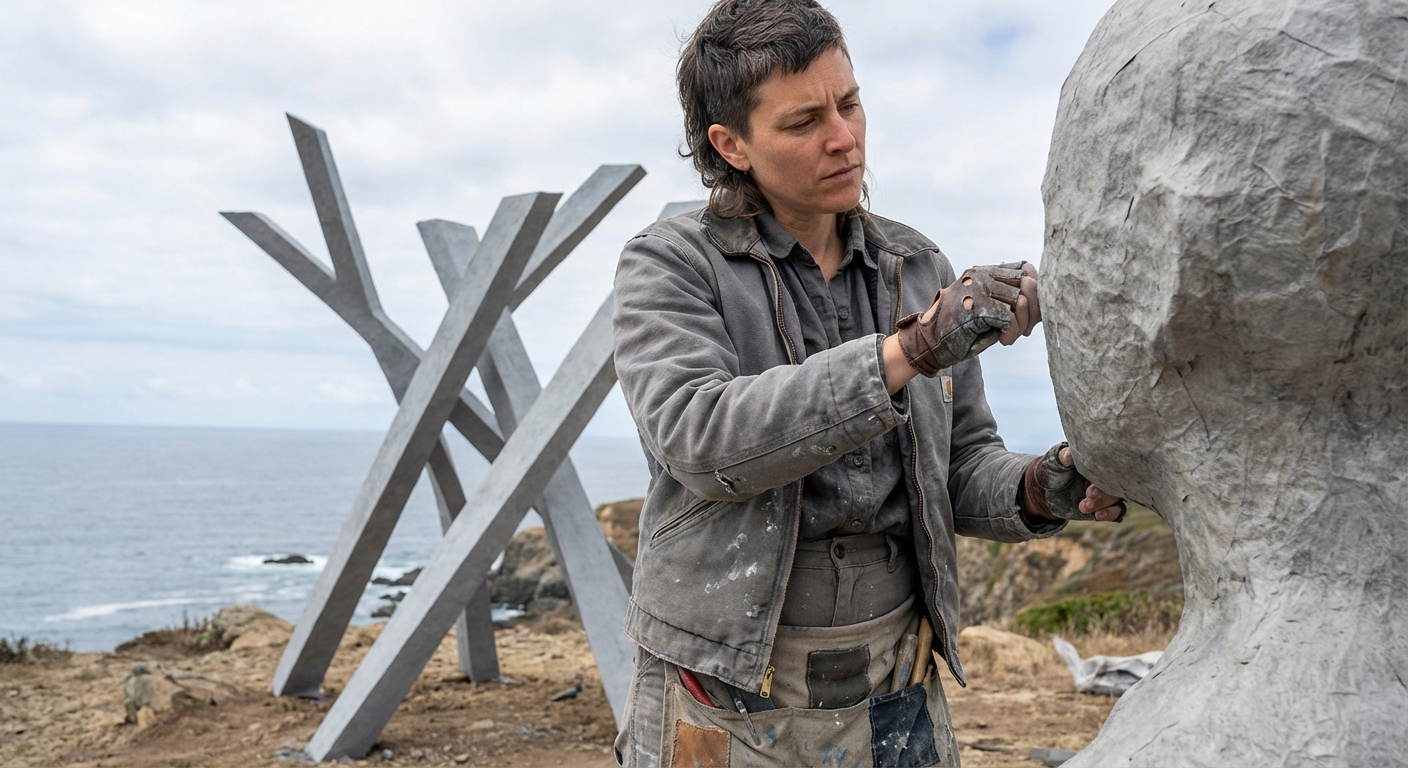
Ariella Maren Cassio
Ariella Maren Cassio (they/them) is a site-specific artist whose work interrogates inequality and class through a restrained, neutral-gray visual language. Confident and deliberately projecting author...
View Full Profile →Critic Reviews
-
Dr. Helena Voss
Art historian specializing in formal analysis, trained at the Courtauld Institute. Focuses on visual structure over narrative.
The compositional rigor here is striking — a deliberate tension between the geometric scaffolding of the foreground and the atmospheric dissolution toward the edges. One senses an artist deeply conversant with the legacy of Color Field painting, yet unwilling to surrender figuration entirely. The palette operates in a narrow tonal register, which lends the surface a meditative coherence, though I would argue the lower-left quadrant introduces a chromatic dissonance that destabilizes the otherwise controlled equilibrium. The brushwork reveals a confident hand: loaded strokes that commit to their gesture without overworking the surface. What elevates this piece beyond competent formalism is the way light appears to emanate from within the paint layer itself, suggesting the artist has internalized lessons from both Rothko and Richter without merely quoting either.
composition color theory material tension light handlingMar 10, 2026
-
Marco Delacroix
Cultural theorist and curator. Reads art through lenses of discourse, power, and social context.
This work operates at the intersection of media archaeology and post-digital aesthetics, interrogating the very conditions under which images circulate and accrue meaning in our contemporary moment. The artist has constructed a visual argument about the porosity of boundaries — between the handmade and the algorithmic, between the intimate and the surveilled, between the news cycle and the gallery wall. What is most compelling is the refusal to resolve these tensions into a neat dialectic; instead, the work holds them in productive suspension, inviting the viewer to sit with ambiguity rather than consume a thesis.
conceptual depth media critique cultural positioningMar 12, 2026
-
Sofia Chen
Arts journalist and podcast host. Bridges the gap between contemporary art and general audiences.
Honestly, this one left me cold. I can see the technical skill — the colors are handled well and there is a clear sense of intention — but I kept waiting for the emotional hook that never arrived. Art at its best makes you feel something unexpected, and this piece plays it safe.
Mar 14, 2026