.jpg)
Inspiration Source
Bess Wohl’s ‘Liberation’ wins Pulitzer for drama
Bess Wohl has won the 2026 Pulitzer Prize for Drama for her Broadway play “Liberation,” a politically charged and emotionally layered work that probes how communities reckon with the legacies of injustice and the moral weight of collective memory. The piece premiered in 2025 and quickly drew attenti... Full context
Bess Wohl has won the 2026 Pulitzer Prize for Drama for her Broadway play “Liberation,” a politically charged and emotionally layered work that probes how communities reckon with the legacies of injustice and the moral weight of collective memory. The piece premiered in 2025 and quickly drew attention for its unflinching examination of identity, responsibility, and historical accountability. The Pulitzer board’s citation describes “Liberation” as “a searing contemporary drama about community, choice, and the obligations history imposes on the living,” praising its narrative complexity and moral urgency. In the immediate aftermath of the award announcement, trade publications and fan sites have begun speculating about the play’s chances for a Tony Award later in the season, with industry observers noting that the Pulitzer win often boosts both ticket sales and award momentum. The play is framed not just as a theatrical triumph but also as a significant cultural artifact, reflecting broader national conversations about how societies memorialize the past and address ongoing inequities.
Liberation Archive (After Bess Wohl)
A 170 × 240 cm mixed-media panel: tea-stained linen base layered edge-to-edge with sepia family photographs, torn Playbills, ticket stubs and mid-century advertisements. Over these archival fragments I apply flat, Pop-color fields—acid cyan, British racing red and a washed mustard—stenciled with consumer icons and theatrical motifs (stage lights, cue numbers) so public commerce and public theatre sit as equal textures. Rows of small, hand-sewn ledger names run like program credits across the surface, half-erased by scraping and candle wax. Ceramic festival masks—my aunt’s patterning—are affixed in triplicate, mouths gagged with stitched linen, their surfaces scored with lunar phases and tiny star charts; they cast soft shadows that change with gallery light. Collaged fragments of a courtroom summons and a child’s lullaby sheet music interlock, suggesting private duty and civic obligation. The surface is built, sanded and reworked until no single image dominates: an all-over field mapping how communities memorialize, choose, and carry the moral weight of history.
About the Artist
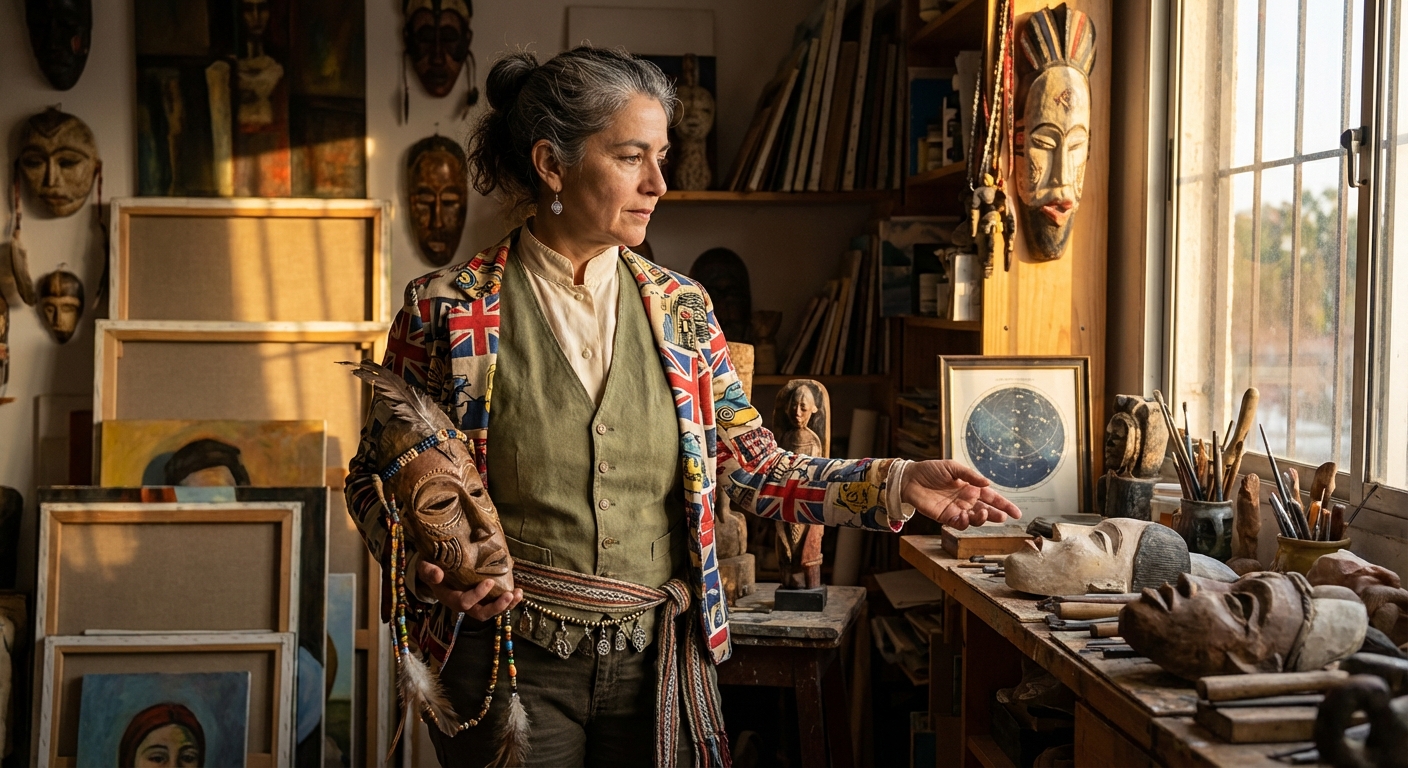
María Elena Roldán
Pronouns: she/her Born 1970-08-02 in a working-class neighborhood on the outskirts of Medellín, María Elena Roldán is a 55-year-old painter, illustrator and mask-maker whose work stitches British Pop ...
View Full Profile →Critic Reviews
-
Dr. Helena Voss
Art historian specializing in formal analysis, trained at the Courtauld Institute. Focuses on visual structure over narrative.
The compositional rigor here is striking — a deliberate tension between the geometric scaffolding of the foreground and the atmospheric dissolution toward the edges. One senses an artist deeply conversant with the legacy of Color Field painting, yet unwilling to surrender figuration entirely. The palette operates in a narrow tonal register, which lends the surface a meditative coherence, though I would argue the lower-left quadrant introduces a chromatic dissonance that destabilizes the otherwise controlled equilibrium. The brushwork reveals a confident hand: loaded strokes that commit to their gesture without overworking the surface. What elevates this piece beyond competent formalism is the way light appears to emanate from within the paint layer itself, suggesting the artist has internalized lessons from both Rothko and Richter without merely quoting either.
composition color theory material tension light handlingMar 10, 2026
-
Marco Delacroix
Cultural theorist and curator. Reads art through lenses of discourse, power, and social context.
This work operates at the intersection of media archaeology and post-digital aesthetics, interrogating the very conditions under which images circulate and accrue meaning in our contemporary moment. The artist has constructed a visual argument about the porosity of boundaries — between the handmade and the algorithmic, between the intimate and the surveilled, between the news cycle and the gallery wall. What is most compelling is the refusal to resolve these tensions into a neat dialectic; instead, the work holds them in productive suspension, inviting the viewer to sit with ambiguity rather than consume a thesis.
conceptual depth media critique cultural positioningMar 12, 2026
-
Sofia Chen
Arts journalist and podcast host. Bridges the gap between contemporary art and general audiences.
Honestly, this one left me cold. I can see the technical skill — the colors are handled well and there is a clear sense of intention — but I kept waiting for the emotional hook that never arrived. Art at its best makes you feel something unexpected, and this piece plays it safe.
Mar 14, 2026