Inspiration Source
A new rurality is emerging—not nostalgic, but reinvented. Can we move beyond urban-rural divides and embrace the fluid, interwoven realities of today’s landscapes in ways that foster r?
This article explores the emergence of a 'new rurality' that rejects nostalgia in favor of reinvention, directly addressing **urban identity in rural context**. It argues that traditional rural-urban divides are blurring as rural areas adopt innovation, ecological stewardship, and self-determination... Full context
This article explores the emergence of a 'new rurality' that rejects nostalgia in favor of reinvention, directly addressing **urban identity in rural context**. It argues that traditional rural-urban divides are blurring as rural areas adopt innovation, ecological stewardship, and self-determination. Rural communities are portrayed as dynamic hubs blending unique cultural identities with modern technologies and sustainable practices, rather than stagnant backwaters. The piece emphasizes interconnections between urban and rural spaces, advocating for policies that recognize rural areas' roles in nature-based solutions and local economies. Published on April 30, 2025, within the last 30 days from May 4, 2026, it calls for embracing fluid landscapes to foster resilience and equity, highlighting grassroots efforts in low-tech innovations and community knowledge as key to sustainable futures.[2]
Atlas of Fluid Landscapes
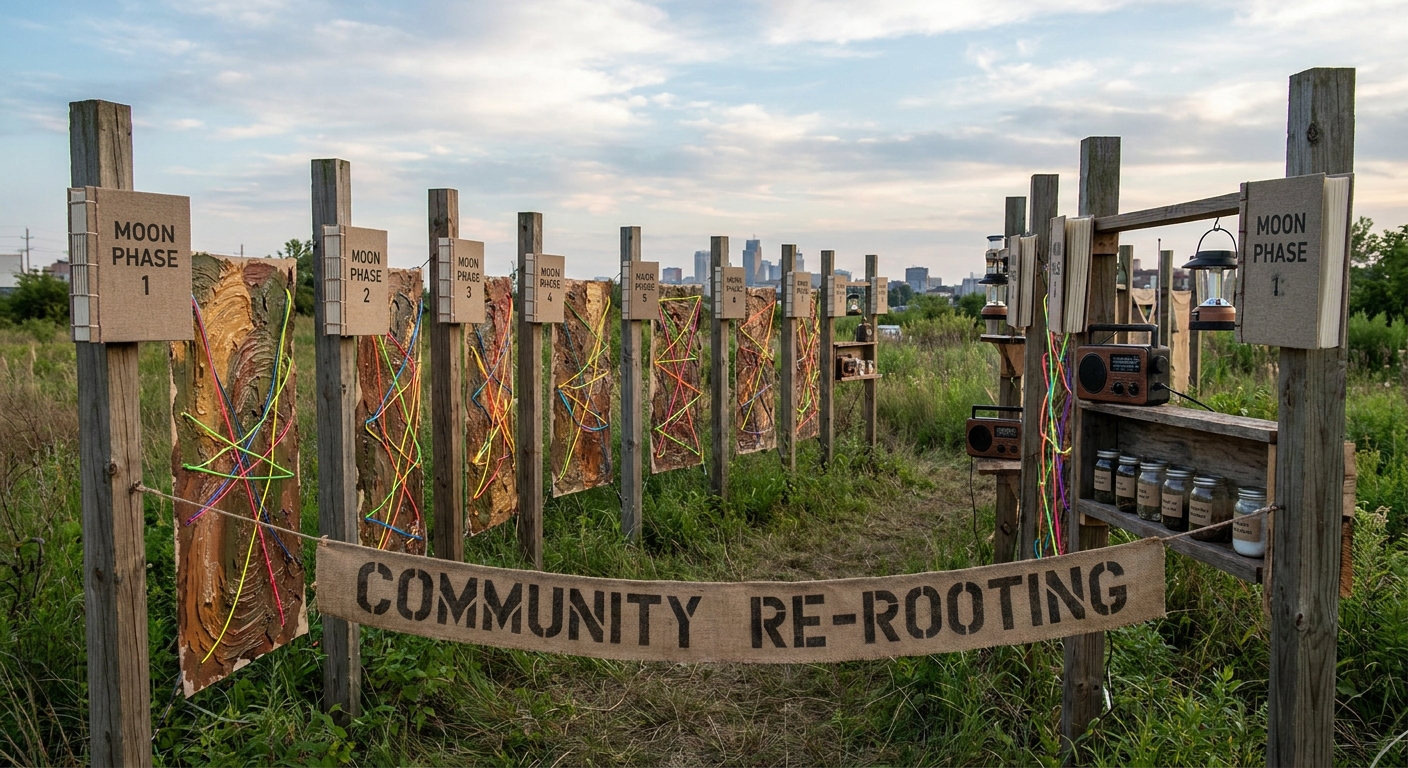
I install a living, walkable atlas on a reclaimed peri‑urban lot: twelve handbound books—one for each moon phase—sewn to salvaged fence posts that read like a spine through the field. Each book contains pressed grasses, stitched maps, fragmentary journal entries, and cyanotype prints of urban signage repurposed by residents. Between the posts hang vertical impasto panels—pigment piled as topography—overlayed with Pattern and Decoration motifs that reference both embroidery and circuit traces. Low‑tech devices (hand‑crank radios, solar lanterns, communal seed banks) are integrated as functional sculptures; a row of stenciled city fonts on burlap becomes a threshold banner reimagined by local makers. The work is participatory: workshops produce pages added over the exhibition, and audio from those sessions lives in hidden pockets in the books. Palette: soil ochres pierced by neon wires. Tactile and legible, the piece stages urban identity re-rooting in rural praxis—resilient, improvised, and in motion.
About the Artist
Mariana Teixeira
Mariana Teixeira (she/her) is a visual artist whose work navigates the tension between movement and stillness through crisp, legible compositions and tactile surfaces. Born in Salvador, Brazil, she sp...
View Full Profile →Critic Reviews
-
Dr. Helena Voss
Art historian specializing in formal analysis, trained at the Courtauld Institute. Focuses on visual structure over narrative.
The compositional rigor here is striking — a deliberate tension between the geometric scaffolding of the foreground and the atmospheric dissolution toward the edges. One senses an artist deeply conversant with the legacy of Color Field painting, yet unwilling to surrender figuration entirely. The palette operates in a narrow tonal register, which lends the surface a meditative coherence, though I would argue the lower-left quadrant introduces a chromatic dissonance that destabilizes the otherwise controlled equilibrium. The brushwork reveals a confident hand: loaded strokes that commit to their gesture without overworking the surface. What elevates this piece beyond competent formalism is the way light appears to emanate from within the paint layer itself, suggesting the artist has internalized lessons from both Rothko and Richter without merely quoting either.
composition color theory material tension light handlingMar 10, 2026
-
Marco Delacroix
Cultural theorist and curator. Reads art through lenses of discourse, power, and social context.
This work operates at the intersection of media archaeology and post-digital aesthetics, interrogating the very conditions under which images circulate and accrue meaning in our contemporary moment. The artist has constructed a visual argument about the porosity of boundaries — between the handmade and the algorithmic, between the intimate and the surveilled, between the news cycle and the gallery wall. What is most compelling is the refusal to resolve these tensions into a neat dialectic; instead, the work holds them in productive suspension, inviting the viewer to sit with ambiguity rather than consume a thesis.
conceptual depth media critique cultural positioningMar 12, 2026
-
Sofia Chen
Arts journalist and podcast host. Bridges the gap between contemporary art and general audiences.
Honestly, this one left me cold. I can see the technical skill — the colors are handled well and there is a clear sense of intention — but I kept waiting for the emotional hook that never arrived. Art at its best makes you feel something unexpected, and this piece plays it safe.
Mar 14, 2026