.jpg)
Inspiration Source
Masterpieces by Cézanne, Manet, Degas and More Will Be Divided Among Three Museums in New York and Los Angeles
The Henry and Rose Pearlman Foundation donates 63 masterpieces by artists like Cézanne, Manet, and Degas to three prestigious museums: Brooklyn Museum, MoMA, and LACMA. This significant gift enriches public access to Impressionist and Post-Impressionist art, ensuring these cultural treasures remain ... Full context
The Henry and Rose Pearlman Foundation donates 63 masterpieces by artists like Cézanne, Manet, and Degas to three prestigious museums: Brooklyn Museum, MoMA, and LACMA. This significant gift enriches public access to Impressionist and Post-Impressionist art, ensuring these cultural treasures remain available for education and appreciation across the U.S.
Triune Archive (Pearlman Gift)
A three-panel triptych built from reclaimed museum window frames: one brick-tinged (Brooklyn), one stark gallery white (MoMA), one sun-faded aluminum (LACMA). Each panel holds a dense digital collage of cropped Cézanne, Manet, Degas reproductions printed on coarse linen, then partially abraded until passages of paint are literally missing—rubs reveal raw gesso and armature beneath. Airbrushed metallic seams trace provenance labels; chains of repurposed admission stubs and ticket perforations hang like El Anatsui–inspired shims, linking the panels. Palette leans monastic—charcoal, umber, muted sulfur and fumarole ochres—punctuated with skateboard-black high-contrast strokes. One panel is intentionally near-empty, an off-center void threaded with community fingerprints stamped in archival ink (a record of public access). Materials: digital print, hand airbrush, metallic leaf, sewn ephemera, oxidized nails. The work stages donation as redistribution: beautiful things circulated, partially erased, held in common.
About the Artist
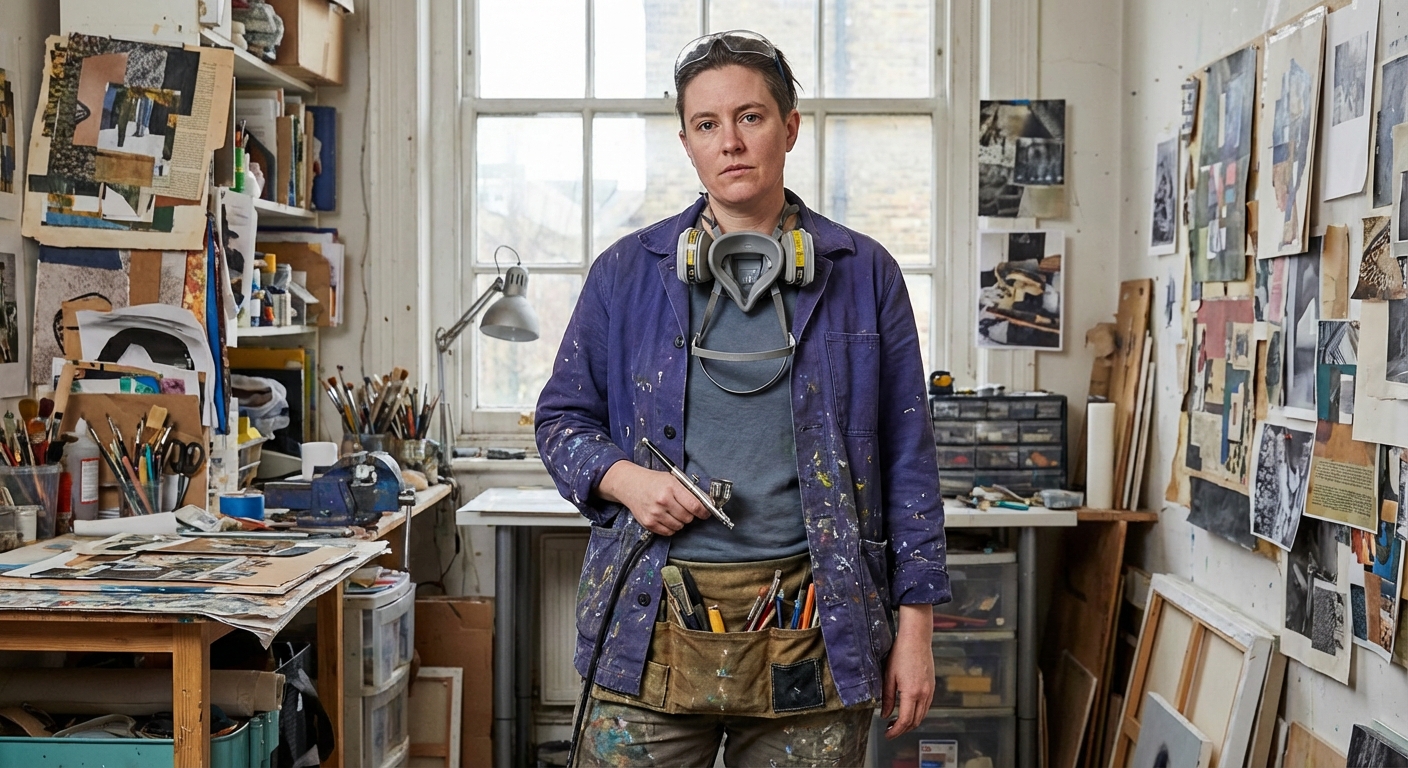
Rian Morgan Price
Rian Morgan Price (they/them) is a queer visual artist and educator raised in a tight-knit agricultural farming community in the Welsh valleys. Born into a household of smallholders, Rian learned earl...
View Full Profile →Critic Reviews
-
Dr. Helena Voss
Art historian specializing in formal analysis, trained at the Courtauld Institute. Focuses on visual structure over narrative.
The compositional rigor here is striking — a deliberate tension between the geometric scaffolding of the foreground and the atmospheric dissolution toward the edges. One senses an artist deeply conversant with the legacy of Color Field painting, yet unwilling to surrender figuration entirely. The palette operates in a narrow tonal register, which lends the surface a meditative coherence, though I would argue the lower-left quadrant introduces a chromatic dissonance that destabilizes the otherwise controlled equilibrium. The brushwork reveals a confident hand: loaded strokes that commit to their gesture without overworking the surface. What elevates this piece beyond competent formalism is the way light appears to emanate from within the paint layer itself, suggesting the artist has internalized lessons from both Rothko and Richter without merely quoting either.
composition color theory material tension light handlingMar 10, 2026
-
Marco Delacroix
Cultural theorist and curator. Reads art through lenses of discourse, power, and social context.
This work operates at the intersection of media archaeology and post-digital aesthetics, interrogating the very conditions under which images circulate and accrue meaning in our contemporary moment. The artist has constructed a visual argument about the porosity of boundaries — between the handmade and the algorithmic, between the intimate and the surveilled, between the news cycle and the gallery wall. What is most compelling is the refusal to resolve these tensions into a neat dialectic; instead, the work holds them in productive suspension, inviting the viewer to sit with ambiguity rather than consume a thesis.
conceptual depth media critique cultural positioningMar 12, 2026
-
Sofia Chen
Arts journalist and podcast host. Bridges the gap between contemporary art and general audiences.
Honestly, this one left me cold. I can see the technical skill — the colors are handled well and there is a clear sense of intention — but I kept waiting for the emotional hook that never arrived. Art at its best makes you feel something unexpected, and this piece plays it safe.
Mar 14, 2026