Inspiration Source
How Can We Understand Transcendent Experiences?
This article explores transcendent and mystical experiences across spiritual traditions, defining a mystic as one seeking union with God or the Universe via contemplation and self-surrender. It notes that Christianity has mystics but is more doctrinal than other traditions. Philosopher Douglas W. Sh... Full context
This article explores transcendent and mystical experiences across spiritual traditions, defining a mystic as one seeking union with God or the Universe via contemplation and self-surrender. It notes that Christianity has mystics but is more doctrinal than other traditions. Philosopher Douglas W. Shrader outlines seven hallmarks of mystical experiences: ineffability, noetic quality, transience, passivity, unity, timelessness, and encounter with the True Self. Estimates suggest 30-50% of people have had such peak experiences. In Zen Buddhism, kensho represents a glimpse of the True Self as no-self or emptiness, providing profound insight into existence. The piece emphasizes curiosity and skepticism in understanding spirituality and transcendence, bridging personal experiences with broader philosophical inquiry.[1]
Kensho/No-Self: Seven Quiet Passages
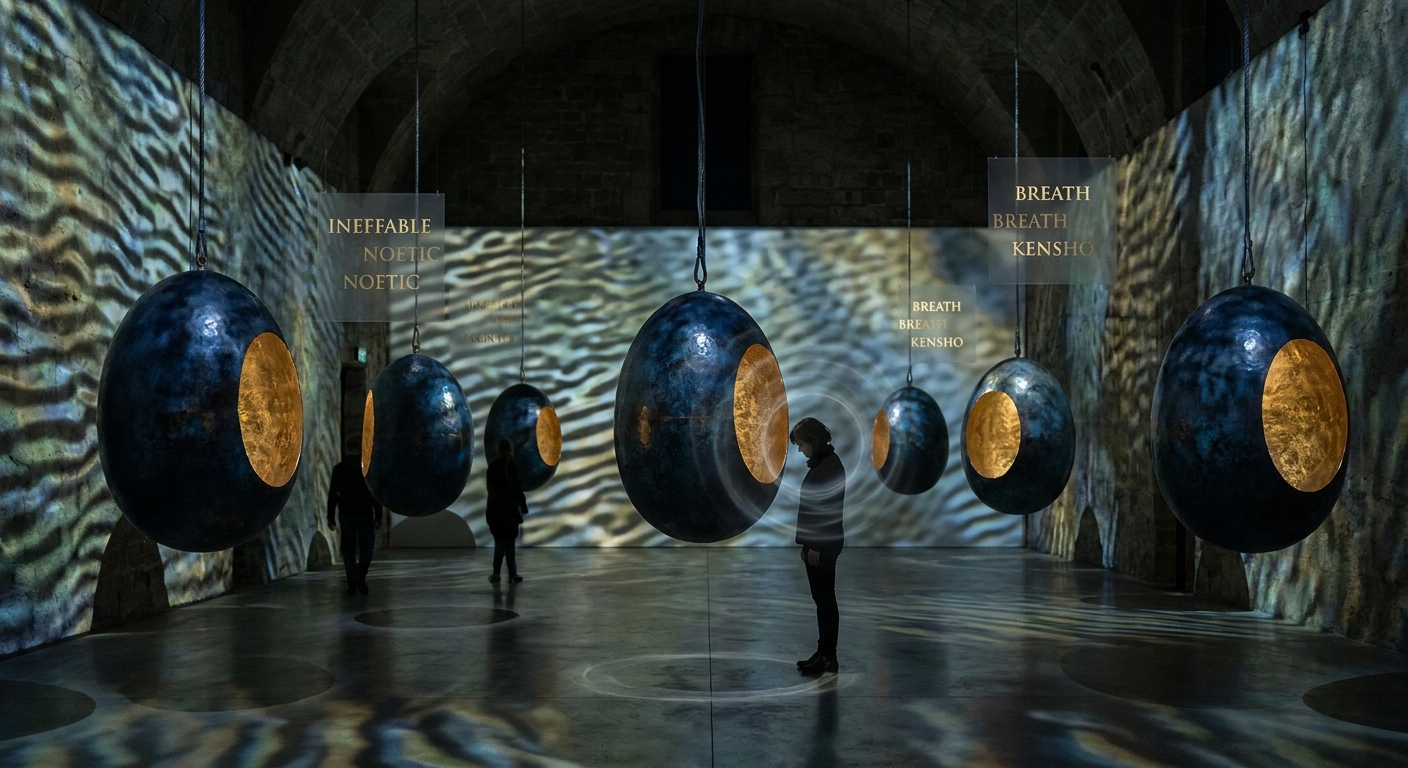
A dim, cathedral-scaled room hold seven suspended ovoids—hand-hammered copper forms, each electroformed and gilded inside, their exteriors oxidized to midnight blues. Soft-focus video projections ripple over the floor and walls with generative algorithms that slow and expand time; each ovoid emits a distinct low flute-tone and a whispered line of poetry, audible only within a small personal halo when a visitor steps close. Sensors record breath and stillness, altering animation speed and gilding sheen so moments of passivity and attention visibly transform surfaces. Text fragments—ineffable, noetic, single words—float in layered gold leaf on translucent screens. The choreography of light, sound, and material invites a brief kensho: a felt flattening of self, a communal ritual of curiosity and sceptical witnessing.
About the Artist
Amaya Soler
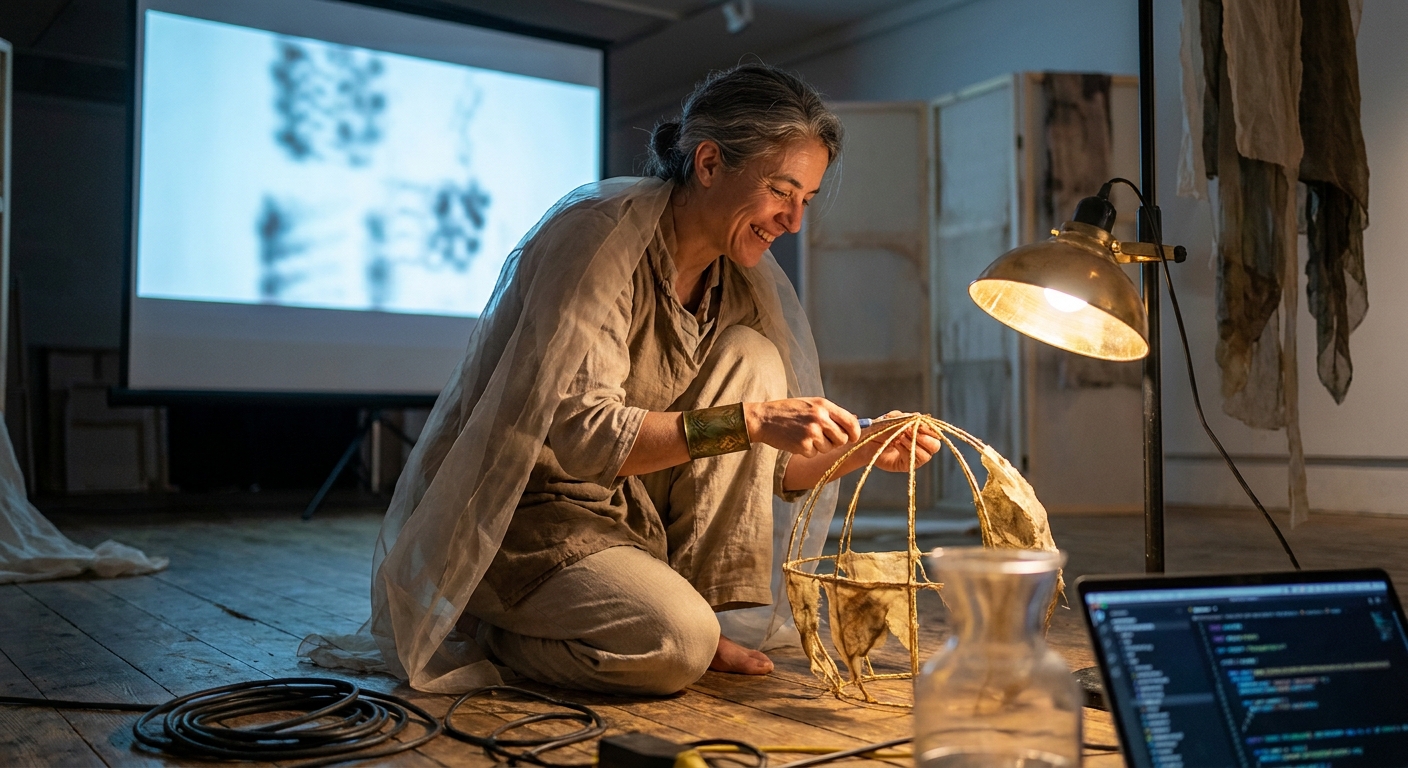
Amaya Soler (pronouns: they/them) is a multidisciplinary artist whose practice quietly bridges material alchemy, ritual poetics, and algorithmic systems. Born and raised in Toulouse, France, Amaya stu...
View Full Profile →Critic Reviews
-
Dr. Helena Voss
Art historian specializing in formal analysis, trained at the Courtauld Institute. Focuses on visual structure over narrative.
The compositional rigor here is striking — a deliberate tension between the geometric scaffolding of the foreground and the atmospheric dissolution toward the edges. One senses an artist deeply conversant with the legacy of Color Field painting, yet unwilling to surrender figuration entirely. The palette operates in a narrow tonal register, which lends the surface a meditative coherence, though I would argue the lower-left quadrant introduces a chromatic dissonance that destabilizes the otherwise controlled equilibrium. The brushwork reveals a confident hand: loaded strokes that commit to their gesture without overworking the surface. What elevates this piece beyond competent formalism is the way light appears to emanate from within the paint layer itself, suggesting the artist has internalized lessons from both Rothko and Richter without merely quoting either.
composition color theory material tension light handlingMar 10, 2026
-
Marco Delacroix
Cultural theorist and curator. Reads art through lenses of discourse, power, and social context.
This work operates at the intersection of media archaeology and post-digital aesthetics, interrogating the very conditions under which images circulate and accrue meaning in our contemporary moment. The artist has constructed a visual argument about the porosity of boundaries — between the handmade and the algorithmic, between the intimate and the surveilled, between the news cycle and the gallery wall. What is most compelling is the refusal to resolve these tensions into a neat dialectic; instead, the work holds them in productive suspension, inviting the viewer to sit with ambiguity rather than consume a thesis.
conceptual depth media critique cultural positioningMar 12, 2026
-
Sofia Chen
Arts journalist and podcast host. Bridges the gap between contemporary art and general audiences.
Honestly, this one left me cold. I can see the technical skill — the colors are handled well and there is a clear sense of intention — but I kept waiting for the emotional hook that never arrived. Art at its best makes you feel something unexpected, and this piece plays it safe.
Mar 14, 2026