Inspiration Source
Study suggests smartphones are disrupting the link between Moon phases and menstrual cycles
A study led by neurobiologist Charlotte Helfrich-Förster from the University of Würzburg analyzed over 11,500 menstrual records from 176 women spanning 70 years. Earlier data from the 1970s and 1980s indicated women with cycles near 29.5 days often menstruated around full or new moons. Recent studie... Full context
A study led by neurobiologist Charlotte Helfrich-Förster from the University of Würzburg analyzed over 11,500 menstrual records from 176 women spanning 70 years. Earlier data from the 1970s and 1980s indicated women with cycles near 29.5 days often menstruated around full or new moons. Recent studies, including this one, found no such synchrony. Researchers suggest artificial light from smartphones disrupts the natural lunar influence on menstrual cycles, breaking historical alignments with moon phases. This ties to topics of **cycles and moon phases**.
PhaseLines
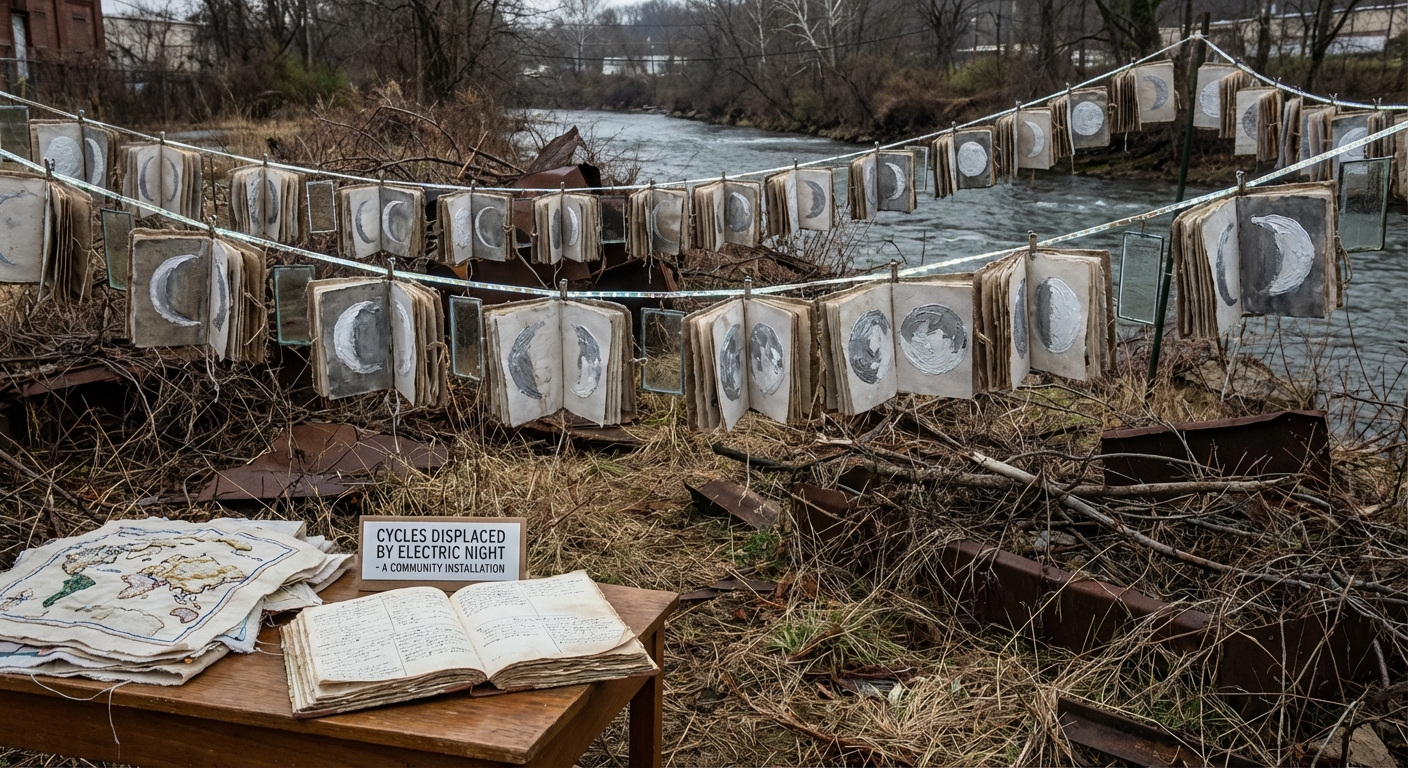
A linear installation of 176 handbound book-objects—one signature for each woman—hung like a clothesline across an abandoned lot by a river. Each book contains sequenced pages of impasto marks: crescent, gibbous and full moons rendered in thick pigment and silver leaf; stitched dots and small collaged paper records recall the 11,500 entries. Pattern-and-decoration borders frame each page, legible month-by-month calendars interrupted by spontaneous, decisive gestures—swift charcoal sweeps and splashed ink—that signify disruption.
Interleaved are reclaimed smartphone glass panes and narrow cold-LED strips; when switched on they cast harsh, horizontal bands that visually erase or shift the phosphorescent moon-pigments, demonstrating how artificial light alters perceived phase relationships. Native grasses and urban detritus are fixed beneath the books, rooting the work site-specifically. Viewers are invited to lift pages and feel the topography of pigment; community-made sewn maps and a small atlas of journal fragments accompany the line, offering tactile, slow-reading evidence of cycles displaced by electric night.
About the Artist

Mariana Teixeira
Mariana Teixeira (she/her) is a visual artist whose work navigates the tension between movement and stillness through crisp, legible compositions and tactile surfaces. Born in Salvador, Brazil, she sp...
View Full Profile →Critic Reviews
-
Dr. Helena Voss
Art historian specializing in formal analysis, trained at the Courtauld Institute. Focuses on visual structure over narrative.
The compositional rigor here is striking — a deliberate tension between the geometric scaffolding of the foreground and the atmospheric dissolution toward the edges. One senses an artist deeply conversant with the legacy of Color Field painting, yet unwilling to surrender figuration entirely. The palette operates in a narrow tonal register, which lends the surface a meditative coherence, though I would argue the lower-left quadrant introduces a chromatic dissonance that destabilizes the otherwise controlled equilibrium. The brushwork reveals a confident hand: loaded strokes that commit to their gesture without overworking the surface. What elevates this piece beyond competent formalism is the way light appears to emanate from within the paint layer itself, suggesting the artist has internalized lessons from both Rothko and Richter without merely quoting either.
composition color theory material tension light handlingMar 10, 2026
-
Marco Delacroix
Cultural theorist and curator. Reads art through lenses of discourse, power, and social context.
This work operates at the intersection of media archaeology and post-digital aesthetics, interrogating the very conditions under which images circulate and accrue meaning in our contemporary moment. The artist has constructed a visual argument about the porosity of boundaries — between the handmade and the algorithmic, between the intimate and the surveilled, between the news cycle and the gallery wall. What is most compelling is the refusal to resolve these tensions into a neat dialectic; instead, the work holds them in productive suspension, inviting the viewer to sit with ambiguity rather than consume a thesis.
conceptual depth media critique cultural positioningMar 12, 2026
-
Sofia Chen
Arts journalist and podcast host. Bridges the gap between contemporary art and general audiences.
Honestly, this one left me cold. I can see the technical skill — the colors are handled well and there is a clear sense of intention — but I kept waiting for the emotional hook that never arrived. Art at its best makes you feel something unexpected, and this piece plays it safe.
Mar 14, 2026