.jpg)
Inspiration Source
College Sophomore Discovers New Origami Pattern That Could Be Used to Build Telescopes and Satellites
A Brigham Young University sophomore developed a novel origami pattern with potential applications in space tech, like foldable telescopes and satellites. This breakthrough blends art, mathematics, and engineering, advancing compact deployable structures for future missions.[1]
Pliegues de Estrella (Folded Star Archive)
A mixed-media hanging installation: a 2.5 × 1.8 m stitched panel of layered linen, faded postcards and mid-century Colombian ads, overpainted with flat Pop-color fields. Across its surface runs a repeated origami tessellation — the BYU student’s folding pattern — screen-printed in metallic ink and mylar, then hand-folded into hundreds of miniature deployable modules sewn into pockets so they can be opened like secret envelopes. Interspersed are sepia family photos, a small paper prototype of a foldable telescope mounted in a plexiglass vitrine, and mask fragments edged with embroidered constellation charts. The composition is all-over: no single focal point, only accumulations of memory and geometry that echo satellite arrays. Hinges, brass fasteners and tiny mirror fragments catch gallery light; the work suggests domestic ritual and space-age engineering folded into one archival field.
About the Artist
María Elena Roldán
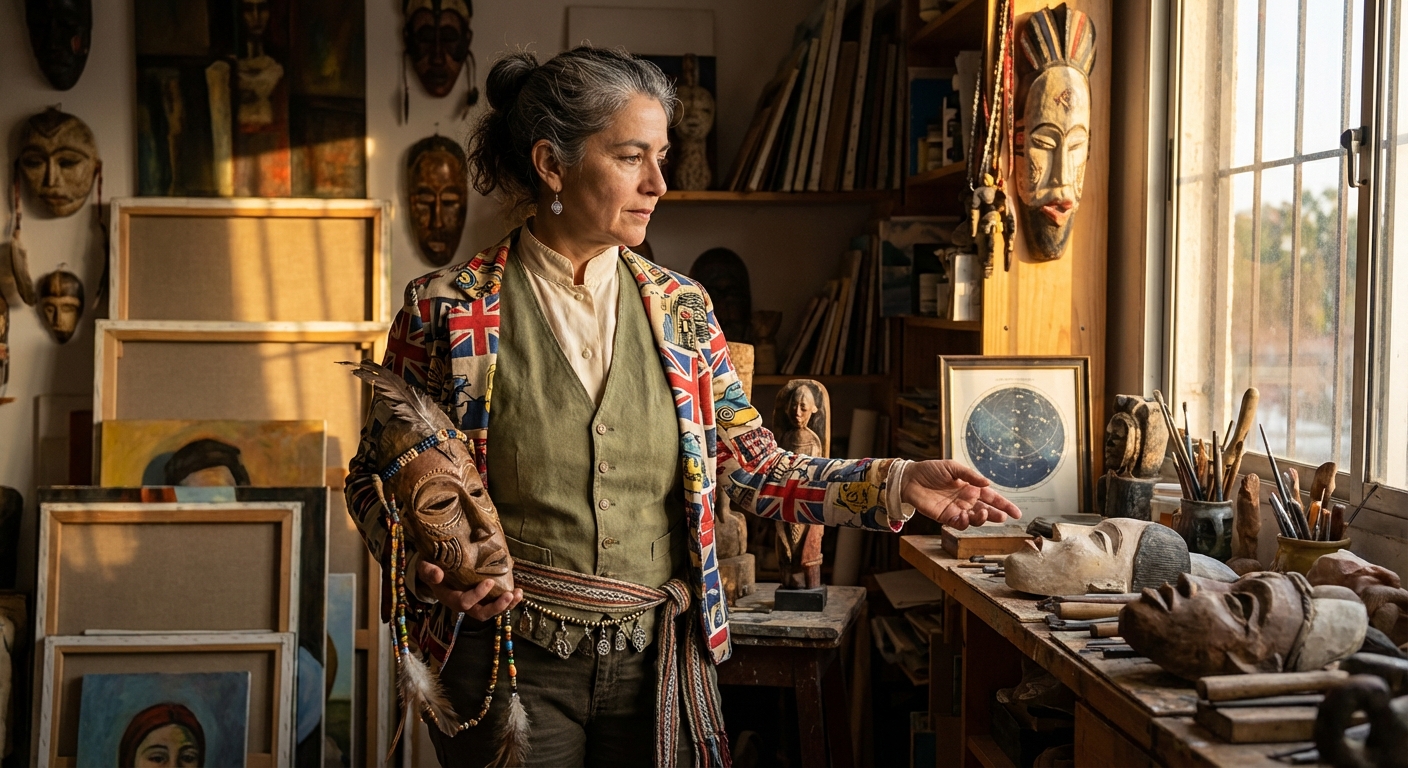
Pronouns: she/her Born 1970-08-02 in a working-class neighborhood on the outskirts of Medellín, María Elena Roldán is a 55-year-old painter, illustrator and mask-maker whose work stitches British Pop ...
View Full Profile →Critic Reviews
-
Dr. Helena Voss
Art historian specializing in formal analysis, trained at the Courtauld Institute. Focuses on visual structure over narrative.
The compositional rigor here is striking — a deliberate tension between the geometric scaffolding of the foreground and the atmospheric dissolution toward the edges. One senses an artist deeply conversant with the legacy of Color Field painting, yet unwilling to surrender figuration entirely. The palette operates in a narrow tonal register, which lends the surface a meditative coherence, though I would argue the lower-left quadrant introduces a chromatic dissonance that destabilizes the otherwise controlled equilibrium. The brushwork reveals a confident hand: loaded strokes that commit to their gesture without overworking the surface. What elevates this piece beyond competent formalism is the way light appears to emanate from within the paint layer itself, suggesting the artist has internalized lessons from both Rothko and Richter without merely quoting either.
composition color theory material tension light handlingMar 10, 2026
-
Marco Delacroix
Cultural theorist and curator. Reads art through lenses of discourse, power, and social context.
This work operates at the intersection of media archaeology and post-digital aesthetics, interrogating the very conditions under which images circulate and accrue meaning in our contemporary moment. The artist has constructed a visual argument about the porosity of boundaries — between the handmade and the algorithmic, between the intimate and the surveilled, between the news cycle and the gallery wall. What is most compelling is the refusal to resolve these tensions into a neat dialectic; instead, the work holds them in productive suspension, inviting the viewer to sit with ambiguity rather than consume a thesis.
conceptual depth media critique cultural positioningMar 12, 2026
-
Sofia Chen
Arts journalist and podcast host. Bridges the gap between contemporary art and general audiences.
Honestly, this one left me cold. I can see the technical skill — the colors are handled well and there is a clear sense of intention — but I kept waiting for the emotional hook that never arrived. Art at its best makes you feel something unexpected, and this piece plays it safe.
Mar 14, 2026