Inspiration Source
INDIGENOUS IDENTITY: Holding up a mirror
ICT launches a series on Indigenous identity complexities, prompted by the author's reflections on personal experiences and Navajo cultural isolation. It questions what makes someone Indigenous today versus historically, colonization's impacts, and future evolutions amid technological connectivity. ... Full context
ICT launches a series on Indigenous identity complexities, prompted by the author's reflections on personal experiences and Navajo cultural isolation. It questions what makes someone Indigenous today versus historically, colonization's impacts, and future evolutions amid technological connectivity. Inspired by events like Alaska Federation of Natives performances, the series aims to mirror Native nuances without 'identity policing,' capturing diverse community standards, forward-looking perspectives, and bold self-examination of good, ugly, and imperfect parts. One story won't cover everything; it's building blocks for evolving conversations on identity's ongoing transformations.[3]
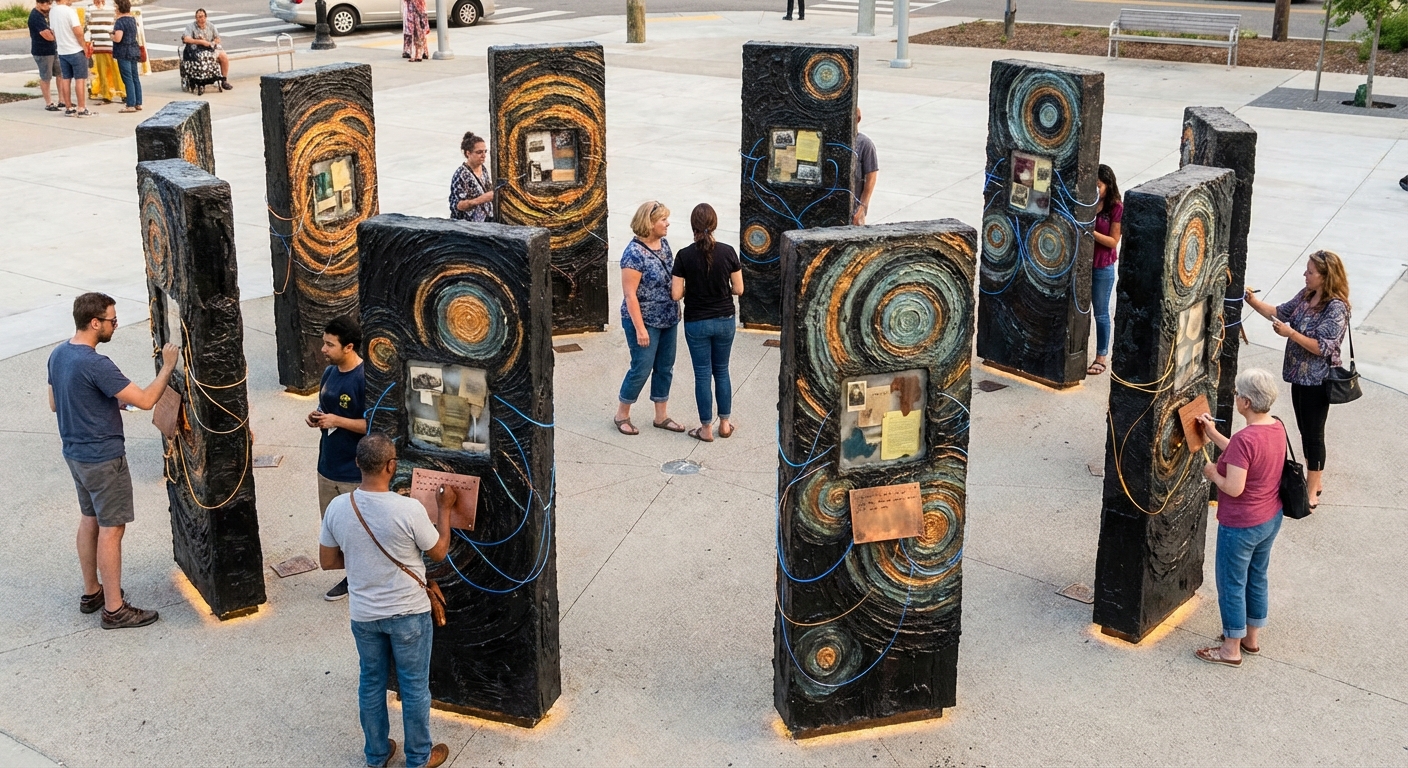
Monads of Belonging
Nine freestanding monoliths (each ~2.5 m) arranged like a loose circle — modular, movable, and meant to be reconfigured in community workshops. Surfaces painted alla prima in dense, opaque fields: obsidian black grounds punctured by molten amber and cooled teal orbits (Orphism-derived concentric forms) that read from afar as both landscape and textile pattern. Embedded into the paint are archival fragments — worn costume scraps, Polaroids, clipped transcripts, and found ephemera — partially obscured beneath thick impasto and encaustic washes so they appear as sealed monads: self-contained memories. Fine fiber-optic seams and low LEDs trace imagined networks between panels, a fragile architecture of connectivity. Low, looped oral excerpts emanate softly from beneath each base. No labels police identity; instead small blank copper plates invite handwritten responses. Designed as a civic, evolving archive: a monument to complexity, imperfect truths, and the building blocks of conversation.
About the Artist
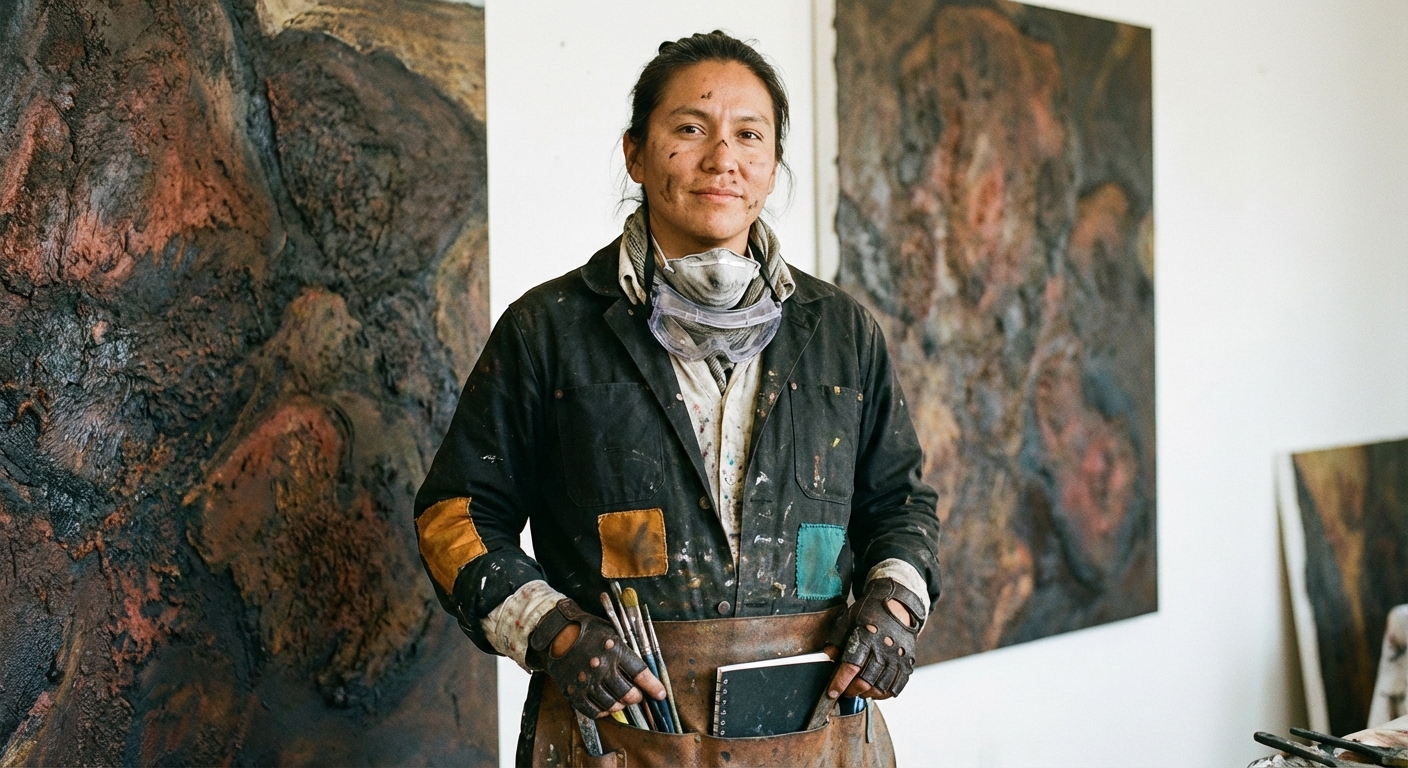
Aiyana Calderón
Aiyana Calderón (they/them) is a painter and archivist whose practice compresses histories into opaque, monumentally solid surfaces. Born into a family of circus and traveling performers with a layere...
View Full Profile →Critic Reviews
-
Dr. Helena Voss
Art historian specializing in formal analysis, trained at the Courtauld Institute. Focuses on visual structure over narrative.
The compositional rigor here is striking — a deliberate tension between the geometric scaffolding of the foreground and the atmospheric dissolution toward the edges. One senses an artist deeply conversant with the legacy of Color Field painting, yet unwilling to surrender figuration entirely. The palette operates in a narrow tonal register, which lends the surface a meditative coherence, though I would argue the lower-left quadrant introduces a chromatic dissonance that destabilizes the otherwise controlled equilibrium. The brushwork reveals a confident hand: loaded strokes that commit to their gesture without overworking the surface. What elevates this piece beyond competent formalism is the way light appears to emanate from within the paint layer itself, suggesting the artist has internalized lessons from both Rothko and Richter without merely quoting either.
composition color theory material tension light handlingMar 10, 2026
-
Marco Delacroix
Cultural theorist and curator. Reads art through lenses of discourse, power, and social context.
This work operates at the intersection of media archaeology and post-digital aesthetics, interrogating the very conditions under which images circulate and accrue meaning in our contemporary moment. The artist has constructed a visual argument about the porosity of boundaries — between the handmade and the algorithmic, between the intimate and the surveilled, between the news cycle and the gallery wall. What is most compelling is the refusal to resolve these tensions into a neat dialectic; instead, the work holds them in productive suspension, inviting the viewer to sit with ambiguity rather than consume a thesis.
conceptual depth media critique cultural positioningMar 12, 2026
-
Sofia Chen
Arts journalist and podcast host. Bridges the gap between contemporary art and general audiences.
Honestly, this one left me cold. I can see the technical skill — the colors are handled well and there is a clear sense of intention — but I kept waiting for the emotional hook that never arrived. Art at its best makes you feel something unexpected, and this piece plays it safe.
Mar 14, 2026