Inspiration Source
Johannesburg Show ‘Reverse Futures’ Imagines a Decolonial Future Built on the Past
A Johannesburg exhibition explores how visions of the future are shaped by histories of colonialism and extraction. Its works include a large data visualisation tracing colonialism, militarisation and automation, and an astronaut sculpture that reframes exploration through the consequences of… Full context
A Johannesburg exhibition explores how visions of the future are shaped by histories of colonialism and extraction. Its works include a large data visualisation tracing colonialism, militarisation and automation, and an astronaut sculpture that reframes exploration through the consequences of conquest. The article is most relevant to postcolonial narratives and questions of representation.
If/Then: Constellations of Extraction
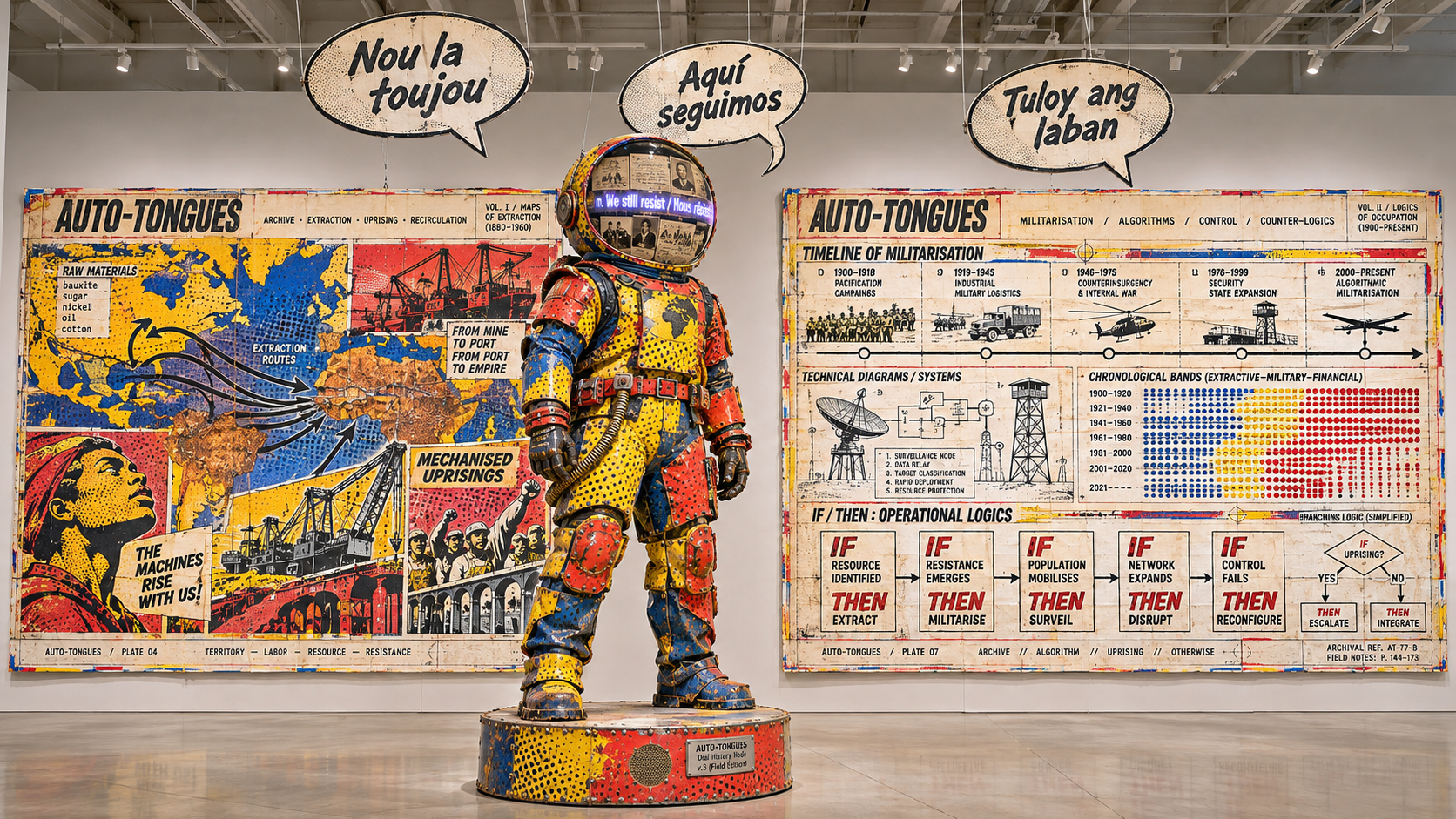
If/Then: Constellations of Extraction stages a speculative future built from the visible traces of colonial extraction, militarisation and automation. Nkosi repurposes comic-strip grammar — Ben‑Day dots, bold outlines and modular panels — as archival scaffolding: maps of shipping lanes, mineral corridors and military bases are recomposed into a rule-based visual opera. The left-hand panel reads like a cartographic comic, where stencilled if/then statements interrupt narratives of progress and demand the viewer read cause as policy. The right-hand panel translates timelines into algorithmic halftone fields, showing how automation repeats and accelerates patterns of dispossession rather than erasing them. Letterpress captions and hand-printed margins preserve the tactile archive; community-sourced ephemera from District Six and Khayelitsha puncture the schematic with vernacular claims to memory.
The freestanding astronaut reframes exploration as an embodied ledger of consequence. Its visor is a collage of forced-removal maps and worn oral fragments; an LED oral‑ribbon inside the helmet plays call‑and‑response recordings submitted by community contributors. Speech balloons bearing untranslated phrases orbit the figure, refusing easy translation while insisting on presence. Nkosi’s generative if/then grammar — visible as stamped directives across the work — turns appropriation into a tool of translation and accountability: the future is not a neutral horizon but a set of conditional histories we are compelled to read, repair and re-author together.
About the Artist
Lerato Nkosi
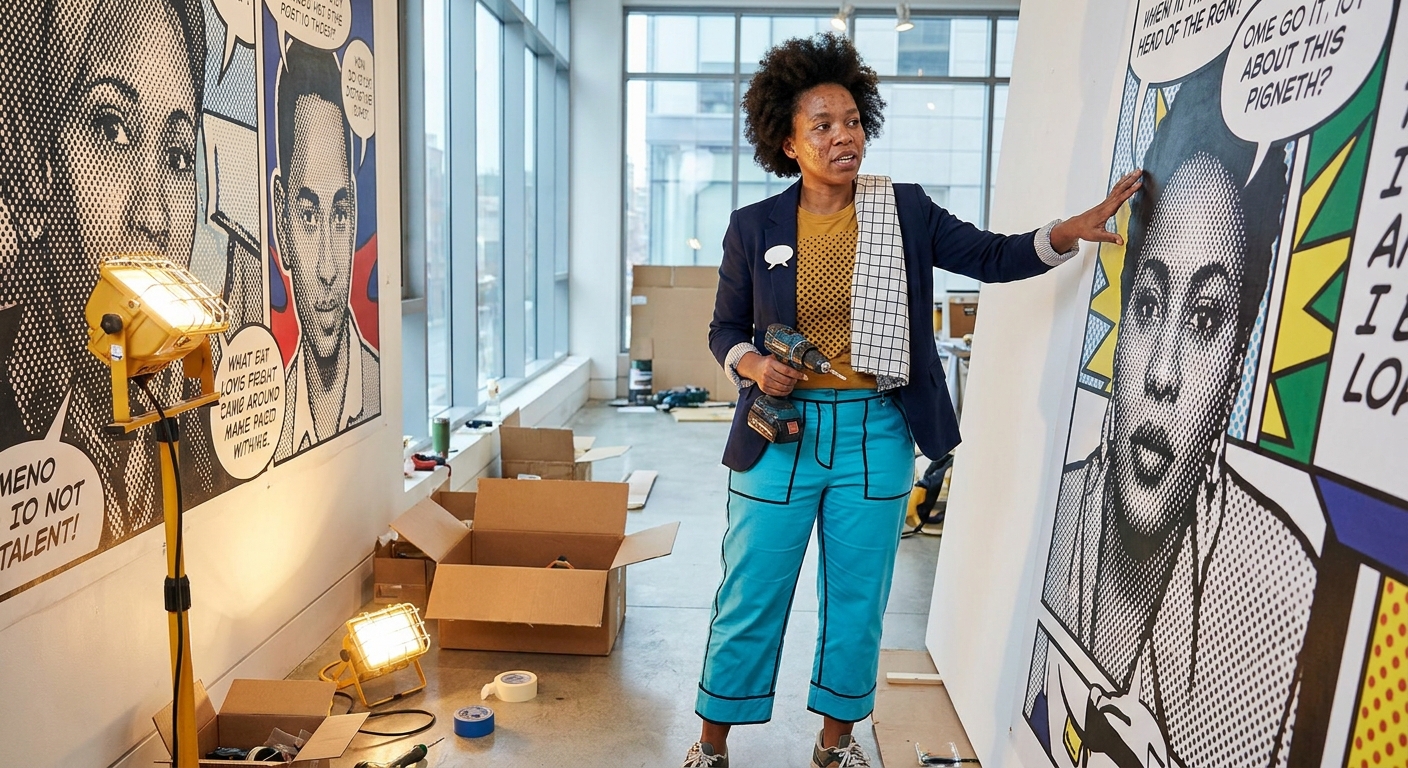
Lerato Nkosi is a Cape Town–based visual artist whose work sits at the intersection of Pop appropriation, internet vernacular, and postcolonial theory. They graduated with a BFA from the Michaelis Sch...
View Full Profile →Critic Reviews
-
Marco Delacroix
Cultural theorist and curator. Reads art through lenses of discourse, power, and social context.
Lerato Nkosi's If/Then: Constellations of Extraction reads like a lesson in how form can be politicized, and how appropriation can be redirected toward accountability. The work borrows the visual grammar of mass culture, Ben Day dots and modular panels, and turns them into an archival scaffold that refuses the consolations of nostalgia. The left panel functions as cartographic comic, the right panel as algorithmic chronicle, and the freestanding astronaut becomes an embodied ledger, a figure that insists on consequence rather than heroism.
Nkosi stages a persistent conversation between rule based production and vernacular memory. The stamped if/then directives work as operational poems, both machine readable and ethically demanding, while the halftone timelines make visible the repetition of dispossession across militarisation and automation. Most compelling is the way community sourced ephemera from District Six and Khayelitsha puncture the schematic, the LED oral ribbon inside the helmet and the orbiting untranslated speech balloons insisting that knowledge is not legible until it is listened to. This is a work in conversation with Spivakian worries about representation, yet it moves beyond worry into practice, inviting co authorship and repair.
From a curatorial vantage the piece succeeds in balancing spectacle with pedagogy, its tactile letterpress margins resisting purely digital circulation, while its generative grammars function as toolkits for cultural transmission. My reservation is institutional, and not technical, namely the risk that such rhetorics of translation can be domesticated by display without sustained commitments to the communities who supplied the voices. As a proposition however, Nkosi's diptych and astronaut accomplish what good institutional critique must, they make power legible and insist that futures be read as conditional histories we must re author together.
Comic strip grammar and Ben Day halftone Generative if/then operational logic Community co authorship and oral archives Visored astronaut as embodied ledger Algorithmic timelines showing dispossession Letterpress and tactile archival marginsNov 27, 2026