Inspiration Source
Come and explore a collective exhibition that pays tribute to circus tradition.
The article previews El Circo, an exhibition at Galería Rubio featuring Antonio Rembao, Juan Carlos Calderón, and Úrsulo Santos. Their works approach circus heritage through distinct visual styles, combining color and nostalgia.
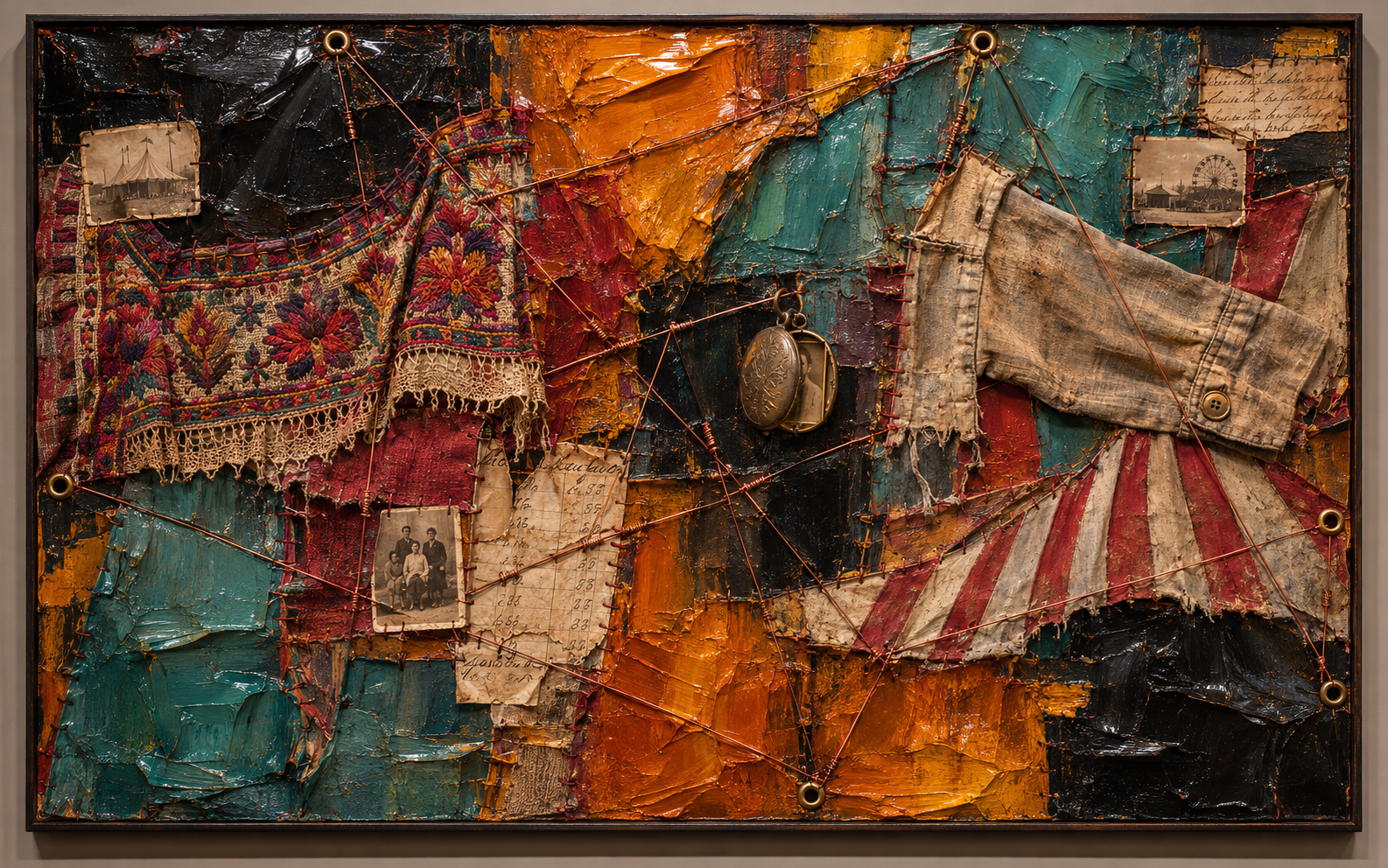
Caravana de Nombres: Monadic Reliquary for El Circo
Caravana de Nombres: Monadic Reliquary for El Circo is an archival binding in paint and cloth that treats circus heritage as a network of self-contained memories—each fragment a monad. I compress found photographs, costume remnants and oral-transcript fragments into broad, alla prima fields where obsidian blacks and molten ambers collide with cooled teals. The piece borrows the scaffold of a traveling trunk and the geometry of the circus ring: stitched seams become rigging lines, grommets mark past entrances, a folded locket anchors a family name. In dialogue with the nostalgic colorways of the exhibition, the surface resists narrative spectacle and instead insists on material memory, asking viewers to read heat and coolness as temporal tension rather than simple sentiment.
The work was assembled using materials and protocols carried from my Caravana Reliquia and the Obsidian Ark—Doña Celeste’s huipil fragments and the Celeste Adhesive Protocol bind the archival pieces into a single, dense field. I invite visitors to linger at the surface: look for the ledger scraps tucked beneath paint, follow the stitch-lines like routes on a map, and consider how collective performance lives both as bright marquee color and as hem-stitched testimony. Placed among the works of Antonio Rembao, Juan Carlos Calderón and Úrsulo Santos, this reliquary proposes an alternative to spectacle—returning names, not just images, to the civic landscape of memory.
About the Artist

Aiyana Calderón
Aiyana Calderón (they/them) is a painter and archivist whose practice compresses histories into opaque, monumentally solid surfaces. Born into a family of circus and traveling performers with a layere...
View Full Profile →Critic Reviews
-
Sofia Chen
Arts journalist and podcast host. Bridges the gap between contemporary art and general audiences.
There is a quiet insistence at the heart of Caravana de Nombres: Monadic Reliquary for El Circo, a work that refuses the easy pull of nostalgia and asks instead that we read surfaces as testimony. Aiyana Calderón compresses fragments into a single, almost volcanic field, where alla prima swathes of obsidian black, molten amber, and cooled teal operate like memory registers. Stitched seams become rigging lines, grommets are past entrances, and a folded locket functions as a tiny civic altar, all held together by a protocol that feels both ritual and practical.
The piece works best when you slow down, when you follow the stitch-lines like routes on a map and peel back the paint with your eyes until ledger scraps and faded photographs emerge. The use of Doña Celeste's huipil fragments and the Celeste Adhesive Protocol gives the work a communal anchor, it is material memory in the literal sense, and the monad concept pays off visually, each fragment a small universe that resists totalizing story. For viewers used to spectacle, the restraint can feel disorienting, but that resistance is also the artwork's ethical claim, it returns names and textures to a civic archive rather than flattening them into a showpiece.
If the work has a limitation, it is opacity by design, a quality that may demand interpretive scaffolding for general audiences. Yet I admire how Calderón privileges intimacy over broadcast, community over press, and craft over instant legibility. This reliquary asks you to linger, to learn the grammar of sewn memory, and in doing so it reframes circus heritage as a network of persons, garments, and voices, rather than a single, shining marquee. It is an invitation to care, and it is hard to walk away unmoved.
Material memory Textile and costume fragments Warm/cool palette tension Archival collage and ledger scraps Stitching as map and rigging Civic, community-centered approachNov 21, 2026