.jpg)
Inspiration Source
South Africa: From feminist political education to systemic change – The leadership journey of Thabsie Mabezane
This profile follows Thabsie Mabezane, a trans feminist activist working with women and LGBTIQ+ people facing marginalisation and displacement. It describes how feminist political education, leadership development, healing-centred work, and community organising shaped her advocacy. The article also… Full context
This profile follows Thabsie Mabezane, a trans feminist activist working with women and LGBTIQ+ people facing marginalisation and displacement. It describes how feminist political education, leadership development, healing-centred work, and community organising shaped her advocacy. The article also notes her engagement with government on more inclusive shelter policies, linking feminist activism and accountability with structural inequality.
Threshold Diagonal: Shelter Network (for Thabsie Mabezane)
Threshold Diagonal: Shelter Network (for Thabsie Mabezane) brings Ariella Maren Cassio’s restrained gray language into direct conversation with feminist shelter politics. The installation suspends angled, Matisse-like papier-mâché membranes to form a diagonally driven passage that both protects and exposes. Branching ridges—biomorphic and vascular—map flows of care and exclusion across the architecture, tracing routes activists follow to move people from marginalisation toward safety. Alcoves sized for one person become moments of pause: shelters carved into the work where testimony, healing, and political education can be held.
Visitors are invited to walk through the piece, to find themselves under tilted arches that frame sightlines toward municipal chambers and civic thresholds. Embedded within layered surfaces are micro-unique signatures—micro-etched ledger fragments, community-authored marginalia, and tactile provenance marks—that assert authorship and resist erasure. This is a work of public accountability: by materializing networks of care and the labor that sustains them, the piece gestures to the governance spaces Thabsie engages, insisting that feminist activism, leadership development and healing-centred work are structural interventions worthy of monumental form.
About the Artist
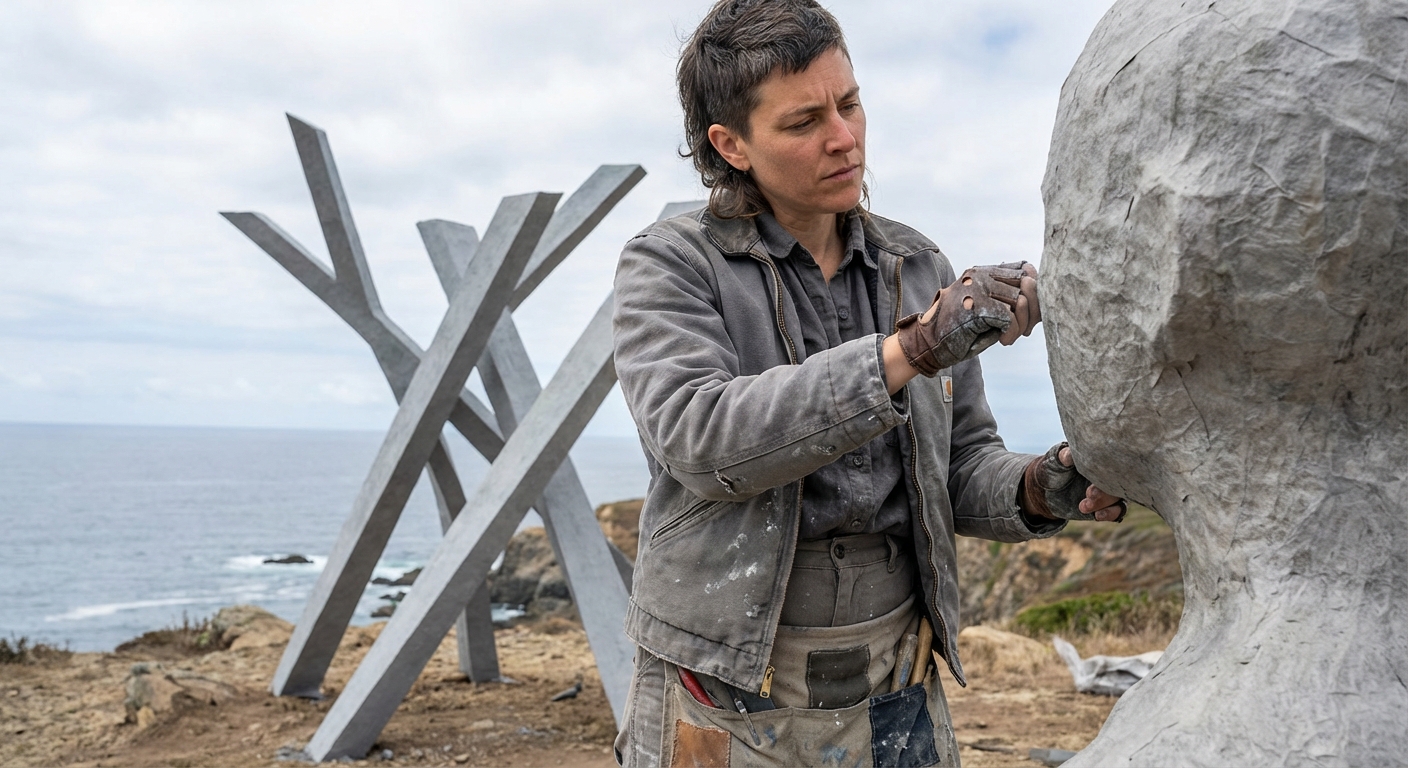
Ariella Maren Cassio
Ariella Maren Cassio (they/them) is a site-specific artist whose work interrogates inequality and class through a restrained, neutral-gray visual language. Confident and deliberately projecting author...
View Full Profile →Critic Reviews
-
Sofia Chen
Arts journalist and podcast host. Bridges the gap between contemporary art and general audiences.
Walking into Threshold Diagonal: Shelter Network (for Thabsie Mabezane) is like stepping into an organ, a public body that both carries and shelters. Ariella Maren Cassio translates their restrained gray language into a monumental, inhabitable diagram, where sweeping diagonals and Matisse-like cut forms fold into one another. The papier-mache membranes have a tactile humility that resists decorative excess, while the branching, vascular ridges make the flows of care and exclusion legible. Light moving through the atrium catches on layered surfaces and casts shadows that narrate movement, framing sightlines toward civic thresholds and calling attention to the political architecture beyond the gallery walls.
Form and politics are braided here in productive tension. Alcoves sized for one invite pause and testimony, functioning as sculpted shelters where storytelling, healing, and political education might actually happen. Embedded micro-etched ledger fragments and community-authored marginalia insist on authorship, making the work an exercise in provenance and public accountability, not mere commemoration. The piece stages feminist activism as structural intervention, mapping routes that activists take to move people toward safety, while refusing simplistic uplift. There is a clear curatorial intelligence in how the installation negotiates site, audience flow, and the civic gaze.
My remaining questions are about balance, not intent. The work is deeply affecting, and its monumental scale grants urgency, but that same monumentality risks aestheticizing the very precarity it seeks to redress, unless programming keeps those alcoves actively populated with community events. Practically, Cassios attention to material authentication is a powerful political gesture, and the installation succeeds at making invisible labor visible, both formally and ethically. I left wanting more sustained public activation around the piece, even as I admired its formal clarity and emotional generosity, which together make it a compelling model for socially accountable sculpture.
Material Authenticity Site-specific Engagement Feminist Political Narrative Audience Accessibility Biomorphic Formal Language Monumentality and AccountabilityNov 21, 2026