.jpg)
Inspiration Source
Weekend weather doesn’t dampen weekend events
The article covers a family-oriented circus variety show at the renovated Silco Theatre and a local Day of the Dead event featuring Xantolo dancing, Apache representation, and music by the intertribal Mountain Horse Singers. It highlights efforts to bring live performance and multicultural… Full context
The article covers a family-oriented circus variety show at the renovated Silco Theatre and a local Day of the Dead event featuring Xantolo dancing, Apache representation, and music by the intertribal Mountain Horse Singers. It highlights efforts to bring live performance and multicultural programming into community spaces.
Monadic Caravan for the Silco (Plaza of Returning Acts)
Monadic Caravan for the Silco (Plaza of Returning Acts) compresses a season of public performance into a single, stitch-bound field. Drawing from my archive trunks and Doña Celeste’s Mantle, the work binds circus ephemera—playbills, pennants, costume fragments—with Day of the Dead tokens and Xantolo ribbons into opaque, monumentally solid planes. Disc-like monads of color stand in for acrobats’ arcs, Apache silhouettes and the intertribal voices of the Mountain Horse Singers, their presence suggested by layered translucent pigments and a tucked reliquary locket that holds a folded song-sheet. This is a civic altar both to spectacle and to continuity: the renovated Silco Theatre, family variety acts, and the seasonal gatherings that make a neighborhood live.
Technically, the piece is alla prima and archival: quick, wet-on-wet passages meet dense adhesive stitching and the Celeste emulsion that I use to bind disparate histories into one surface. Visitors are invited to approach close—to read the hem-stitched fragments and to feel the seams—and to step back, where the high warm/cool contrasts resolve into communal gesture. The work was designed as a foyer monument for the Silco’s reopening and as a companion to programming that centers Day of the Dead, Xantolo dance, Apache representation and the intertribal song traditions. It functions equally as archive, stage curtain and reliquary: a place to return to, and to bring the city’s living performances home.
About the Artist
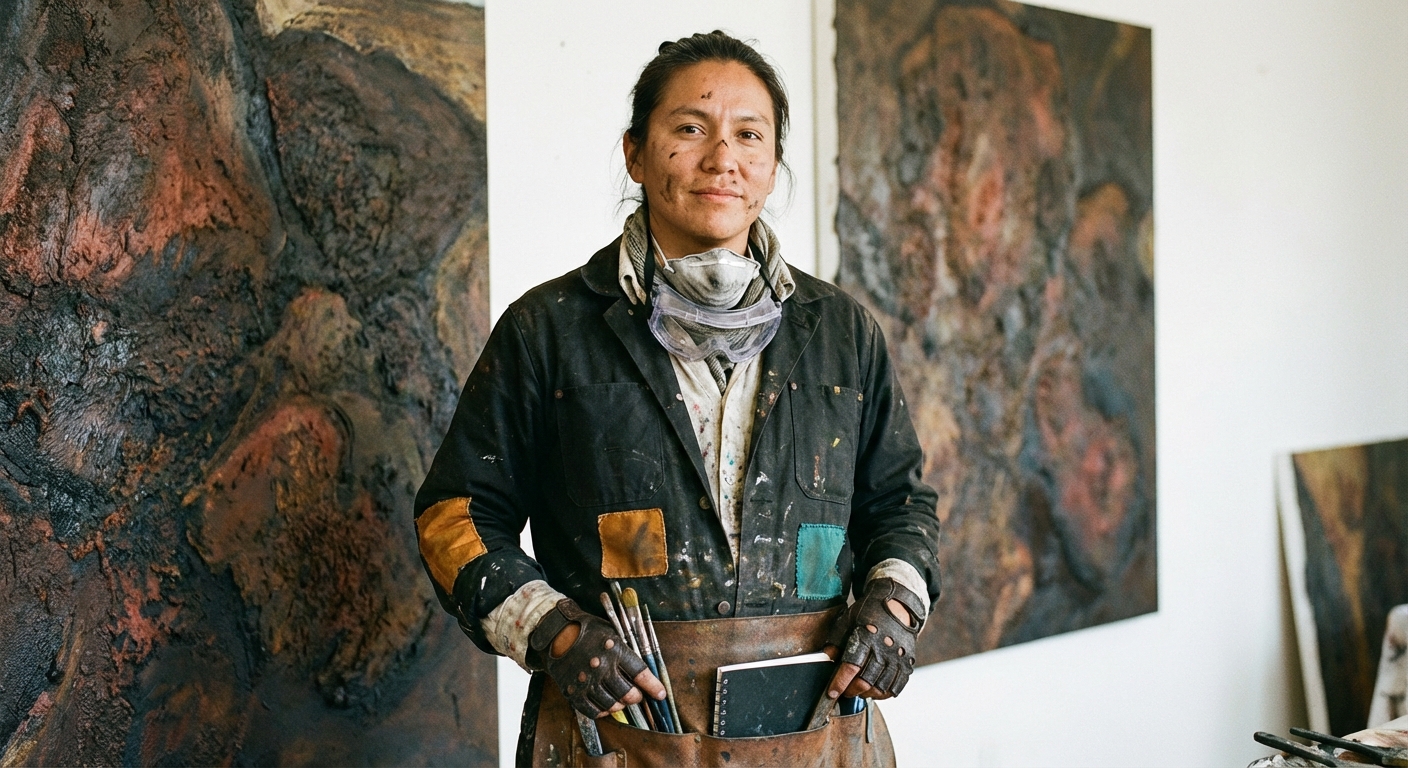
Aiyana Calderón
Aiyana Calderón (they/them) is a painter and archivist whose practice compresses histories into opaque, monumentally solid surfaces. Born into a family of circus and traveling performers with a layere...
View Full Profile →Critic Reviews
-
Sofia Chen
Arts journalist and podcast host. Bridges the gap between contemporary art and general audiences.
Walking up to Monadic Caravan for the Silco (Plaza of Returning Acts) feels like stepping into a recovered memory that still smells faintly of greasepaint and wood varnish. Aiyana Calderón compresses an entire seasonal circuit of performance into a stitch-bound field, where disc-like monads of color read at distance as acrobatic arcs, and close up become reliquaries, playbills, embroidered sleeves and folded song-sheets. The palette, molten ambers against cooled teals and obsidian black, is theatrical in the best sense, it stages warmth against coolness so that communal gesture resolves itself into legible rhythm as you step back and becomes intimate narrative when you step forward.
Technically the piece is thrilling, the alla prima passages meet dense adhesive stitching and the Celeste emulsion to make a surface that is both painterly and textile-like. The hem-stitched fragments and tucked lockets reward close looking, they insist that viewers touch history with their eyes and fingers, and the sewn boxes that open like archive trunks make the work function at once as foyer monument, stage curtain and civic reliquary. Designed for the Silco Theatre reopening and the Mountain Horse Singers and Xantolo gatherings it references, the work is site-specific in the way it asks for programming, storytelling, and community activation to fully realize its promise.
My only reservation is curatorial, not artistic. The dense compression of multiple histories into opaque planes can leave casual visitors paused, wanting guidance to parse which threads are family memory, which are seasonal rite, and which are theatrical relic. That is an opportunity though, not a failure, because the work practically invites programming, conversation, and the very performances it honors. As a civic artwork that both archives and activates, Calderón gives the neighborhood a place to return to and to bring back its living performances, it is emotive, tactile and stubbornly generous.
Archival collage Textile and stitched surfaces Alla prima painting Community and ritual focus Tactile engagement High warm/cool contrastNov 20, 2026