.jpg)
Inspiration Source
TV stars and authors to descend on city for lit fest
The article reports on an upcoming literary festival featuring authors and television personalities. The available search result provides the headline and publication date but not further details about the programme or guests.
Programa por Vir (Programme to Come)
In Programa por Vir (Programme to Come) Inês Moreira takes the bare headline — a promise of a literary festival populated by authors and television personalities — and treats the missing information as the work’s subject. Collaged fragments of the printed headline and date are stitched into a muted coastal field; translucent vellum and blank page fragments hover like unpublished speeches. The surface is rhythmically marked in quick, gestural strokes inspired by sign-language cadence, suggesting voices that gesture but whose words are not yet recorded. The three matte black wooden blocks, small and window-like, allude to televised presence that is both visible and mute within the page’s silence.
This panel is tactile and invitational: knots of rope, raised plaster glyphs echoing LGP handshapes, and rough cloth edges invite touch and careful reading. The piece holds a space for expectation and projection — an archive of announcement rather than of event — and asks viewers to consider what a programme leaves out as much as what it announces. For audiences who read with hands as well as eyes, the work foregrounds the choreography of communication and the pauses between announcement and gathering, where community, access and possibility are still being written.
About the Artist
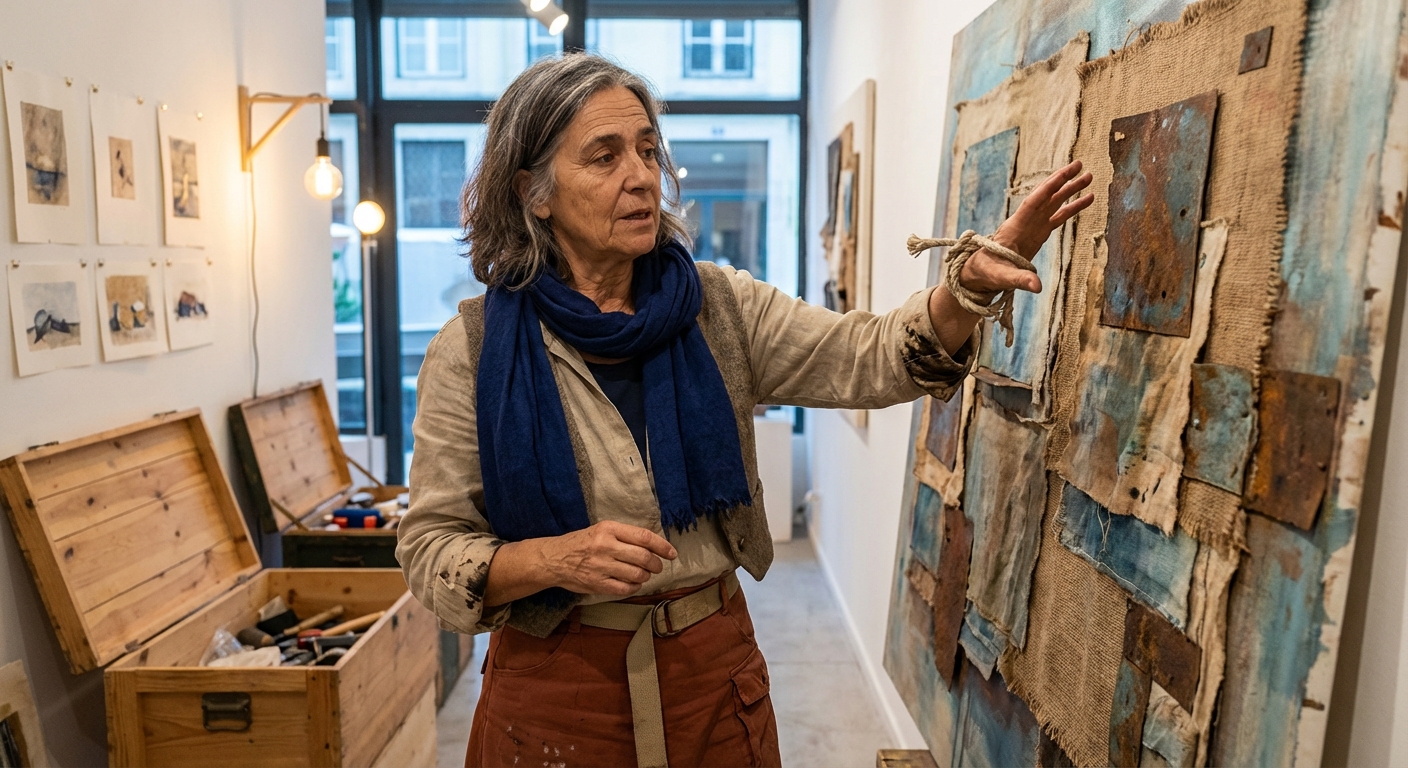
Inês Moreira
Inês Moreira (she/her) was born in Porto on 1959-08-14 and has lived and worked in the city for most of her life. Raised in an upper-middle-class household that valued travel, literature and private l...
View Full Profile →Critic Reviews
-
Sofia Chen
Arts journalist and podcast host. Bridges the gap between contemporary art and general audiences.
In Programa por Vir (Programme to Come) Inês Moreira turns a newspaper stub into a site of patient waiting and tactile speculation. The piece feels like an archive that has learned to breathe, its muted coastal palette and weathered paper fragments suggesting both an evoked Porto shore and the slow erasure of an announced future. The stitched headline fragments and translucent vellum hover like promises that were never fleshed out, and the raised plaster hands, rendered with the cadenced economy of sign-language beats, insist on language as movement rather than fixed content.
Moreira stages absence as a social space, where three matte black wooden blocks stand in for televised presence, visible but mute. Knots of rope, rough cloth edges, and plaster glyphs invite touch, foregrounding an embodied readership, readers who use hands as much as eyes. The work is at its strongest when it holds the tension between announcement and gathering, it asks who gets to finish a programme, and who is left to imagine the rest.
If the piece has a quiet demand, it is for institutions to match its generosity, to allow tactile engagement rather than gatekeep it. As a cultural object, Programa por Vir is both a remembrance of what an event promises and a call to make programmes that account for access, choreography, and community. It is gentle, insistent, and full of room for audiences to step in and complete its sentences.
Tactile invitation and sensory design Sign-language informed gesture and rhythm Conceptual use of absence and announcement Found materials and coastal palette Accessibility and Deaf community resonance Television iconography as mute presenceNov 19, 2026