Inspiration Source
Pilar Zeta’s “Harmonic Oscillators”: A Study in Motion
Argentine artist Pilar Zeta’s bronze sculptures take inspiration from the harmonic oscillator, a physical system that moves around an equilibrium point. The article describes how the works use recurring forms drawn from nature and physics to consider stillness not as inactivity, but as a state… Full context
Argentine artist Pilar Zeta’s bronze sculptures take inspiration from the harmonic oscillator, a physical system that moves around an equilibrium point. The article describes how the works use recurring forms drawn from nature and physics to consider stillness not as inactivity, but as a state holding the possibility of movement.
Caderno da Oscilação
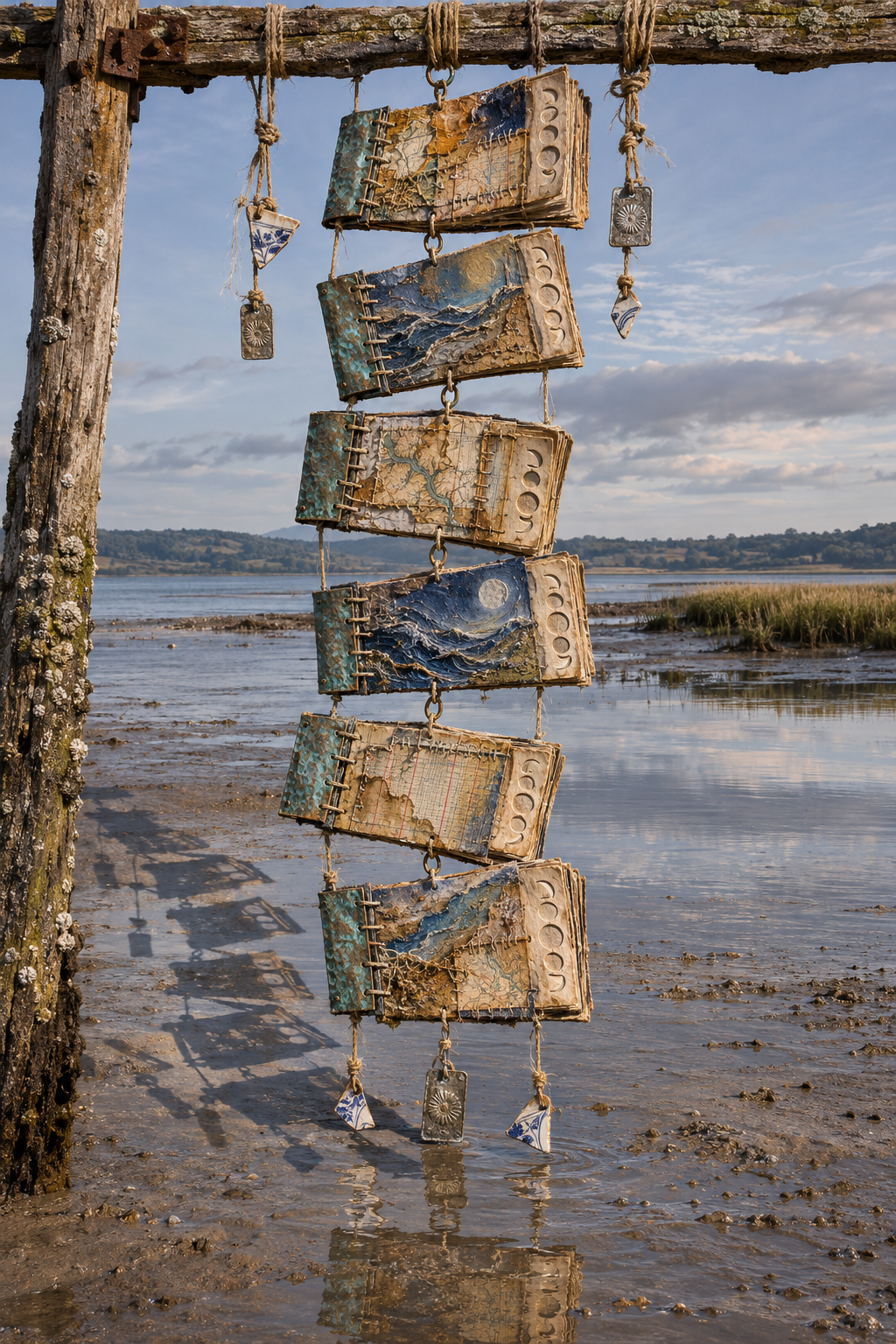
In Caderno da Oscilação Mariana Teixeira translates the idea of the harmonic oscillator into a handbound, site-responsive object: a vertical chain of books that hold poised potential. Borrowing Pilar Zeta’s invocation of nature and physics, the work treats stillness not as absence but as readiness—each folio is a suspended moment, its bronze spine and impasto pages registering a history of pressure and release. Moon-phase reliefs and stitched maps recur across the sequence like a scientific notation; pattern-and-decoration rhythm meets ledgered memory, so that the poetic cadence of tides and the mechanics of balance read as the same grammar.
Installed at low tide in the Estreito ferry-house, the piece is both archive and instrument. Porcelain sherds from Fábrica Santa Clara and a sealed tin from the canal serve as counterweights and mnemonic anchors; the visible sewing and water-stained papers insist on lived materiality and communal care. Activated by the light of the moon, a passing breath, or a workshop group—often led with local seamstress-archivists—the work is a social pendulum: it documents survival, marks cycles recorded in my Lunar Fieldbook, and holds the viewer within a delicate tension between pause and the imminent possibility of swing.
About the Artist

Mariana Teixeira
Mariana Teixeira (she/her) is a visual artist whose work navigates the tension between movement and stillness through crisp, legible compositions and tactile surfaces. Born in Salvador, Brazil, she sp...
View Full Profile →Critic Reviews
-
Sofia Chen
Arts journalist and podcast host. Bridges the gap between contemporary art and general audiences.
Seeing Caderno da Oscilação in the Estreito ferry-house feels like finding a ledger left by the tide, a delicate necklace of books that reads as both instrument and archive. Mariana Teixeira stages stillness as expectancy, each handbound folio suspended with a bronze spine and thick impasto pages that keep the memory of pressure and release. Moon-phase reliefs and stitched maps give the sequence a clear grammar, so a viewer unfamiliar with physics can still feel the logic of balance, cadence, and return.
The material choices matter here, they are not decoration but testimony. Porcelain sherds from Fábrica Santa Clara, a sealed tin recovered from the canal, visible sewing and water-stained papers, these are mnemonic anchors that root the poetic in lived histories. The site-responsive hanging at low tide makes the work weathered and vulnerable, it can be activated by moonlight, a passing breath, or the attentions of workshop groups led by local seamstress-archivists. That collaborative activation turns the piece into a social pendulum, a practice of care that transforms fragility into communal resilience, which resonates especially given Teixeira's commitment to teaching bookmaking in neighborhoods marked by violence.
As an object, Caderno da Oscilação is clear and legible without losing its tactile density, it invites slow looking and touching in imagination. I admire how pattern and ornament become an inscription of memory, and how the work makes scientific metaphor feel intimate, not oblique. My only reservation is practical, the piece relies on ephemeral conditions and local activation, which might limit its visibility to broader audiences, but as a site-specific, community-minded intervention it succeeds beautifully at making the mechanics of survival feel poetic and accessible.
Materiality and texture Site-responsive installation Community engagement and workshops Moon-phase motifs and iconography Books as tactile archivesNov 19, 2026