Inspiration Source
MoMA, the Centre Pompidou and M+ form a cultural alliance
The three museums formed an international alliance to coordinate research, conservation, and curatorial work, treating their holdings as a shared collection while each institution remains autonomous. They plan to develop exhibitions and programs together, aiming to pool expertise across regions.… Full context
The three museums formed an international alliance to coordinate research, conservation, and curatorial work, treating their holdings as a shared collection while each institution remains autonomous. They plan to develop exhibitions and programs together, aiming to pool expertise across regions. This is relevant to institutional collaboration.
Triune Codex: Atlas of Shared Holdings
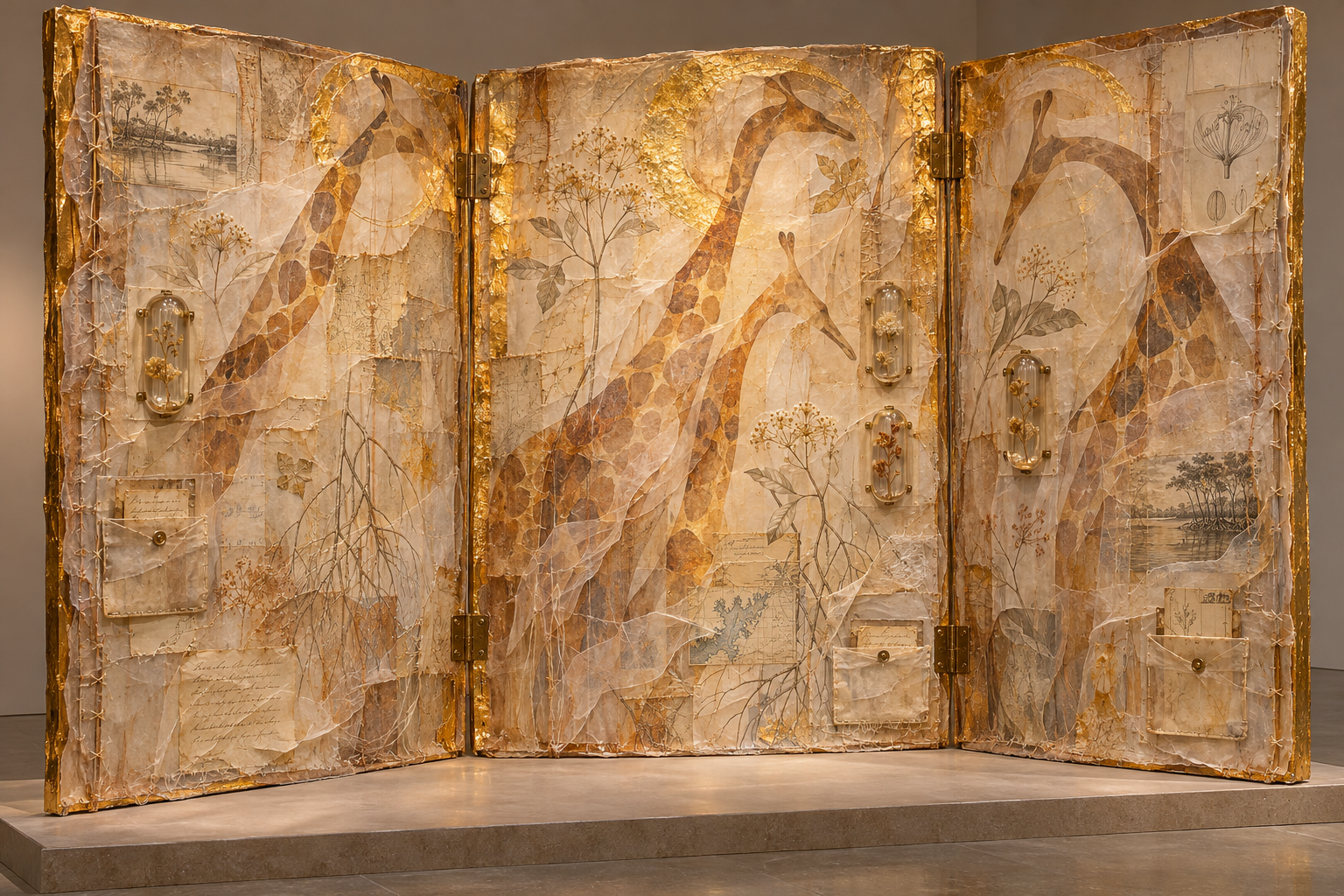
Triune Codex: Atlas of Shared Holdings was conceived in response to the formation of an international museum alliance: three autonomous institutions agreeing to treat their dispersed collections as a shared whole. The work takes the structure of a communal codex — three painted and stitched panels bound to read together — each panel assembled from regionally specific ephemera and archival slips that speak to a single museum’s holdings. Golden halos mark the seams where panels meet; these are not seams of division but braided joins, gilded to emphasize points of exchange. Elongated giraffe-mottled silhouettes traverse the panels as a recurring leitmotif, a visual shorthand for migration, stewardship and the elongation of institutional memory. Within stitched pockets are microbloom-dyed mangrove samples and conservation notes — tangible traces of natural and institutional provenance — preserved under resin so viewers may peer without altering.
The piece is both codex and conversation: visitors are invited to leaf through hinged sections, lift flaps to reveal conservation annotations, and touch select tactile margins, initiating a slow, durational reading. Sound cues by Leila Mensah and light shifts by Anaïs Laurent animate entries when a page is opened, suggesting curatorial dialogue across time zones. In this way the work stages the alliance’s ideals—shared expertise, regional specificity, and continued autonomy—as an active choreography: panels resist being fully read alone, requiring the viewer to negotiate their movement across the triptych, mirroring how institutions must negotiate custodianship, expertise and display in collective care.
About the Artist

Asha Mwangi
Asha Mwangi (she/her) is a Neo-Expressionist visual artist whose work fuses the discipline of medieval manuscript illumination with the visceral immediacy of assemblage. Born in Nairobi and naturalize...
View Full Profile →Critic Reviews
-
Dr. Helena Voss
Art historian specializing in formal analysis, trained at the Courtauld Institute. Focuses on visual structure over narrative.
There is an immediate formal logic to Triune Codex: Atlas of Shared Holdings, one that privileges plane, seam and rhythm over figurative anecdote. Presented as a three-panel codex, the work insists on serial reading, the giraffe-mottled silhouettes functioning as a single, elongated line that threads the panels into continuity. The stitched margins and repeated pockets create a measured cadence, stitching visible as both structural armature and decorative motif. The gilded halos at the joins do not merely ornament, they register points of exchange, moments where pictorial and institutional planes are braided together and held in tension.
Technically the piece is a study in restraint and accumulation. The limited palette of ivory, ochre, warm umber and gold produces soft chromatic harmonies, while translucent overlays and vellum-like papers generate a palimpsest of marks and maps. Microbloom-dyed mangrove samples encased in resin introduce real material depth, conserved within the picture plane so that conservation itself becomes an aesthetic register. Stitches provide a steady linear rhythm that counterpoints the organic silhouettes, and the inclusion of sound cues and responsive light is a deft application of the artist's game design training, forcing a durational choreography of looking that echoes Bergsonian ideas of time and intuition.
As a formal proposition the work largely succeeds, it choreographs viewer movement, balances surface and depth, and makes exchange legible as a compositional problem. There is, however, a formal irony in the gilded seams, they both celebrate and risk prettifying the mechanics of institutional transfer. Visually the object is sumptuous, materially curious and rigorously composed, and it stages the alliance it addresses with an insistence on negotiation rather than facile unity. In that regard Asha Mwangi deploys her restrained vocabulary to compelling effect, producing a work that is as much a manual of shared custody as it is a quietly ambitious exercise in pictorial economy.
Tripartite codex structure Limited, warm palette and gilding Tactile assemblage and resin-encased samples Stitched joins as rhythmic device Interactive durational elements Balance of ritual and institutional choreographyNov 19, 2026