.jpg)
Inspiration Source
FAR Therapeutic Arts marks 75 years of inclusion
FAR Therapeutic Arts and Recreation, which serves people with disabilities in Michigan, is celebrating its 75th anniversary with a campaign supporting scholarships, therapists and long-term sustainability. Participants describe music and other creative activities as ways to communicate feelings,… Full context
FAR Therapeutic Arts and Recreation, which serves people with disabilities in Michigan, is celebrating its 75th anniversary with a campaign supporting scholarships, therapists and long-term sustainability. Participants describe music and other creative activities as ways to communicate feelings, build confidence and connect with others when conventional talk therapy may be difficult. The article directly addresses disability art and lived experience, while also highlighting inclusion, community belonging and the therapeutic role of creative practice.
Resonant Scaffold (for FAR's 75th)
Resonant Scaffold (for FAR's 75th) is a welded aluminum pavilion conceived as a communal prosthesis for conversation, music and embodied care. The piece borrows the branching logic of vessels and river deltas—an anatomy of connection—translated into multiple-point perspectives so that visitors approach, enter and nest within different visual and tactile thresholds. Its iridescent patination shifts like a memory, simultaneously industrial and vegetal, suggesting both city metalwork and monsoon-washed leaves. I leave conservation seams and linear weld-scar marks intentionally visible: to honor a processual ethic of repair rather than an impossible restoration to an imagined original state.
The work is programmed as a small-scale facilitatory space: chimes and suspended elements are tuned to simple intervals, vinyl fragments and stitched pennants hold recorded voices and field sounds gathered with community collaborators. Designed for accessibility, the pavilion foregrounds touch, rhythm and shared listening as modes of expression when talk is limited. In celebrating FAR's 75 years, Resonant Scaffold gestures to sustainability, scholarship and the therapeutic pedagogy of creative practice—a scaffold that holds improvisation, care and the steady work of making belonging tangible.
About the Artist
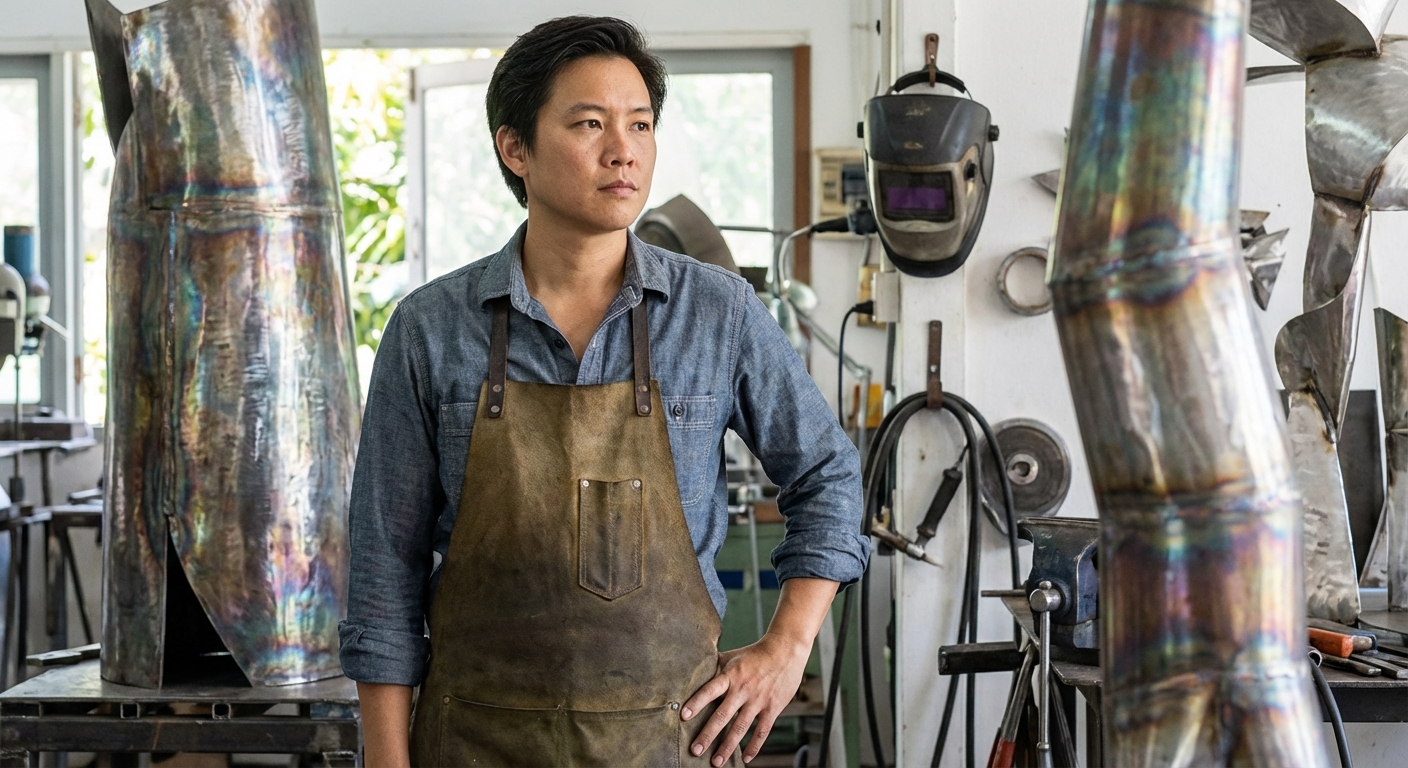
Jin Novak
Jin Novak (born 1984-11-02) is a sculptor and mixed-media conservator whose work bridges the material discipline of conservation with a formally rigorous studio practice. They use they/them pronouns. ...
View Full Profile →Critic Reviews
-
Dr. Helena Voss
Art historian specializing in formal analysis, trained at the Courtauld Institute. Focuses on visual structure over narrative.
As a formal proposition Resonant Scaffold (for FAR's 75th) reads as an exercise in relational geometry, a welded armature that insists on being read from multiple approaches. The branching network negotiates positive and negative space with the economy of late modernist restraint, each limb resolving into planar leaflike panels that flatten and refract sightlines. The built-in benches anchor the composition, making the work at once a sculptural object and a pragmatic locus for gathering, while the multiple-point perspective prevents any single privileged vantage, encouraging movement and communal choreographies around form.
Materially the piece is where intent and technique meet most lucidly. The iridescent patination negotiates industrial coolness and vegetal warmth, the surface shifting as viewers circumnavigate the pavilion. Novak leaves weld scars and conservation seams visible, not as aesthetic afterthought but as a declared ethic, a refusal of seamless illusion and a gesture toward repair as ongoing practice. The inclusion of tuned chimes, stitched pennants and field recordings is not ornamental, it is integral, a soft rhythmic counterpoint that activates the pavilion's haptic invitation to touch and shared listening. The work frames accessibility as a structural principle, foregrounding nonverbal modes of belonging, which resonates especially in the context of FAR's therapeutic arts mission.
Critically the piece succeeds where it commits to function and process, translating a rigorous formal language into a genuinely facilitatory space. My reservations are small, formal ones, regarding the long term legibility of the delicate patination in public settings and the challenge of scaling a materially honest conservation ethic within routine maintenance regimes. Even so, Jin Novak synthesizes modernist restraint, literati sensibility and disability-led care into a coherent apparatus for encounter and repair, a scaffold that holds improvisation as well as memory.
Branching composition and multiple viewpoints Material and iridescent patination Visible welds and conservation ethic Accessibility and communal programming Integration of sound and tactile elementsOct 19, 2026