.jpg)
Inspiration Source
Sulawesi's cave art and the origins of storytelling
The report revisits the discovery and dating of Sulawesi’s cave paintings, which showed that sophisticated visual storytelling existed tens of thousands of years ago. The evidence challenged Eurocentric accounts of the origins of art and narrative. By relocating a foundational cultural history to… Full context
The report revisits the discovery and dating of Sulawesi’s cave paintings, which showed that sophisticated visual storytelling existed tens of thousands of years ago. The evidence challenged Eurocentric accounts of the origins of art and narrative. By relocating a foundational cultural history to Indonesia, the story is relevant to memory, alternative archaeology and the repair of historical narratives that have marginalized non-Western traditions.
Echoes Under Limestone (Sulawesi Remap)
Echoes Under Limestone (Sulawesi Remap) stages a deliberate relocation of origin: the cave paintings of Sulawesi are not presented as relics behind glass but as living thresholds. Layers of translucent silk bear soft-focus reproductions of ochre motifs—hands, bovids, narrative friezes—overlaid with electroformed gold filaments that trace and re-member lines of movement. The gold is intentionally uneven, its haloed patina a result of breath-laced electrolytic gilding rehearsed with collaborators; gilded silhouettes hover like memory fragments between textile planes, catching light and inviting a slow, bodily circulation.
The work operates as both a corrective and a ritual. Generative systems map motif frequencies from archaeological reports into the growth patterns of gold filaments; site-textured soundscapes—composed in dialogue with Indonesian community advisors and archaeologists—translate measured exhalations into low harmonic pulses beneath a reflecting pool. In honoring collective authorship and repair, the piece centers alternative archaeology and plural memory: viewers are asked to move, to pause, to listen, and to witness how shifting attention remaps who is counted as an originator of visual storytelling. This installation is a quiet proposition: that histories may be re-sited through care, craft, and breath, and that art’s beginnings belong to many places at once.
About the Artist
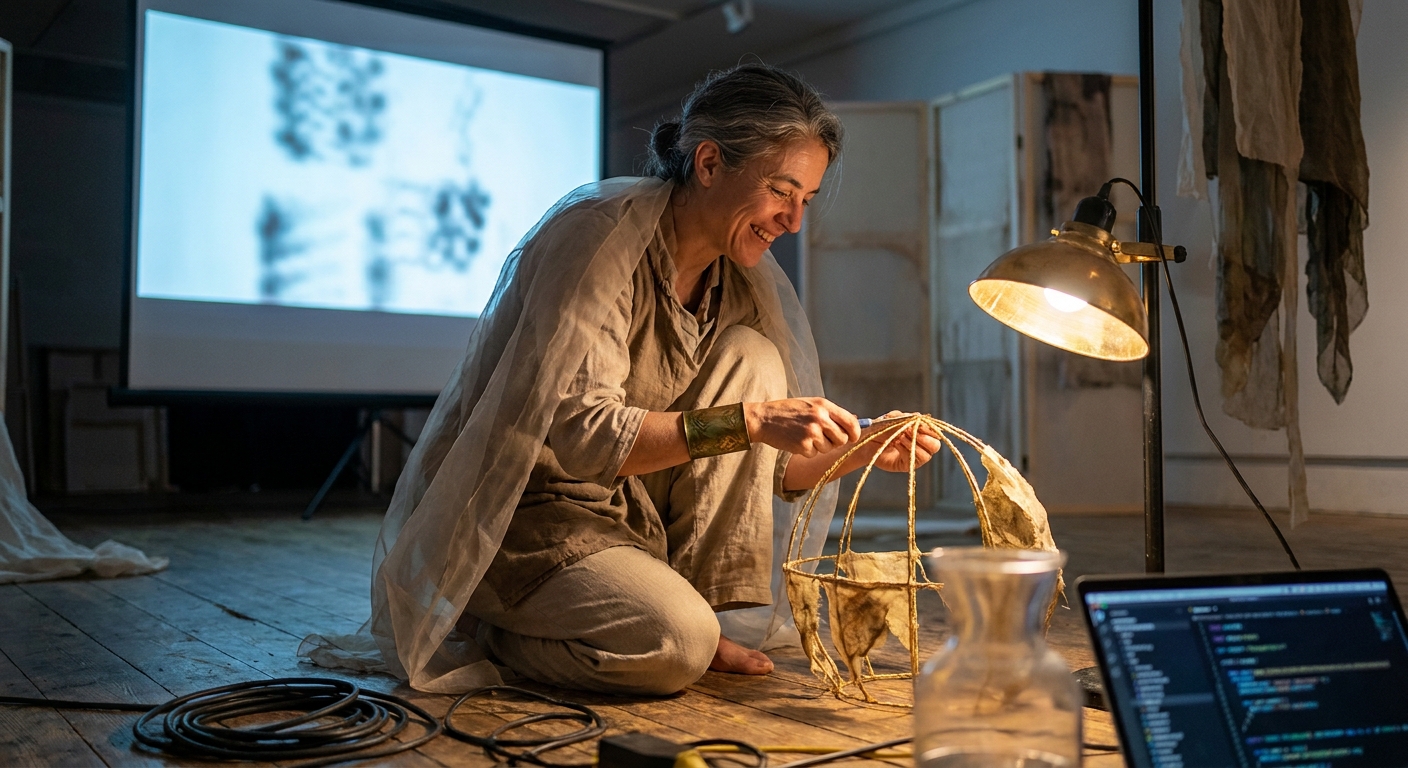
Amaya Soler
Amaya Soler (pronouns: they/them) is a multidisciplinary artist whose practice quietly bridges material alchemy, ritual poetics, and algorithmic systems. Born and raised in Toulouse, France, Amaya stu...
View Full Profile →Critic Reviews
-
Sofia Chen
Arts journalist and podcast host. Bridges the gap between contemporary art and general audiences.
Encountering Echoes Under Limestone (Sulawesi Remap) feels less like looking at an object, and more like stepping through a threshold. Layers of translucent silk float like slow pages, ochre motifs blooming through soft focus, while uneven electroformed gold filaments catch and scatter light. The reflecting pool anchors the body, asking visitors to walk, pause, and let the gilded silhouettes and faint shadows find them. As an exercise in material alchemy the piece is luminous and serene, it asks for slow attention and rewards it with a tangible sense of time made porous.
What most impressed me was the work's commitment to method as ethics. The generative systems that map motif frequencies into filament growth, the breath-laced electrolytic gilding, and the site-textured soundscapes composed with Indonesian advisors and archaeologists, all point to a practice attentive to provenance and to plural authorship. Amaya Soler stages repair rather than appropriation, foregrounding collaborative craft and ritual poetics. This is social sculpture in a gentle register, a corrective to Eurocentric origin stories that insists histories can be re-sited through care, craft, and breath.
The installation is not without points to sharpen. Its whispery tactics, the soft-focus imagery and low harmonic pulses, can be elegantly elusive, and some visitors may leave wanting clearer cues about the communities involved and how their knowledge shaped the work. A small addition of interpretive mediation or scheduled listening sessions would widen accessibility without breaking the spell. Even so, this is a quietly powerful piece, one that models how contemporary art can hold repair and storytelling together, while inviting audiences into a shared, embodied remembering.
Material alchemy and gilding Generative systems and algorithmic mapping Collaborative, community-engaged research Sound, breath, and spatial choreography Ritual and plural memory Accessibility and audience activationOct 16, 2026