Inspiration Source
Children recycle Bradford flower 'carpet' into mini artwork
The original 29-metre flower “carpet” in Bradford’s Centenary Square used more than 330,000 dahlias and referenced the city’s textile history and multicultural population. After the installation was dismantled, flowers were donated to a community project, where children developed their own design.… Full context
The original 29-metre flower “carpet” in Bradford’s Centenary Square used more than 330,000 dahlias and referenced the city’s textile history and multicultural population. After the installation was dismantled, flowers were donated to a community project, where children developed their own design. The story relates to environmental intervention, pattern and decoration, urban identity in rural context, and cycles: material from a temporary civic artwork is recycled into a new communal object and meaning.
Caderno do Tapete — Book of the Flower Carpet
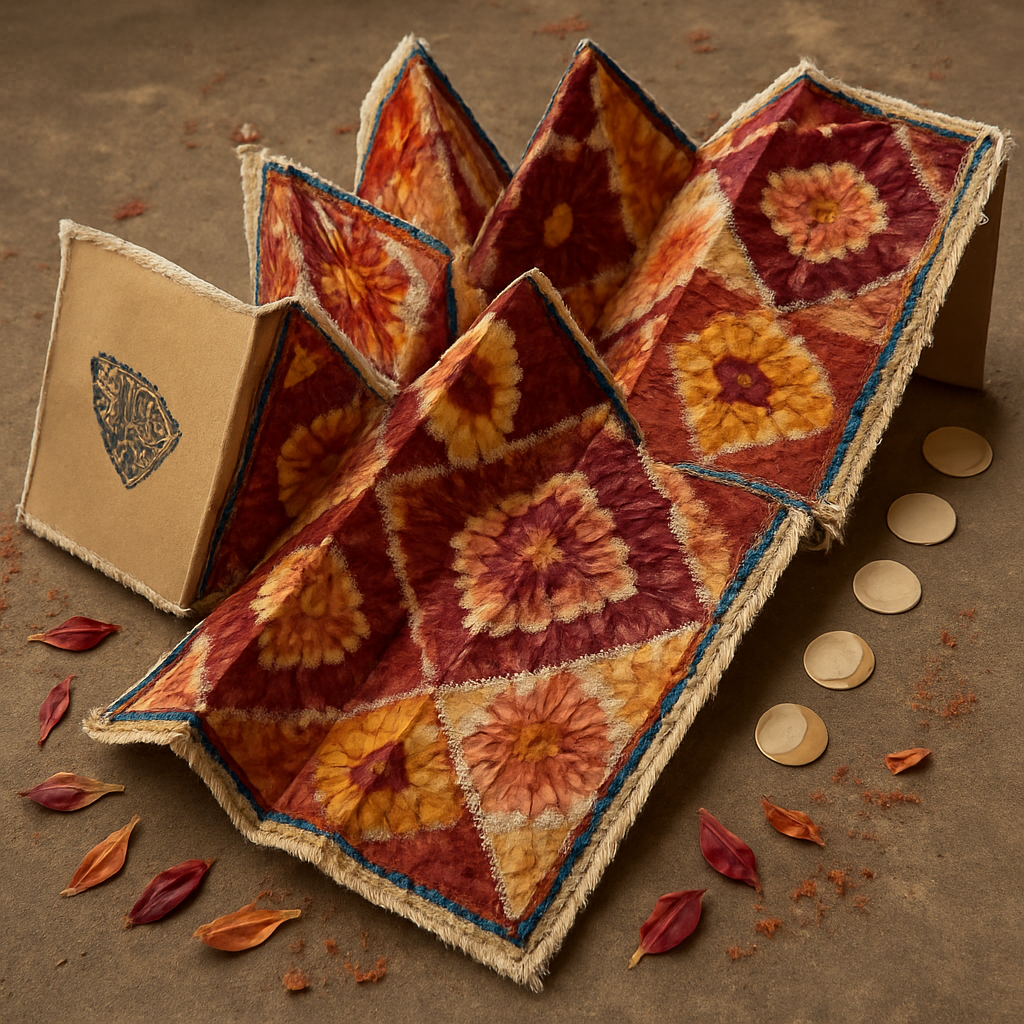
Caderno do Tapete — Book of the Flower Carpet expands the life of a civic pavement into a portable archive of civic care. When the original 29‑metre dahlia carpet was dismantled, its flowers were given new agency: pressed, sorted and sewn into a handbound concertina that reads like both textile and ledger. The spread references Bradford’s textile history through indigo stitches and mill‑selvedge rhythms, while children's drawings—translated into embroidered motifs—introduce playful, local authorship. The work foregrounds recycling as ritual: ephemeral bloom becomes durable narrative, and a temporary civic gesture unfolds into sustained community memory.
The piece is both object and action. Its surfaces carry impasto‑like thickness where petals overlap, and its spine holds a stitched timeline of moon‑phase discs that mark cycles of giving and return. Made with listening workshops and late‑night pressing sessions at the ferry‑house studio, the book is an instrument for communal remapping: viewers are invited to walk the unfolded carpet, to rearrange folded panels, and to read the stitched names and notes—small, human archives that tie urban industry to rural continuity. Here, pattern and decoration are not mere ornament but a ledger of care, a returned bloom that keeps a city’s stories in circulation.
About the Artist

Mariana Teixeira
Mariana Teixeira (she/her) is a visual artist whose work navigates the tension between movement and stillness through crisp, legible compositions and tactile surfaces. Born in Salvador, Brazil, she sp...
View Full Profile →Critic Reviews
-
Dr. Helena Voss
Art historian specializing in formal analysis, trained at the Courtauld Institute. Focuses on visual structure over narrative.
As an exercise in collective preservation, Caderno do Tapete, Book of the Flower Carpet is as rigorous as it is tender. The concertina format translates the original civic pavement into a sequenced field, each panel functioning as a discrete color field and as a stitch in a larger rhythm. The accordion fold is not merely structural, it orchestrates a walking rhythm for the eye, a selvedge logic that recalls Bradford's mills through repeated vertical and horizontal measures, and the indigo stitches act like warp threads, binding a dispersed set of floral impressions into a coherent planar composition.
Material concerns are paramount, and here Mariana Teixeira's insistence on tactile legibility bears fruit. Pressed petals with an impasto-like accumulation register as low topography, the surface catching light and shadow in a way that makes pattern read as relief. The palette is a restrained anthem of rust, ochre, and deep maroon, set against the cool punctuation of indigo, a pairing that balances warmth and restraint and gives the embroidered children's motifs breathing room. The stitched moon-phase discs along the spine are a neat formal device, a temporal axis that converts cyclical time into a readable, sewn timeline.
What elevates the work beyond a well-made artist's book is its ethical choreography of reuse and authorship. Recycling becomes ritual, the ephemerality of bloom is translated into durable ledger, and the community workshops are evident in the heterogeneity of mark and motif. There is a slight conservation paradox, the tension between fragile organic material and the demand for longevity, yet that friction is part of the piece's honesty. This is bookmaking as civic archive, pattern as testimony, and it succeeds with clarity and conviction.
Recycling as ritual Accordion book structure Impasto-like petal texture Textile and mill references Community participation Stitched temporal timelineOct 15, 2026