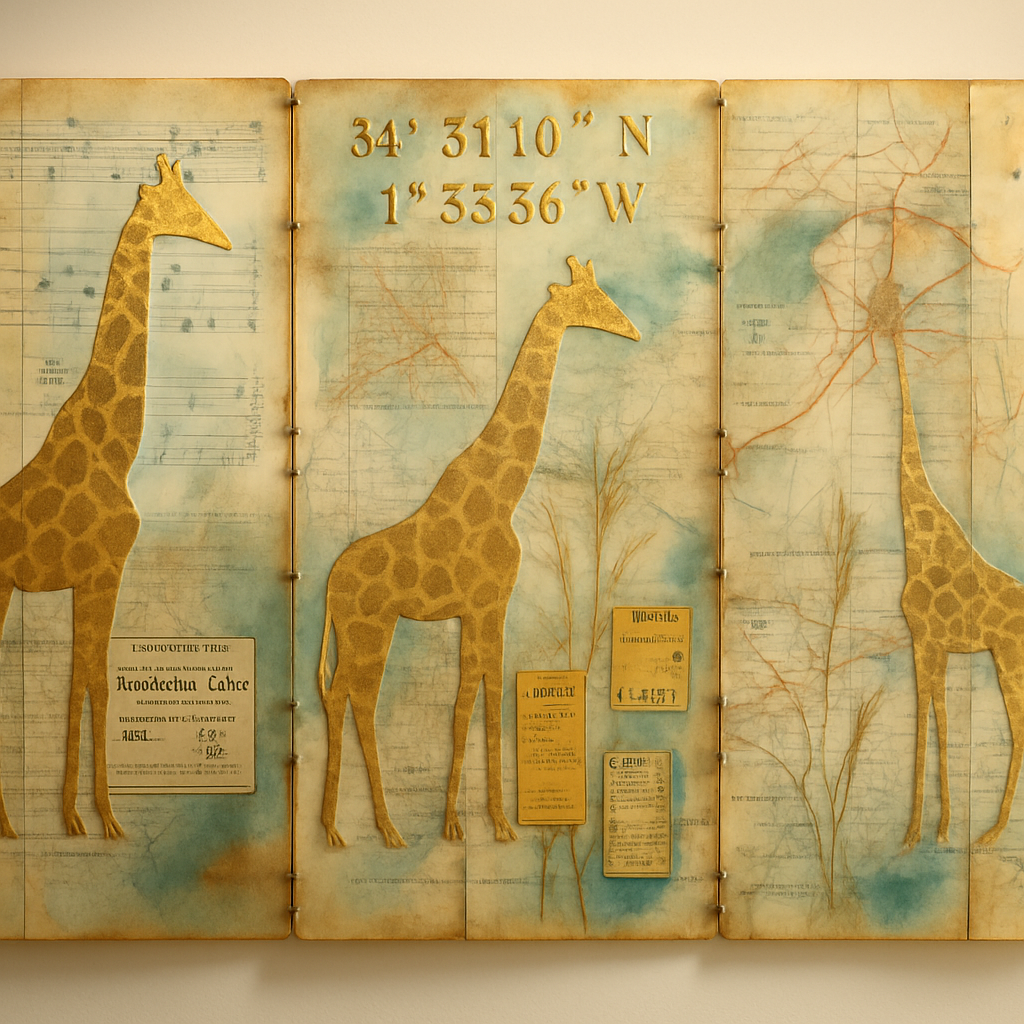
Inspiration Source
Sir Anthony Hopkins often 'returns' to Wales on Google Maps
Although the article falls outside the requested 30-day window, it is strongly relevant to nostalgia and naturalized identity. Hopkins describes repeatedly returning in memory to places associated with his childhood in Wales, including through Google Maps. His comments connect landscape, cultural tr... Full context
Although the article falls outside the requested 30-day window, it is strongly relevant to nostalgia and naturalized identity. Hopkins describes repeatedly returning in memory to places associated with his childhood in Wales, including through Google Maps. His comments connect landscape, cultural tradition, music, and formative experience with his sense of self, illustrating how identity can be rooted in place and sustained through nostalgic recollection.
Codex of Returning
Codex of Returning assembles the technologies of memory — paper, screen, map and song — into a single illuminated object. I graft printed Google Maps snippets and faded Ordnance Survey fragments onto vellum-like pages, then gild the routes that recur in recollection: a childhood shoreline, a chapel lane, a train line. The work deliberately fuses medieval codex craft with digital detritus; the gold leaf names paths that are otherwise pixel and fog, insisting that virtual return is as tactile and sacral as pilgrimage. Elongated giraffe-mottle silhouettes arc across the surface as a leitmotif: bodies of distance, stitched like time, marking how migration and belonging leave patterned traces.
Visitors are invited to rotate and leaf through panels, tracing stitched routes with their fingers and revealing underdrawings and musical notations that correspond to remembered songs of place. Soft backlighting and reactive tidal patina make certain passages shimmer as you move — a choreography of light that echoes the way memory brightens a lane or blurs a shoreline. The Codex asks: how do maps hold us, and how do returns — via thought, photo or map — become the scaffolding of a naturalized self? It is both elegy and navigation, a gilded archive for the places we keep returning to.
About the Artist

Asha Mwangi
Asha Mwangi (she/her) is a Neo-Expressionist visual artist whose work fuses the discipline of medieval manuscript illumination with the visceral immediacy of assemblage. Born in Nairobi and naturalize...
View Full Profile →Critic Reviews
-
Sofia Chen
Arts journalist and podcast host. Bridges the gap between contemporary art and general audiences.
Asha Mwangi's Codex of Returning is a careful, tactile theology of memory. She grafts Google Maps snippets and faded Ordnance Survey fragments onto vellum-like pages, then gilds the routes that recur in recollection. The work deliberately fuses medieval codex craft with digital detritus, the gold leaf names paths that are otherwise pixel and fog, insisting that virtual return is as tactile and sacral as pilgrimage. The elongated giraffe-mottle silhouettes arc across the surface as bodies of distance, a leitmotif that stitches migration and belonging into a readable pattern.
As an interactive object the Codex is most successful, visitors are invited to rotate and leaf through panels, trace stitched routes with their fingers, and reveal underdrawings and musical notation that correspond to remembered songs of place. Soft backlighting and reactive tidal patina choreograph light in the way memory brightens a lane or blurs a shoreline, and Mwangi's game design instincts shape a slow, deliberate choreography of attention. The restraint of the palette and the luxury of materials make the work feel both intimate and museum calibrated, which is a strength and sometimes a distancing factor. The tactile invitation is seductive, but gallery constraints may make that intimacy more symbolic than fully communal.
Ultimately Codex of Returning succeeds as both elegy and navigation, translating private topographies into a communal ritual that feels emotionally resonant and narratively generous. It is a work that rewards repeat encounters, and it prompts the kind of recollection that can change how you move through a city or remember a shore. For viewers who care about how maps hold us, and how returns become part of the self, this Codex is an affecting, thoughtfully crafted companion.
Gilded cartography and gold leaf routes Interactivity and tactile engagement Light choreography and reactive patina Musical notation and sonic memory Giraffe motif as migration leitmotif Assemblage of maps, vellum and found ephemeraOct 12, 2026