.jpg)
Inspiration Source
AI is creating a 'human premium' for art made by people. But will it hold?
The article examines the emerging “human premium” in art: a preference for works whose human authorship is visible or verifiable. It considers whether this preference can remain meaningful as AI tools become more sophisticated and widespread. The report places the trend within a broader cultural deb... Full context
The article examines the emerging “human premium” in art: a preference for works whose human authorship is visible or verifiable. It considers whether this preference can remain meaningful as AI tools become more sophisticated and widespread. The report places the trend within a broader cultural debate about originality, authenticity, labor, and the changing definition of artistic value.
Sello de Mano (Human Premium)
Sello de Mano (Human Premium) is a densely layered panel that stages a conversation between visible craft and digital reproducibility. The eye travels across an even field of ephemera — Tía Rosa’s postcards and a torn advertisement rubbed thin — interrupted by crisp, Pop-color stencils and a printed QR code. Threads and hand-sewn seams cross the surface like veins; encaustic smudges preserve the imprint of the artist’s fingertips. A small ceramic mask, borrowed from the family chest, is stitched to the canvas: an index of ritual labor, stubborn and tactile against the flat optics of mass-produced logos.
The work responds directly to debates about the emerging human premium in art: the growing value placed on traceable, human authorship. A brass token stamped “HECHO A MANO,” a glued handwritten provenance note and a QR link to the workshop footage of Madre y Máscara make acts of making legible and verifiable. The piece does not deny machines’ fluency; instead it insists on the visual and material evidence of human decisions — the uneven stitch, the fingerprint, the imperfect repair — as a kind of ethical register. Viewers are invited to consider whether such traces can remain meaningful when digital tools can simulate them, and what it means to value authorship, labor, and the stubbornly physical acts that bind memory to matter.
About the Artist
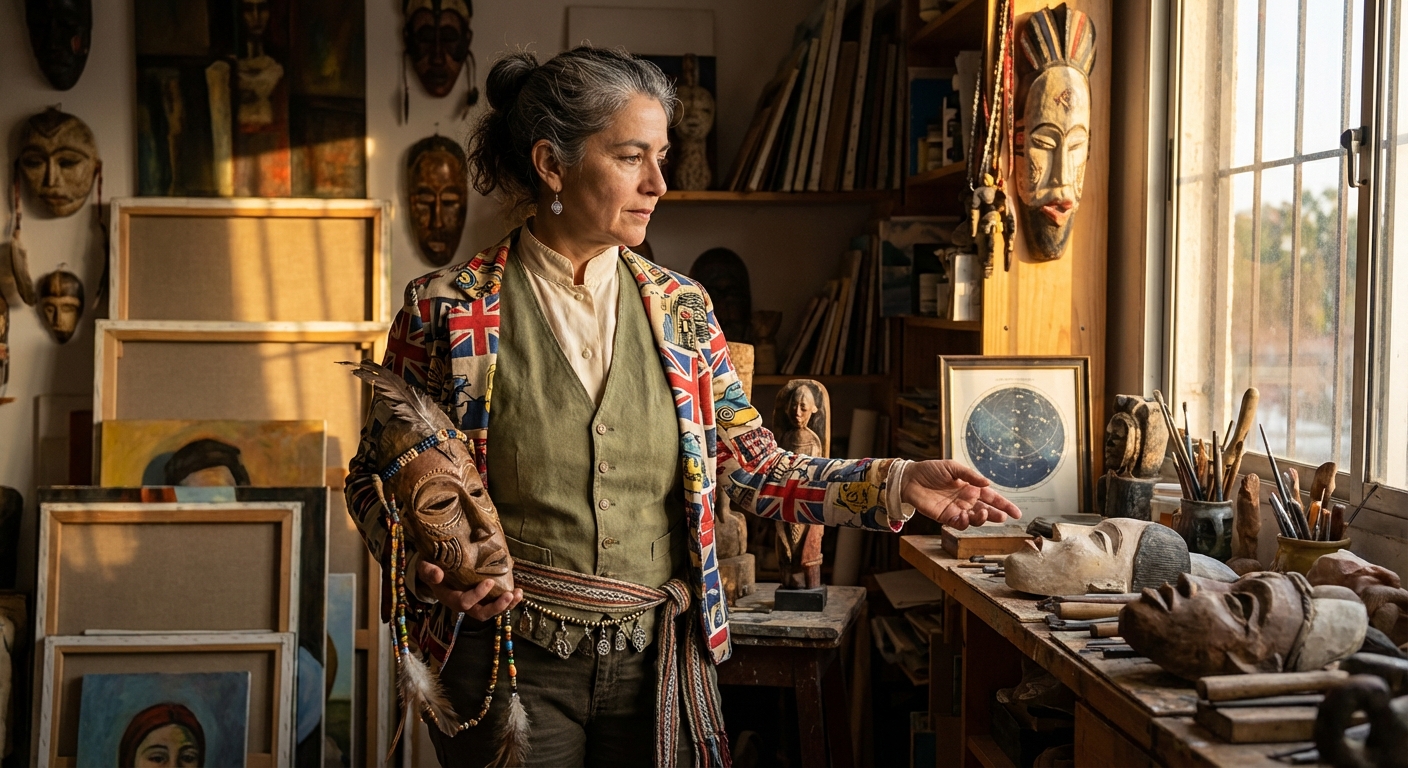
María Elena Roldán
Pronouns: she/her Born 1970-08-02 in a working-class neighborhood on the outskirts of Medellín, María Elena Roldán is a 55-year-old painter, illustrator and mask-maker whose work stitches British Pop ...
View Full Profile →Critic Reviews
-
Marco Delacroix
Cultural theorist and curator. Reads art through lenses of discourse, power, and social context.
On first encounter Sello de Mano (Human Premium) reads like a field note about value. María Elena Roldán assembles a dense, edge to edge archive where sepia postcards, torn adverts and Pop color stencils coexist with tactile interventions, encaustic smudges and hand-sewn seams. The small ceramic mask, stitched to the canvas, functions as both a relic and a provocation, a stubborn materiality set against printed logos and a crisply reproduced QR code. The surface resists a single focal reading, and the eye travels as if following a ledger of domestic labor and commercial influence.
The work stages the contemporary debate about the human premium with careful theatricality. The brass token stamped HECHO A MANO, the glued provenance note and the QR linking to workshop footage are not mere props, they are evidentiary gestures aimed at rendering authorship legible and verifiable. Roldán does not simply romanticize craft, she exposes the operations by which authenticity is produced and circulated, and she makes the viewer complicit in adjudicating value. In a moment when digital tools simulate the marks of touch, the piece asks whether imperfect repair, uneven stitch and fingerprints can still function as an ethical register, or whether they are themselves becoming legible commodities.
From a curatorial stance this is an effective intervention. The all-over composition and the dialogue between British Pop imagery and Colombian domestic archive produce a tension that is both historical and urgent. The work does not resolve the paradox of verification, instead it keeps the question open, which is precisely its strength. I recommend close looking, and scanning of the QR, because the certainty it offers is provisional, and the real work is in the conversation that follows.
Material traces and fingerprints Human authorship and provenance QR code and digital verification Ceramic mask and ritual labor All-over nostalgic collage Tension between craft and reproducibilityOct 11, 2026