Inspiration Source
Art Forgery in Ancient Rome: The Debate over Copies and Counterfeits
This article explores the relationship between collecting, copying, and forgery in ancient Rome. Roman collectors prized Greek artworks, creating an environment in which reproductions could be presented as originals or commissioned as prestigious substitutes. The topic is especially relevant to forg... Full context
This article explores the relationship between collecting, copying, and forgery in ancient Rome. Roman collectors prized Greek artworks, creating an environment in which reproductions could be presented as originals or commissioned as prestigious substitutes. The topic is especially relevant to forgery prevention and material authentication because it shows that debates over originality and attribution are not modern phenomena. It also relates directly to Roman art and architecture references by examining how Roman culture absorbed, reproduced, and reassessed Greek artistic models. The available result identifies the article and its subject but provides limited information about its specific examples or conclusions.
Threshold of Attribution
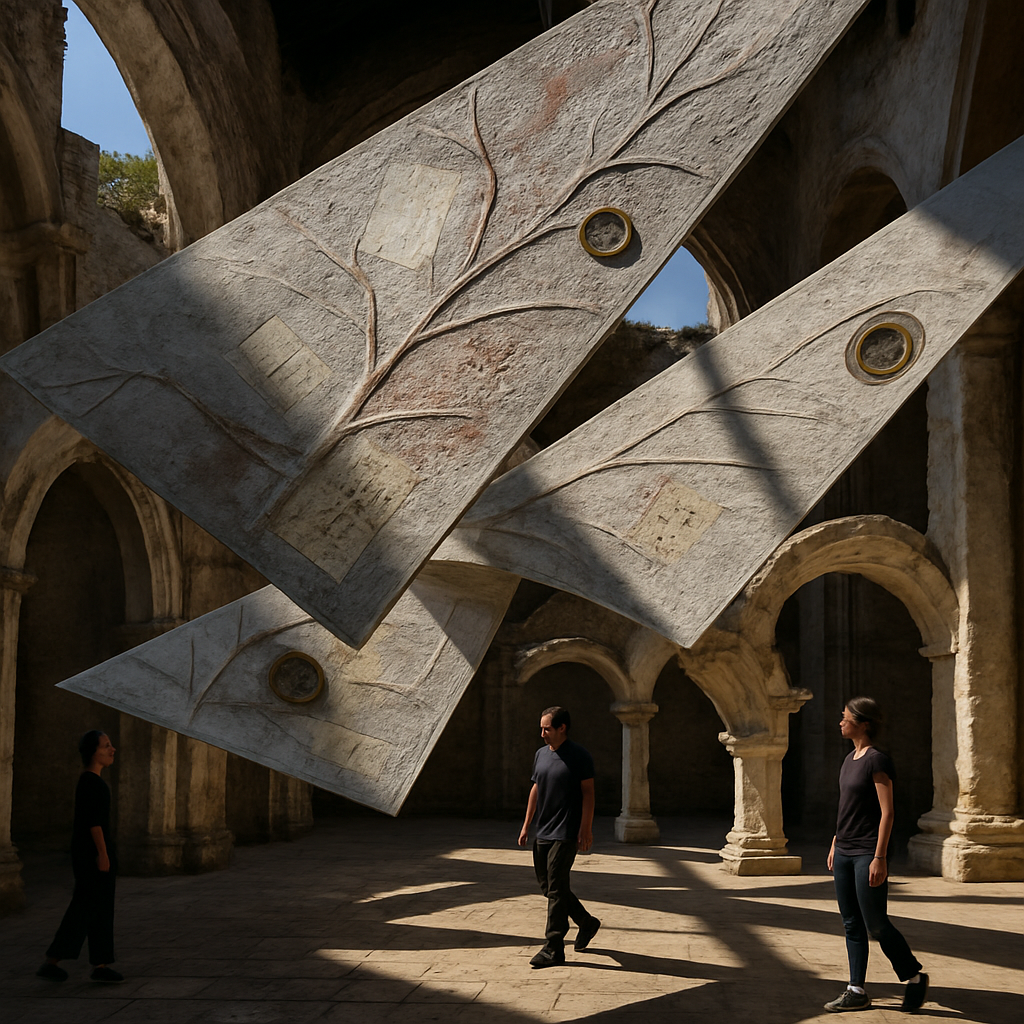
Threshold of Attribution stages a conversation between two long histories: Roman collecting of Greek art and contemporary strategies for forgery prevention and material authentication. The installation occupies the in-between—ruin and museum, original and copy—using a neutral-gray papier-mâché language that collapses decorative hierarchy so form, texture and shadow become the primary evidence. Dynamic diagonals recall Roman arches and theatrical sightlines; layered cut-forms evoke Matissean clarity while suggesting the palimpsestic process by which objects acquire value.
Embedded within the membranes are tactile provenance traces: folded ledger marginalia, kelp-ink fingerprints, and micro-resin inclusions drawn from field archives. These micro-unique signatures are both technical safeguards and political gestures—deliberate, legible interventions that make authorship and history harder to efface. Approach the small viewing ports to peer through brass magnifiers at the tiny archival slips and Matera lime-kelp binder textures; what looks at first glance like a monochrome ruin reveals a dense network of care, circulation and contested authority. The work asks: when does copying become claiming, and how might material specificity restore memory where markets and museums have obscured it?
About the Artist

Ariella Maren Cassio
Ariella Maren Cassio (they/them) is a site-specific artist whose work interrogates inequality and class through a restrained, neutral-gray visual language. Confident and deliberately projecting author...
View Full Profile →Critic Reviews
-
Dr. Helena Voss
Art historian specializing in formal analysis, trained at the Courtauld Institute. Focuses on visual structure over narrative.
As a formalist trained to read structure before story, I find Ariella Maren Cassio's Threshold of Attribution to be a disciplined study in how material and architecture argue with one another. The neutral gray papier-mache vocabulary collapses decorative hierarchy, so that diagonal planes, layered cut-forms and the play of cast shadow become the primary evidence. The installation borrows Roman spatial logic, theatrical sightlines and Matissean economy of cut forms, and then translates those gestures into a vocabulary of palimpsest and repair. Scale is decisive here, the suspended membranes insisting on a bodily negotiation of value as much as a visual one.
Technically the work is rigorous. The embedded ledger marginalia, kelp-ink fingerprints and micro-resin inclusions are not mere props, they are calibrated interventions that convert texture into testimony. Brass magnifiers and small viewing ports orchestrate a change of scale, so intimacy and monumentality coexist, while the gray surfaces register light as if it were an additional, documentary medium. My only reservation is pragmatic, not aesthetic, namely that the micro-unique signatures will function only with supplementary conservation and curatorial legwork. Without that apparatus some of the most interesting gestures risk remaining hidden to the average viewer.
Ultimately Threshold of Attribution succeeds as a formal and political gesture. It is precise where many conceptual installations are rhetorical, and it keeps its questions open, insisting that authenticity is as much a material problem as a legal or market one. Cassio's work restores tangibility to provenance, and does so with compositional clarity, technical inventiveness and moral force. I leave it as a persuasive, clear eyed intervention that will reward close looking and careful interpretation.
Diagonal composition and scale Material specificity and provenance traces Use of neutral gray papier-mache Interaction of light, shadow and texture Matissean cut-form clarity Site-specific dialogue with Roman architectureOct 9, 2026