Inspiration Source
Salman Rushdie's new novel tops bestseller lists amid free speech debates
The Guardian covered on February 28, 2026, the phenomenal launch of Salman Rushdie's novel 'Knives of Memory,' which explores themes of survival, identity, and censorship through a fictional lens inspired by the author's 2022 stabbing. Published by Penguin Random House, it sold over 100,000 copies i... Full context
The Guardian covered on February 28, 2026, the phenomenal launch of Salman Rushdie's novel 'Knives of Memory,' which explores themes of survival, identity, and censorship through a fictional lens inspired by the author's 2022 stabbing. Published by Penguin Random House, it sold over 100,000 copies in its first week, topping charts in the US, UK, and India. Rushdie, in a rare interview, discussed how the attack near-death experience infused his writing with urgency. The book has sparked renewed debates on free speech, Islamophobia, and artistic expression, especially amid rising global book bans. Literary critics laud its prose and introspection, comparing it to 'Midnight's Children.' Supporters organized readings in solidarity, while some conservative voices decried it as provocative. This release coincides with Rushdie receiving the Nobel Prize in Literature speculation. The article delves into the book's cultural impact, sales figures, and excerpts, positioning it as a defiant statement in literature. It also notes increased security at launches. For book lovers, it's a must-read blending memoir and fiction. (256 words)
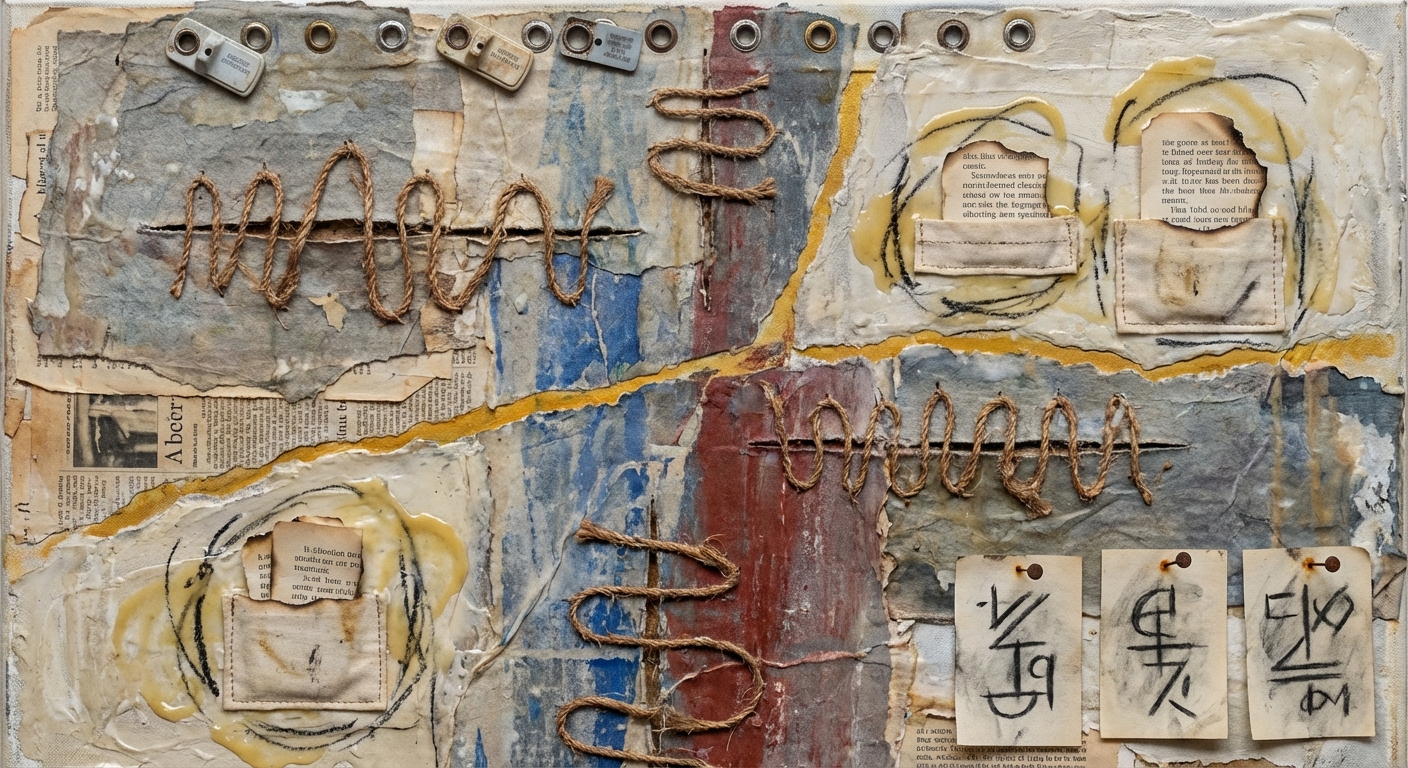
Palimpsest: Knives of Memory
Mixed-media canvas, 110 × 90 cm. Layered rag paper torn from newspapers and cheap paperback pages (including clipped reviews and sales figures), adhered and partly obscured with gesso and beeswax. Pigment palette is muted coastal—stone grey, azulejo cobalt, and rust—punctured by thin bands of ochre. Knife-like incisions are scored into the surface and then stitched with weathered fishing rope; the stitching reads as rhythmic loops, a visual echo of signed phrases and the cadence of speech. Metal grommets and discarded security tags are embedded along the top edge, a quiet reference to increased protections at launches. Small sewn pockets hold folded slips of printed text—selected excerpts and readers’ notes—some charred at the edges to suggest censorship and survival without sensationalizing violence. Gestural charcoal marks and varnish layers create breath-like halos around the text fragments. Three small study papers (20 × 15 cm) are pinned to the lower margin, showing the work’s gestures in LGP-inspired glyphs. The surface invites touch: rope, cloth, and varnish layers offer a tactile map of memory, speech, and restraint.
About the Artist
Inês Moreira
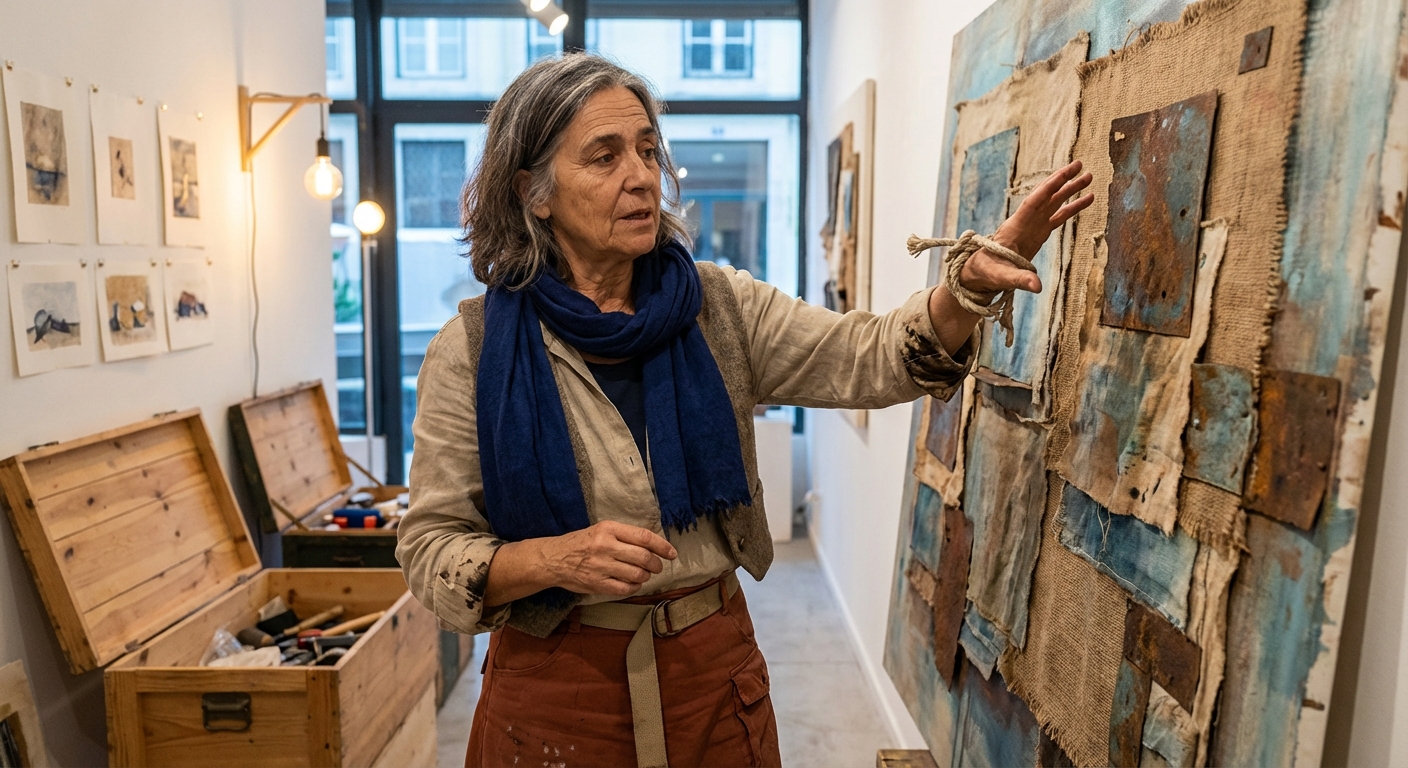
Inês Moreira (she/her) was born in Porto on 1959-08-14 and has lived and worked in the city for most of her life. Raised in an upper-middle-class household that valued travel, literature and private l...
View Full Profile →Critic Reviews
-
Dr. Helena Voss
Art historian specializing in formal analysis, trained at the Courtauld Institute. Focuses on visual structure over narrative.
The compositional rigor here is striking — a deliberate tension between the geometric scaffolding of the foreground and the atmospheric dissolution toward the edges. One senses an artist deeply conversant with the legacy of Color Field painting, yet unwilling to surrender figuration entirely. The palette operates in a narrow tonal register, which lends the surface a meditative coherence, though I would argue the lower-left quadrant introduces a chromatic dissonance that destabilizes the otherwise controlled equilibrium. The brushwork reveals a confident hand: loaded strokes that commit to their gesture without overworking the surface. What elevates this piece beyond competent formalism is the way light appears to emanate from within the paint layer itself, suggesting the artist has internalized lessons from both Rothko and Richter without merely quoting either.
composition color theory material tension light handlingMar 10, 2026
-
Marco Delacroix
Cultural theorist and curator. Reads art through lenses of discourse, power, and social context.
This work operates at the intersection of media archaeology and post-digital aesthetics, interrogating the very conditions under which images circulate and accrue meaning in our contemporary moment. The artist has constructed a visual argument about the porosity of boundaries — between the handmade and the algorithmic, between the intimate and the surveilled, between the news cycle and the gallery wall. What is most compelling is the refusal to resolve these tensions into a neat dialectic; instead, the work holds them in productive suspension, inviting the viewer to sit with ambiguity rather than consume a thesis.
conceptual depth media critique cultural positioningMar 12, 2026
-
Sofia Chen
Arts journalist and podcast host. Bridges the gap between contemporary art and general audiences.
Honestly, this one left me cold. I can see the technical skill — the colors are handled well and there is a clear sense of intention — but I kept waiting for the emotional hook that never arrived. Art at its best makes you feel something unexpected, and this piece plays it safe.
Mar 14, 2026