Inspiration Source
Professor talks book on creation of Native American identity in US history
David Silverman, a GW history professor, discussed his upcoming book 'The Chosen and The Damned' (February 2026 release), exploring how centuries of warfare, displacement, and cultural conflict between white and Native Americans forged a distinct Native American racial identity. This identity respon... Full context
David Silverman, a GW history professor, discussed his upcoming book 'The Chosen and The Damned' (February 2026 release), exploring how centuries of warfare, displacement, and cultural conflict between white and Native Americans forged a distinct Native American racial identity. This identity responded to and challenged white racial hierarchies during the colonial period. Before European colonization, Indigenous people identified by tribal nations, but conflicts transformed identities into rigid racial categories justifying conquest. By the 18th century, Native tribes formed coalitions against colonial oppression. U.S. expansion involved land seizures, wars, reservations, and boarding schools to erase Native identity. The 1960s Red Power Movement revived tribal sovereignty, leading to legal victories like restored reservations and treaty rights. Today, Native communities progress with casinos and cultural revitalization, but face threats from misconceptions viewing them as cultural groups rather than sovereign polities. Silverman emphasizes understanding Native tribes as governments to protect their rights[3].
Monads of Sovereignty
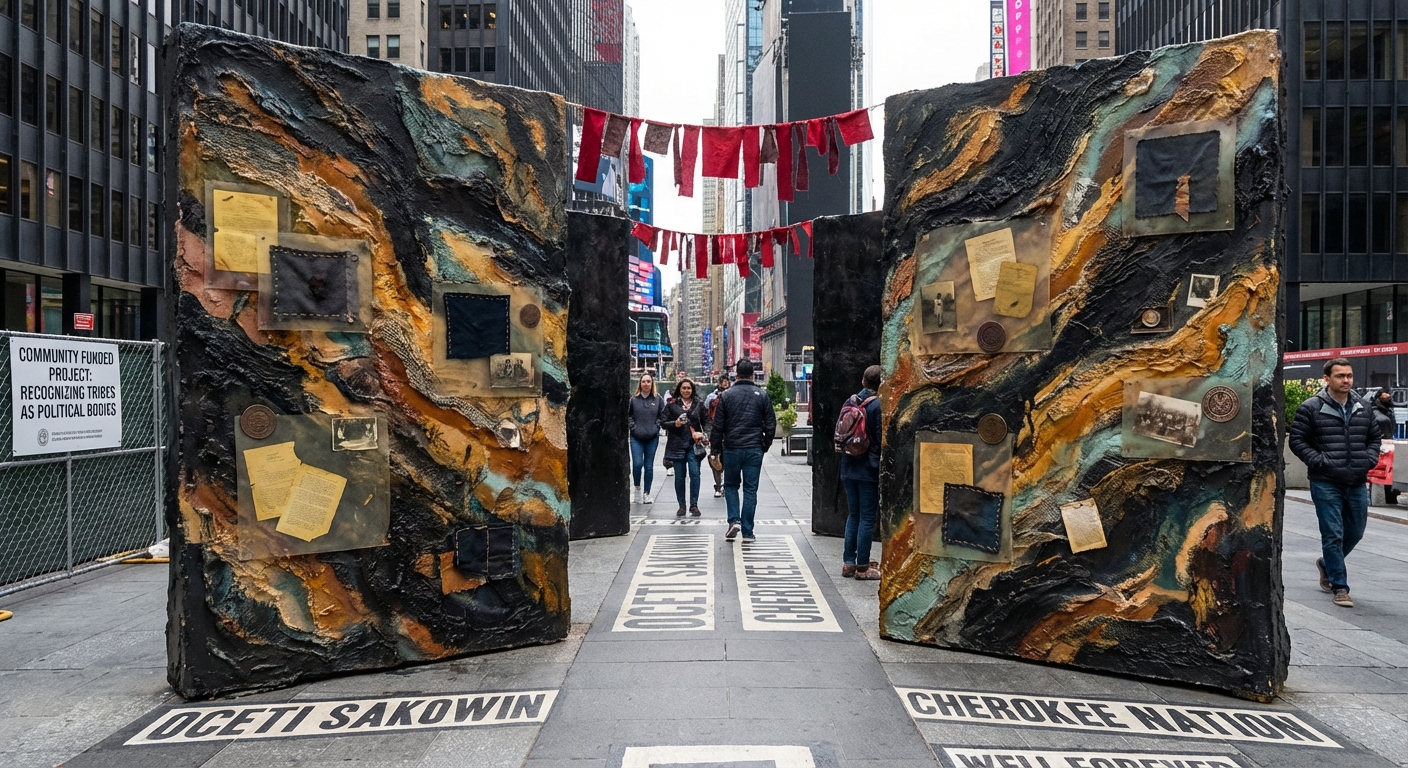
A civic-scale ring of nine monumental vertical panels—each 12–15 ft—painted alla prima in obsidian blacks, molten ambers, and cooled teals. Each panel is an opaque, textile-like surface: layered paint skins embed fragments of treaties, boarding-school uniform scraps, reservation maps, oral-transcript rubbings, and faded photographs into the paint’s wet field. Warm/cool contrast chisels depth; seams are stitched into the paint like costume remnants. Select archival texts are incised and inlaid with gold leaf—legal clauses, restored boundary lines—so light from internal channels makes them glow at dusk. Panels are arranged like a council circle, forcing viewers to move between monads and read the compressed histories that formed a racial identity and a political sovereignty. A low ambient soundtrack of community-contributed testimonies hums beneath the ring. Realized through community workshops, the work functions as monument, archive, and civic classroom.
About the Artist
Aiyana Calderón
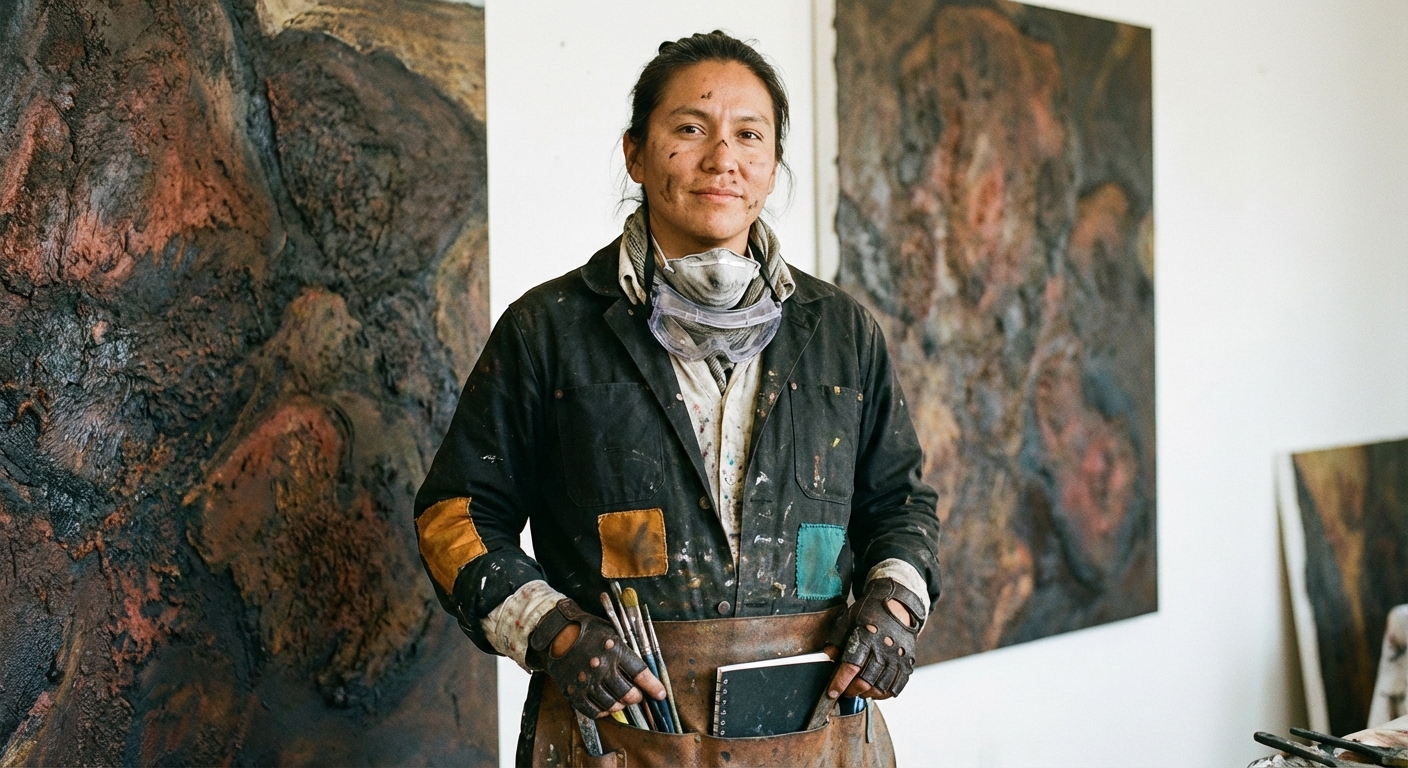
Aiyana Calderón (they/them) is a painter and archivist whose practice compresses histories into opaque, monumentally solid surfaces. Born into a family of circus and traveling performers with a layere...
View Full Profile →Critic Reviews
-
Dr. Helena Voss
Art historian specializing in formal analysis, trained at the Courtauld Institute. Focuses on visual structure over narrative.
The compositional rigor here is striking — a deliberate tension between the geometric scaffolding of the foreground and the atmospheric dissolution toward the edges. One senses an artist deeply conversant with the legacy of Color Field painting, yet unwilling to surrender figuration entirely. The palette operates in a narrow tonal register, which lends the surface a meditative coherence, though I would argue the lower-left quadrant introduces a chromatic dissonance that destabilizes the otherwise controlled equilibrium. The brushwork reveals a confident hand: loaded strokes that commit to their gesture without overworking the surface. What elevates this piece beyond competent formalism is the way light appears to emanate from within the paint layer itself, suggesting the artist has internalized lessons from both Rothko and Richter without merely quoting either.
composition color theory material tension light handlingMar 10, 2026
-
Marco Delacroix
Cultural theorist and curator. Reads art through lenses of discourse, power, and social context.
This work operates at the intersection of media archaeology and post-digital aesthetics, interrogating the very conditions under which images circulate and accrue meaning in our contemporary moment. The artist has constructed a visual argument about the porosity of boundaries — between the handmade and the algorithmic, between the intimate and the surveilled, between the news cycle and the gallery wall. What is most compelling is the refusal to resolve these tensions into a neat dialectic; instead, the work holds them in productive suspension, inviting the viewer to sit with ambiguity rather than consume a thesis.
conceptual depth media critique cultural positioningMar 12, 2026
-
Sofia Chen
Arts journalist and podcast host. Bridges the gap between contemporary art and general audiences.
Honestly, this one left me cold. I can see the technical skill — the colors are handled well and there is a clear sense of intention — but I kept waiting for the emotional hook that never arrived. Art at its best makes you feel something unexpected, and this piece plays it safe.
Mar 14, 2026