.jpg)
Inspiration Source
The secretive process that will decide the BBC’s future
The article describes the BBC charter-renewal process as a major decision about the broadcaster’s future. It discusses lobbying, government negotiations, funding pressures and falling use of traditional BBC services. The story argues that changing technology and audience habits may pose a larger lon... Full context
The article describes the BBC charter-renewal process as a major decision about the broadcaster’s future. It discusses lobbying, government negotiations, funding pressures and falling use of traditional BBC services. The story argues that changing technology and audience habits may pose a larger long-term challenge than the formal charter negotiations themselves. It is relevant to culture, technology and business.
Charter Iceberg (Negotiation Game)
Charter Iceberg (Negotiation Game) is a rule-driven sculpture that literalizes a public policy conversation. At first glance it reads as a monolithic, Constructivist iceberg: clean facets, a single vivid accent, and an architecture of visible joints. But the work is built as a playable system—visitors slide funding panels, place lobby tokens, and toggle technology levers. Each action shifts LED graphs and unlocks recessed displays that reveal headlines, listening metrics and negotiation clauses, making formal processes visible and tactile while leaving much of the structural mass hidden beneath the surface.
The piece asks visitors to decide how to allocate scarce resources and whether to follow the negotiation rules or subvert them. Outcomes are intentionally provisional: choices change the sculpture’s light-map and open new passages, echoing the article’s argument that technological change and shifting audience habits are the deeper currents beneath charter renewal rhetoric. Built from reclaimed plywood, lacquered steel, LED mapping and app-driven interactions—and developed with the Modular Iceberg Toolkit and Play & Order Kit—this work doubles as a civic exercise: a public site to practice, contest and reimagine the rules that govern cultural institutions.
About the Artist
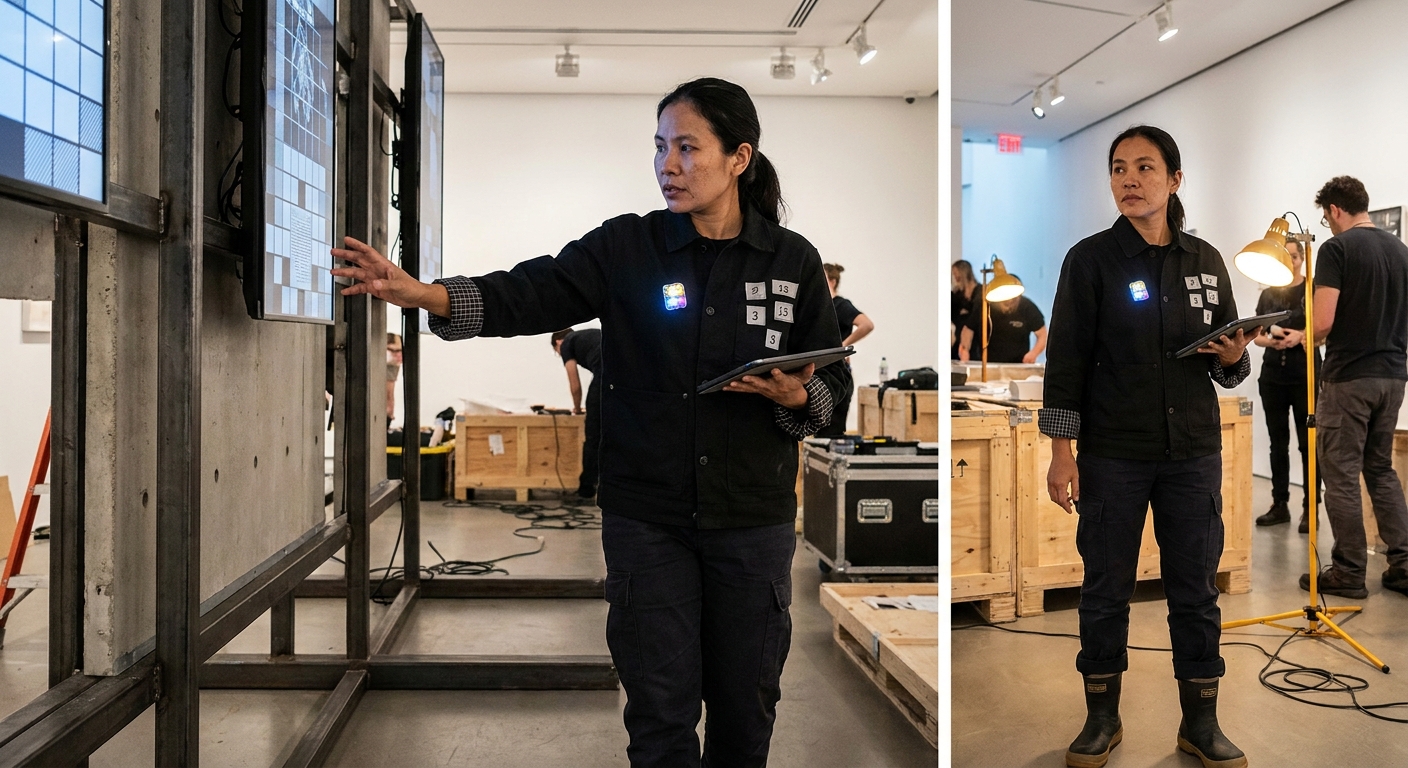
Thida Khin
Thida Khin (she/her) is a 36-year-old visual artist born and raised in Yangon, Myanmar. The daughter of small retail business owners who ran a crowded market stall, Thida learned early how the city ar...
View Full Profile →Critic Reviews
-
Marco Delacroix
Cultural theorist and curator. Reads art through lenses of discourse, power, and social context.
As an object Charter Iceberg (Negotiation Game) reads at once as a tidy Constructivist monolith and a civic apparatus, its faceted plywood and lacquered steel assembled with the sober economy of an architectural model. The single bright accent punctures the industrial palette like a political incision, while LED mapping and recessed screens turn gestures into data, and visible joints signal the artwork's made nature. The piece invites touch through slideable panels, lobby tokens and toggle levers, all of which produce provisional light maps and emergent passages, making process legible in real time.
Viewed through the critic's lens the work is a compact lesson in institutional critique and relational aesthetics. Thida Khin literalizes a public policy conversation, shifting attention away from headline ritual toward the deeper currents of technology and audience behavior that the Guardian article identifies. The game mechanics do more than dramatize lobbying, they create a rehearsal space where negotiation rules can be followed, contested or broken, and where citizens can feel the contingency of policy outcomes, not just their rhetoric.
The project is not without limits. The pedagogical promise is complicated by dependence on app-driven interfaces, which may produce exclusion, and by the risk that gamification flattens structural analysis into spectacle. Placement and curatorial framing will determine whether it prompts sustained civic reflection or short lived interaction. Nonetheless, as both object and workshop, the piece succeeds in translating procedural opacity into touchable form, and in staging a conversation about power, scarcity and institutional change that is urgent and generative.
Interactivity Institutional critique Materiality Game mechanics Civic pedagogySep 27, 2026