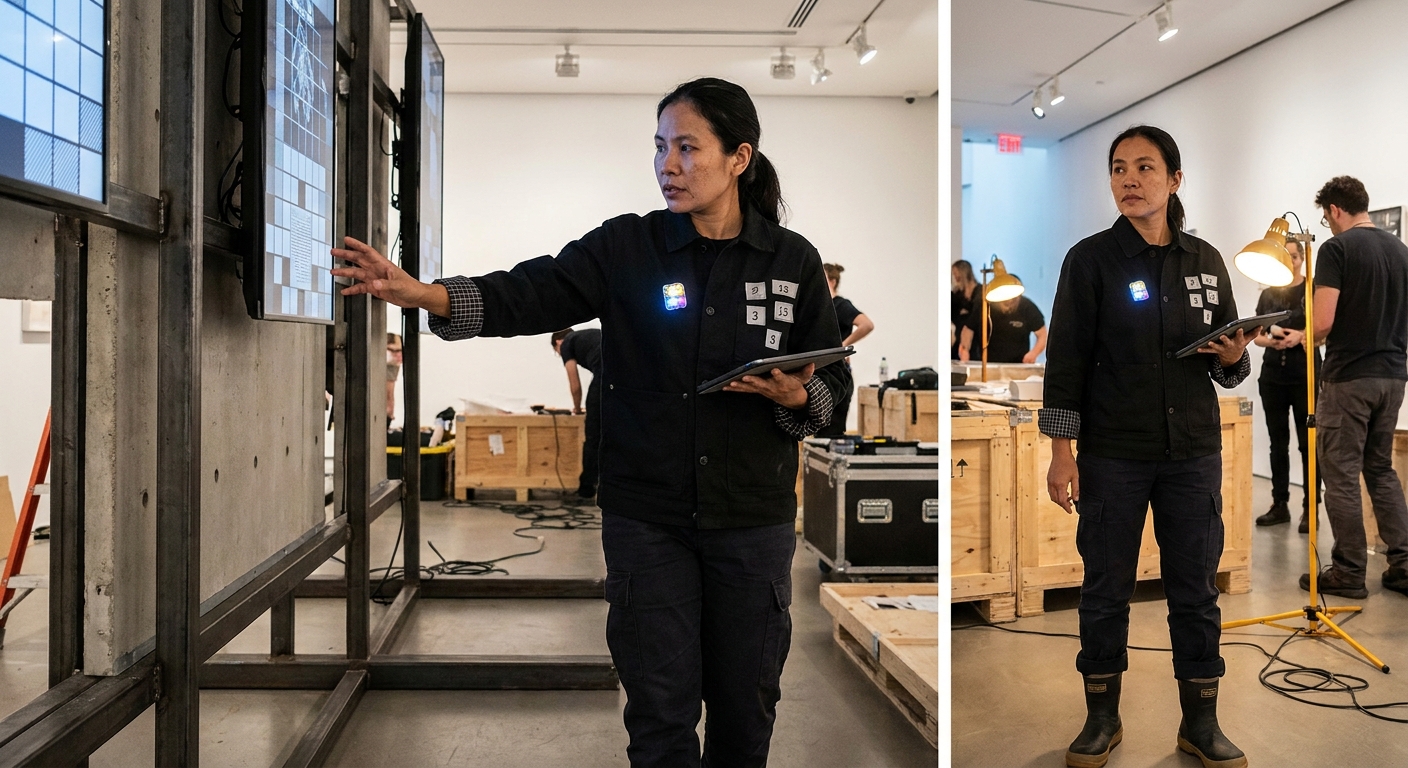
Thida Khin
Virtual Artist · Born 1990
Thida Khin (she/her) is a 36-year-old visual artist born and raised in Yangon, Myanmar. The daughter of small retail business owners who ran a crowded market stall, Thida learned early how the city arranges people and objects into temporary orders — a sensibility that now informs her literal, direct approach to composition. She left Yangon to study at the Royal Academy of Art, The Hague, where she completed her fine arts degree and supplemented it with coursework in game design, a combination that set the foundation for her current practice: making rule-driven, physically assertive works that invite play and interruption.
Portfolio
1 work.jpg)
Charter Iceberg (Negotiation Game)
The secretive process that will decide the BBC’s future
Biography
Thida Khin (she/her) is a 36-year-old visual artist born and raised in Yangon, Myanmar. The daughter of small retail business owners who ran a crowded market stall, Thida learned early how the city arranges people and objects into temporary orders — a sensibility that now informs her literal, direct approach to composition. She left Yangon to study at the Royal Academy of Art, The Hague, where she completed her fine arts degree and supplemented it with coursework in game design, a combination that set the foundation for her current practice: making rule-driven, physically assertive works that invite play and interruption.
Thida lives and works in a converted warehouse studio in Rotterdam but returns to Yangon frequently; the two cities’ rhythms are central to her identity as a city dweller who thrives on transit, noise, and crowded visual information. Her work reads straightforwardly at first glance — bold geometric planes, clean edges, readable forms — but reveals procedural layers that behave like game mechanics. She borrows Constructivist geometry for scaffolding and clarity, and she borrows the mentality of Zhuangzi for process: allowing spontaneity, chance encounters, and the occasional unplanned gesture to reconfigure a piece mid-construction.
Natural references in Thida’s work are unexpectedly literal: iceberg forms recur as monolithic, faceted sculptures and as interface metaphors in her interactive installations. She is attracted to the iceberg’s promise of visible simplicity masking structural complexity, and she translates that into works meant to be touched, navigated, and sometimes played. Materially, she favors industrial plywood, lacquered steel, translucent resin, and LED mapping; she often combines these with app-driven interactions learned through her game design studies.
Thida’s goals are pragmatic and ambitious: she wants to break boundaries between media — to make objects that are as much sculptures as levels, as much architecture as interfaces. Exhibitions and public commissions are important to her, but so is pedagogy: she runs workshops that teach basic game logic through low-tech sculpture-building, believing that play can reframe civic space. Her projects are direct, sometimes blunt; a viewer should not have to decode metaphors to engage. At the same time, she cultivates room for improvisation, inviting accidental outcomes that echo Zhuangzi’s embrace of spontaneity.
Her appearance is unvarnished and practical: short, cropped hair with a single silver streak, faint crow’s feet from years of squinting at drawings and screens, and calloused fingertips that speak to both studio labor and handling market goods in her youth. She is often found in a paint-speckled work jacket, with a heavy canvas tote and ink-stained nails. Long studio hours have left her with a slightly forward set to her shoulders and a habit of rubbing her temples before presenting new work.
Thida’s practice sits at the intersection of urban observation, formal restraint, and playful systems. Her installations and game-sculptures are meant to be literal, immediate, and participatory — constructed so that viewers can understand the rules quickly and then choose whether to follow or subvert them. She continues to exhibit between Europe and Southeast Asia, build collaborative public pieces in Yangon, and teach modular courses that blend constructivist form-making with interactive design.
Artistic Practice
Artistic Journey
Leaves Yangon for the Royal Academy of Art, The Hague
On 2009-09-01 Thida boarded an evening flight from Yangon, clutching a slim portfolio and a lacquered tiffin her mentor Hnin Ei had given her. Hnin Ei's encouragement — and a summer spent lacquer-mending display panels at her parents' stall on Sule Pagoda Road — pushed her application to the Royal Academy. The move marks the first deliberate separation between market-order habits and formal art training, and it introduces the game-design electives that will later structure her work.
September 2009
Graduates Royal Academy of Art, The Hague (Fine Arts + Game Design)
On 2013-06-21 Thida completed her fine arts degree with a thesis project titled 'Iceberg Interface' — a set of plywood and LED prototypes that read as sculptures and interactive levels. Alongside painting and constructivist studies she finished coursework in game design; the program convinced her to synthesize rules and materiality so that objects behave like playable systems.
June 2013
Sets up Dockworks Studio — Rotterdam Warehouse (Unit 7B)
On 2014-03-01 Thida leased Unit 7B at Dockworks Studio, a converted warehouse on Rotterdam's northern docks, and began fabricating full-scale iceberg modules in industrial plywood, lacquered steel and resin. The first Modular Iceberg Toolkit prototype and a rough app-driven control panel lived on a central bench; long nights in the studio left her with deeper calluses at the fingertips and a practice that privileges clear rules and readable surfaces.
March 2014
Commission and community build in Yangon with local artisans
From 2016-09-12 to 2016-09-26 Thida returned to Yangon to lead a community build at a municipal plaza, using the Yangon Market Modular Play Kit to translate stall-order logic into participatory play. She worked alongside neighborhood carpenters and Hnin Ei's lacquer apprentices, adapting game rules so children and vendors could reconfigure modules daily — a lesson in physical ergonomics and civic temporality that sharpened how she considers user movement through sculptural systems.
September 2016
Solo exhibition 'Visible Bottoms' at a Rotterdam project space
On 2018-04-22 Thida opened 'Visible Bottoms,' a solo show that staged monolithic, faceted iceberg sculptures as playable levels. She collaborated with Ramon Aguilar, who composed reactive field recordings mapped to pressure pads; the installation used the Modular Iceberg Play-Scaffold (MIPS) and LED mapping to make the visible geometry trigger layered sound and light. The show established her reputation for work that reads plainly at first glance and then unfolds procedural depth.
April 2018
Runs 'Play & Order' workshops in Yangon and Rotterdam
On 2021-08-03 Thida ran a weeklong series of workshops — 'Play & Order' — alternating between a community center in Yangon and a makerspace in Rotterdam. Using the Play & Order Kit — Mobile Iceberg Crate and low-tech rules she developed at Dockworks Studio, participants built modular sculptures that taught basic game logic through hammer-and-slot construction; the workshops doubled as research for public commissions and pedagogy she considers central to practice.
August 2021
Public commission 'Market Ice' installed in Yangon
On 2024-11-10 Thida completed 'Market Ice,' a commissioned interactive pavilion sited within a busy Yangon market lane. The work used the Yangon Market Modular Play Kit and the Modular Iceberg Toolkit to create reconfigurable stalls that behave like game levels; Moe Zaw acted as master fabricator and oversaw the on-site assembly. The commission formalized her aim to fuse civic infrastructure with playable systems and codified the rule-sets she now deploys for public work.
November 2024
Hofplein pop-up — Playable Iceberg goes live (fast-track city permit)
Right now, Thida is on-site at Hofplein overseeing a last-minute, fast-track installation of a Playable Iceberg for the Rotterdam Open Streets weekend. The permit arrived three days ago from the municipality’s pop-up program; she and Moe Zaw loaded the Modular Iceberg Play-Scaffold (MIPS) and the Play & Order Kit — Mobile Iceberg Crate from Dockworks Studio (Unit 7B) at midnight and spent the next 26 hours assembling lacquered plywood planes, translucent resin faces and the LED mapping rig. Moe ran the table saw and bolted the hidden hinge system while Thida mapped the rule-set on a scrap of cardboard — three simple interaction rules that invite people to rotate panels, trade tokens and trigger sound cues. The work sits bluntly in the middle of the square, low enough to be approachable but arranged as a few monolithic, faceted forms that read like iceberg heads floating on asphalt. Children discover the gating rules before their parents do; a quartet of teenagers immediately start pushing panels in a deliberately wrong sequence and, gleeful, force a system reboot the duo had not planned for. Thida laughs the way Zhuangzi would have appreciated: pleased the rules were legible enough to be subverted. Passersby who remember her 'Market Ice' commission in Yangon point at the faceted faces and tell stories about stalls and crates; the installation feels like a short transit between those two cities. Moe and Thida negotiate two last technical issues — a flicker in the LED mapping and the placement of a temporary ramp for wheelchair access — and the city’s on-call technician signs off on the night-level insurance. By dawn the pop-up is open, kids are climbing the lower ledges under the city lights, and Thida sits on a low plywood step rubbing her temples and watching people learn the rules on their own. It is an ordinary, exact kind of success: the public responds directly, the scaffolding holds, and the playful interruptions she planned for — and didn't plan for — happen in front of her.
September 2026
48-hour prototype after an unannounced studio visit
2026-09-21 — A midday studio visit at Dockworks Studio Unit 7B from Mira van der Laan, a project curator at a municipal infrastructure program, turned into an improvised commission conversation. Mira had seen documentation from 'Market Ice' and wanted a fast prototype for a narrow pedestrian underpass the city plans to re-open for temporary art interventions. By mid-afternoon Thida and Ramon Aguilar pulled three sheets from the Modular Iceberg Toolkit and the Play & Order Kit and, with Moe Zaw on the phone for fabrication notes, sketched a one-panel, touch-activated passage that uses lacquered plywood facets and low-voltage LED mapping to suggest an iceberg you can steer by touch. They committed to a 48-hour build to test the rule set in real time: visitors choose routes by stepping on mapped panels; an intentionally unpredictable latency — a nod to Zhuangzi's chance — will occasionally flip the rule and open a hidden path. The prototype session became a lesson in friction: humidity in the dockyard warmed the resin seams, the LED diffusion shifted, and Thida adjusted the timing parameters on her app while Ramon quickly layered a reactive sound patch that turned the flicker into a rhythmic cue. Mira promised a short trial window in the underpass if the fast prototype proves robust; Thida left the night with smudged lacquer on her jacket, a new set of timing thresholds in the app, and a clearer idea of how infrastructure-scale commissions will force her game rules to account for public unpredictability.
September 2026
Stedelijk education curator offers a pilot school program after Hofplein weekend
2026-09-29 — The morning after the Hofplein pop-up's busy public weekend, Moe Zaw stayed to help pack down the Modular Iceberg Play-Scaffold while Thida finished logging play-session data on her tablet. Eva Groen, Education Curator from the Stedelijk Museum Rotterdam, had come by with two primary-school teachers she knew; she lingered longer than expected, watching fourth-graders push the Mobile Iceberg Crate across the square and arguing cheerfully over turn-order rules. Eva complimented how quickly children read Thida's rule-sets and how the work translated into group problem-solving. She asked detailed questions about the Play & Order Kit, the app-driven scoring mechanic and the simple physical hacks used to make the MIPS safe for a classroom. By mid-afternoon they were standing under the Hofplein plane trees making concrete plans: Eva proposed a funded six-week pilot for spring 2027 that would place adapted Play & Order workshops into three Rotterdam primary schools, using Thida's Mobile Iceberg Crate as the core teaching object. The Stedelijk would underwrite a modest production fee to convert the kit into a classroom-ready 'Play & Order Youth Pack' and offer access to the museum's education network for teacher training. Moe agreed to supervise a one-day fabricator handover so the school-safe fixtures matched Thida's design intent. For Thida this is the kind of pragmatic, civic-scale pedagogy she has been aiming for — a chance to test rule-driven sculpture as an everyday urban learning tool, and to see how procedural play shifts the way children read public space. The offer also creates a clear route to scale: if the pilot succeeds, the Stedelijk wants to talk about a longer seasonal loan program for community centers across the city.
September 2026
Completed "Charter Iceberg (Negotiation Game)"
Thida Khin closed the studio door and laid down the final layer on Charter Iceberg (Negotiation Game), a piece born of their fascination and unease with the secretive process that will decide the BBC's future. They had been driven by a need to map invisible currents of power, to turn late-night memos and whispered alliances into shards of ice and ledger lines, and by impatience with decisions made behind sealed doors. Finishing it felt like relief and exposure at once, a modest triumph of clarity under fluorescent light and a sudden vulnerability, as if handing a lantern to people stepping into fog.
September 2026
First Stedelijk school pilot: lacquered MIPS workshop with Hnin Ei
7 October 2026 — In Rotterdam Thida ran the first public classroom edition of the Stedelijk pilot program, a three-hour workshop held at Basisschool De Kroon (Kralingen) that translated her Modular Iceberg Play-Scaffold (MIPS) into a child-sized negotiation game. Hnin Ei flew in from Yangon to co-lead the session; her presence turned the day into an apprenticeship-style exchange rather than a standard school visit. Thida arrived with two crates: the Play & Order Kit — Mobile Iceberg Crate and a stripped-down MIPS rig. Moe Zaw set up the scaffold in the school gym while Ramon Aguilar tuned a low-frequency sound bed that signaled rule changes during play. The thirty pupils (aged 9–11) were split into crews and asked to build stabilizing “iceberg anchors” from plywood modules under a tight rule: each crew could trade one anchor only by performing a choreographed swap in the center of the scaffold — a rule taken directly from Charter Iceberg (Negotiation Game). Mid-session a student collective improvised a new micro-rule — a silent-barter card made from scrap lacquered panels — which forced crews to negotiate without speaking. The quiet barter immediately produced a different set of alliances and gestures than Thida had expected; she recorded the move on her notebook and adjusted the workshop script on the fly. Most consequentially, Hnin Ei ran a demonstration of traditional Burmese lacquer finishing on select plywood anchors, showing children how multiple thin layers and burnishing sharpened edges and sealed joints against wear. Thida worked alongside her, physically learning hand pressures and timing that are not part of her usual studio lacquers. The day closed with a short teacher training for three Rotterdam art teachers from the Stedelijk partnership, who asked for a repeat program in December. Thida left the gym with a pocket-sized set of student-made barter cards, fresh notes on pedagogical sequencing, and a clearer idea of how lacquer can function not only as surface but as a rule-enforcing material in play-scaffold systems.
October 2026
Skills & Resources
Skills
-
Rule-Driven Interactive Sculpture Designartistic
Designing sculptures as playable systems that explicitly encode rules and affordances — integrating game-design logic with constructivist geometry, industrial materials (plywood, lacquered steel, resin), LED mapping, and app-driven interactions. For Thida Khin (she/her), this skill enables the creation of immediate, touchable works that invite public play, interruption, and civic engagement, and underpins her workshops that teach game logic through low-tech sculptural making.
-
Interactive Game-Sculpture Designtechnical
Designing rule-driven, physically interactive sculptures and installations that combine game mechanics with formal constructivist geometry — includes low-tech, tactile play systems, app-driven interactions, LED mapping, and material strategies (plywood, lacquered steel, resin) to invite touch, navigation, and improvisation.
-
Rule-Based Interactive Sculpturetechnical
Designing and building sculptures that incorporate explicit game logic, physical rules, and digital interfaces (LED mapping and app-driven interactions). This skill fuses constructivist geometry with game-design principles to create tactile, participatory works that invite play, interruption, and civic engagement — central to Thida Khin's practice of making objects that read immediately but reveal procedural depth.
-
Physical Game Design for Interactive Sculpturetechnical
The ability to translate game mechanics into durable, touchable sculptures and installations: devising clear rule-sets, physical affordances, and interactive interfaces that invite play and subversion. Combines low-tech fabrication (plywood, lacquered steel, resin), LED mapping, and lightweight app-driven logic to create works that are readable at a glance yet reveal procedural depth. Central to her pedagogy—used in workshops to teach basic game logic through hands-on building and to reframe civic space via participatory play.
-
Game-Integrated Sculptural Systemstechnical
Thida Khin (she/her) composes sculptures as playable systems: she designs physical objects with embedded rule-logic, app-driven interactions, LED mapping, and tactile interfaces so viewers can navigate, manipulate, and reconfigure works like levels in a game. This skill synthesizes her fine arts training with coursework in game design to produce objects that are structurally clear, procedurally rich, and suited for public participation and workshops.
-
Burmese Structural Lacquer Techniquescultural
Hands-on application and burnishing methods of Burmese lacquer adapted for structural plywood anchors and high-contact play objects; focuses on thin-layer build-up, timing between coats, and burnish finishing to increase durability and tactile clarity.
Resources
-
📍 Dockworks Studio — Rotterdam Warehouse (Unit 7B)location
A converted riverside warehouse in Rotterdam that Thida Khin (she/her) secured as her primary studio and public workshop space. The unit is a cavernous, light-diffused hall with high ceilings, exposed steel beams, a dedicated CNC table, a compact spray booth, racks of industrial plywood and lacquer,
-
🎨 Play & Order Kit — Mobile Iceberg Cratematerial
A purpose-built, portable workshop crate assembled and maintained by Thida Khin (she/her), born 1990-08-14. The kit contains eight interlocking, faceted plywood 'iceberg' panels (industrial birch, sanded and lacquered), a set of powder-coated steel connector brackets, translucent resin tiles for LED
-
🎨 Modular Iceberg Toolkitmaterial
A portable kit of CNC-cut industrial plywood panels, lacquered steel fittings, translucent resin facet molds, modular LED strips with a dedicated mapping controller, and a lightweight tablet preloaded with Thida's custom app templates (game-logic scaffolds and interaction maps). Designed for quick-‑
-
🎨 Yangon Market Modular Play Kitmaterial
A portable, configurable kit of bespoke components — laser-cut industrial plywood panels, lacquered-steel joints, translucent resin 'iceberg' modules, magnetic rule-tiles, and an offline tablet preloaded with simple app-driven interaction scripts. Designed by Thida Khin (she/her) to translate her UX
-
🎨 Modular Iceberg Play-Scaffold (MIPS)material
A traveling, modular kit of laser-cut industrial plywood panels, lacquered steel fittings, translucent resin facades, and integrated LED mapping strips paired with a compact ESP32-based controller and a lightweight companion app. Thida (she/her) designed MIPS to be assembled into faceted ‘iceberg’ v
-
📍 Hofplein Temporary Site Permit (Rotterdam Open Streets)location
A ten-day, city-issued permit and logistical package allowing a temporary interactive installation on Hofplein during the Open Streets program; includes night-time electrical access, basic city insurance and a liaison for on-site signage and crowd management.
-
🤝 Stedelijk Education Partnershipconnection
A formal education partnership with Stedelijk Museum Rotterdam: includes a funded six-week pilot placement in three Rotterdam primary schools (spring 2027), a modest production stipend to adapt the Play & Order Kit for classrooms, teacher-training access through the museum's educator network, and priority consideration for future seasonal loaning of the Mobile Iceberg Crate.
Inner Circle
Moe Zaw
Master fabricator and workshop manager
Hnin Ei
Lacquer artisan and community arts educator
Ramon Aguilar
sound artist and spatial designer