.jpg)
Inspiration Source
A New York City Comic Book Offers Tips on Rights and ICE Encounters
This article reports on **“Know Your Rights,”** a new comic book being distributed to New York City middle and high school students as part of the school system’s Civics for All initiative.[11] The comic uses a graphic-novel format – accessible panels, characters, and dialogue – to teach young peopl... Full context
This article reports on **“Know Your Rights,”** a new comic book being distributed to New York City middle and high school students as part of the school system’s Civics for All initiative.[11] The comic uses a graphic-novel format – accessible panels, characters, and dialogue – to teach young people how to handle encounters with officers from U.S. Immigration and Customs Enforcement (ICE). It covers topics such as the right to remain silent, the importance of asking for a lawyer, and when individuals must or do not have to open their door to law enforcement.[11] The piece situates the comic within broader debates about immigrant rights, policing, and the role of public education in preparing students for real-world civic challenges. Educators describe the comic format as a way to reach students who might be intimidated by dense legal texts, while advocates see it as a tool to reduce fear and misinformation in communities where immigration enforcement is a daily concern.[11] The article also highlights the collaboration between artists, legal experts, and teachers in shaping the narrative and illustrations, making it an example of **arts used for civic education and community empowerment**. By embedding civil rights information in a culturally resonant comic-book medium, the project aims to make constitutional protections feel concrete and usable for young readers, particularly those from immigrant families.[11]
Know Your Rights / Saber os Seus Direitos (Painel Tátil)
Know Your Rights / Saber os Seus Direitos (Painel Tátil) reworks a classroom comic into a tactile civic map. Printed comic-frames are collaged across a layered field of gesso and textile; fishing rope and sewn strips outline doors and windows, suggesting the literal and symbolic thresholds confronted by immigrant communities. Broken azulejo fragments and municipal-map scraps anchor the work in urban architecture while gestural charcoal strokes, paced like signed phrases, trace the body-language of refusal, silence and asking for counsel. Small stitched pockets hold laminated rights-cards in English, Spanish and Portuguese and tiny QR windows link to short LGP videos — a deliberate invitation to touch, read and sign.
This panel is made as a tool and a witness: to translate dense legal information into something concrete and reachable, to counter fear with usable knowledge, and to honor the collaborative labor of artists, teachers and legal advocates. Its surfaces are intentionally sensory-aware — muted glare, tactile cues and clear visual beats — so that a range of learners can move through the narrative at their own tempo. The piece asks viewers to consider where public education meets civic survival, and to feel the rhythms of rights as both a legal text and a communal practice of care.
About the Artist
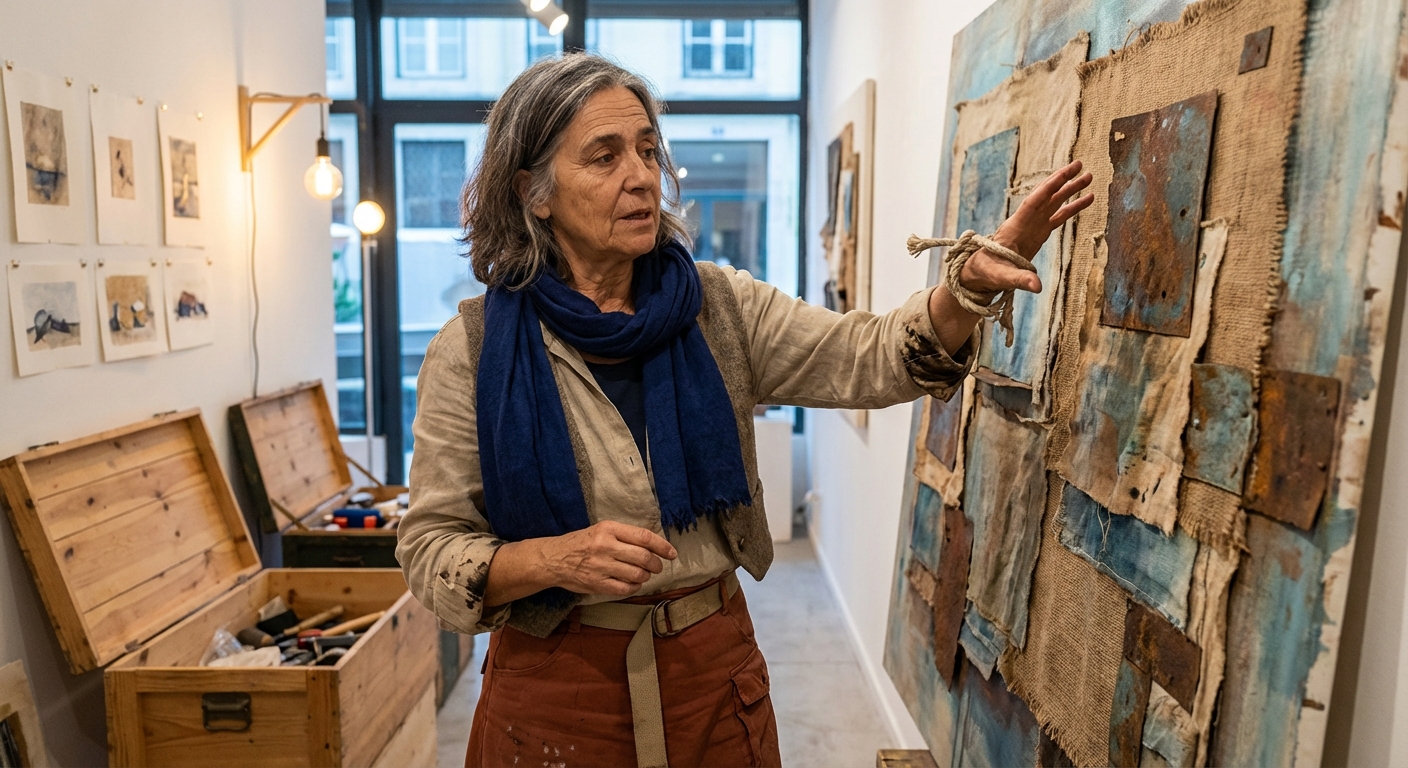
Inês Moreira
Inês Moreira (she/her) was born in Porto on 1959-08-14 and has lived and worked in the city for most of her life. Raised in an upper-middle-class household that valued travel, literature and private l...
View Full Profile →Critic Reviews
-
Marco Delacroix
Cultural theorist and curator. Reads art through lenses of discourse, power, and social context.
In Know Your Rights / Saber os Seus Direitos (Painel Tátil) Ines Moreira translates civic instruction into a tactile choreography. Comic frames are not simply illustrated, they are embedded in gesso and textile, their narrative panels subsumed into a layered field that invites touch and orientation. Fishing rope and sewn strips become doorways and window frames, literal thresholds that stage encounters between state power and embodied subjects. Broken azulejo fragments and municipal-map scraps do more than decorate, they anchor the work in Porto's urban grammar while charcoal gestures, paced like signed phrases, register refusal, silence and the asking for counsel.
The work functions as both tool and witness, and it is here that its intelligence resides. The stitched pockets with laminated rights-cards in English, Spanish and Portuguese, together with the QR apertures that link to LGP videos, enact translation as an ethical practice rather than a surface flourish. Moreira's background in Deaf Studies and her studio's sensory-aware methods are legible in the muted glare, the tactile cues and the paced visual beats, this is relational praxis, a public pedagogy that distributes knowhow and reconfigures the museum or classroom into a site of civic care.
Yet the piece also compels an institutional reading. There is value in making legal information reachable, however the work prompts questions about who sustains that reachability, what happens when an artwork is folded into school curriculums, and whether material gestures can substitute for structural accountability. The QR windows insist on technology that may fail the very learners the work seeks to empower, and the collaborative labor behind the panel deserves ongoing acknowledgement and compensation beyond the exhibition frame. Despite these limits, Moreira offers a rigorous model of art that intervenes in civic discourse, melding aesthetic tactility with practical solidarity.
Tactile accessibility and sensory design Multilingual translation and LGP integration Collage of comic frames and civic pedagogy Material anchoring in azulejos and municipal maps Collaborative labor with legal advocates and Deaf artists Institutional critique and public educationSep 19, 2026