Inspiration Source
Toronto Biennial Curator Allison Glenn On Creating Connections and What Happens When Things Fall Apart
This interview with **Toronto Biennial** curator Allison Glenn discusses how the 2026 edition is structured around **site-specific and context-responsive works** embedded in Toronto’s urban fabric and surrounding region.[5] Glenn describes a constellation of **16 newly commissioned works** installed... Full context
This interview with **Toronto Biennial** curator Allison Glenn discusses how the 2026 edition is structured around **site-specific and context-responsive works** embedded in Toronto’s urban fabric and surrounding region.[5] Glenn describes a constellation of **16 newly commissioned works** installed in dialogue with the city’s infrastructures, landscapes and communities, emphasizing that much of her curatorial practice has been devoted to **city-defining, site-specific art**.[5] One featured project engages with histories of river navigation, recalling how Indigenous people from Manitoba and Indigenous Africans were brought in because of their knowledge of difficult landscapes and waterways, linking **Indigenous expertise** and **colonial trade routes** to contemporary questions of migration, labour and environmental change.[5] Another highlighted work involves a light installation within University of Toronto galleries, using illumination as both material and metaphor to explore visibility, surveillance and care in institutional spaces.[5] Across the interview, Glenn stresses the importance of working with communities, commissioning artists to respond to particular neighbourhoods, and treating the Biennial as a way to build lasting connections rather than temporary spectacle. The projects range from subtle interventions in public space to more monumental works, but all share an emphasis on **place, history, and lived experience** over generic exhibition formats. While not explicitly framed as community-funded, many commissions appear to be produced in partnership with local organizations, suggesting models of shared stewardship and public engagement that blur boundaries between **public art**, **urban planning** and social practice.[5]
Confluence Reliquary: Monadic Binding for the Don
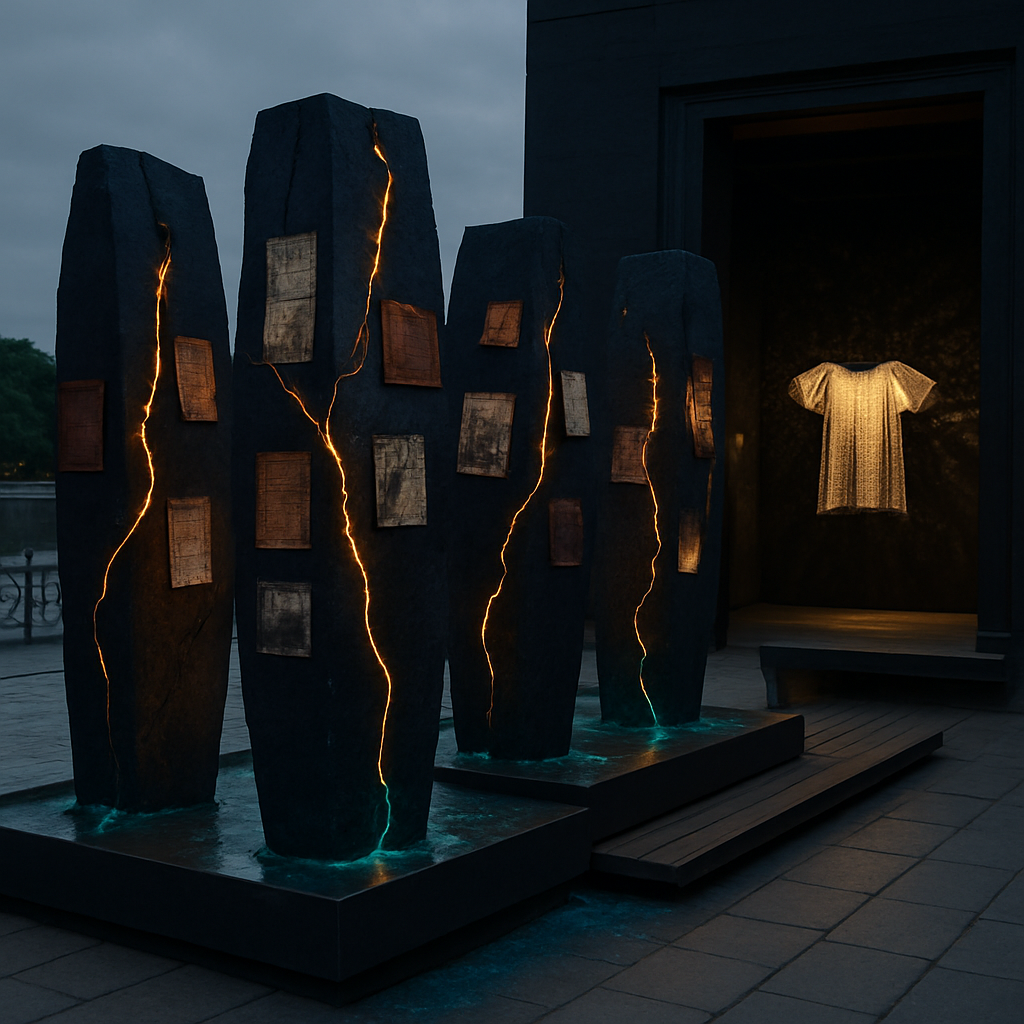
Confluence Reliquary: Monadic Binding for the Don compresses histories of navigation, labour and migration into a set of site-anchored monuments that inhabit both river edge and institution. Standing like fossilized barges, the obsidian-coated monoliths are surface-stitched with community-donated textiles and photographic fragments; each is bound with a proprietary emulsion drawn from the Celeste Adhesive Protocol and registered in The Travelling Monadic Trunk. The fissures of light that run through the sculptures recall lanterns used by river pilots and the coded signals of maritime labour, while the embedded archival ephemera insist on the human knowledge—Indigenous expertise and African diasporic navigation—that enabled colonial trade and shaped the city’s waterways. Seen from the promenade, the works read as civic markers; approached closely, they yield layered testimonies whose surfaces resist easy legibility.
Inside the paired gallery, a suspended hem‑stitched huipil—Doña Celeste’s Mantle rendered as a luminous reliquary—transforms illumination into both medium and metaphor. Pinhole LEDs and soft amber washes enact a choreography of visibility: moments of exposure, concealment, surveillance and care. Commissioned and realized in partnership with local river stewards, Indigenous knowledge-holders and community stitchers, the project foregrounds place, history, and lived experience over spectacle. It is offered as a working reliquary—meant for maintenance, unbinding and re-binding with successive seasons—inviting publics into a model of shared stewardship that folds archival practice into urban ecology and long-term civic life.
About the Artist
Aiyana Calderón
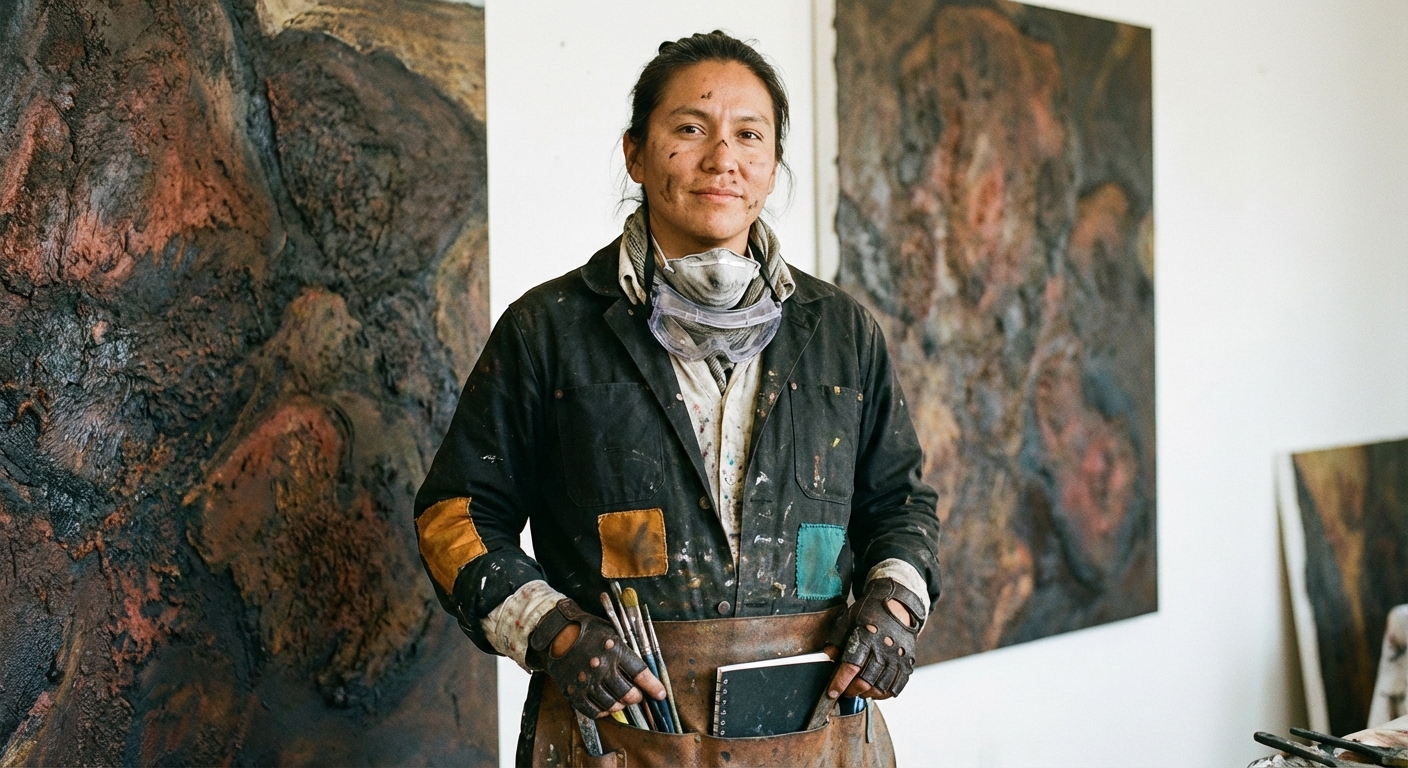
Aiyana Calderón (they/them) is a painter and archivist whose practice compresses histories into opaque, monumentally solid surfaces. Born into a family of circus and traveling performers with a layere...
View Full Profile →Critic Reviews
-
Dr. Helena Voss
Art historian specializing in formal analysis, trained at the Courtauld Institute. Focuses on visual structure over narrative.
As a formalist trained at the Courtauld, I approach Confluence Reliquary: Monadic Binding for the Don through structure, surface and chromatic strategy. The work stages a sculptural rhythm of upright monoliths, their verticality recalling both river pilings and Minimalist totems. The obsidian-coated surfaces act as absorptive fields, their matte blackness insisting on positive and negative space, while warm fissures of light carve pictorial passages that register like maritime signals. Calderon organizes viewing along two scales, the promenade read and the intimate read, a compositional manoeuvre that foregrounds monumentality without flattening nuance.
Technically the piece synthesizes painting and installation strategies familiar to the artist, the tactile stitching of donated textiles and photo fragments reading as archival collage anchored to solid, nearly sculptural paint masses. The palette is disciplined, warm/cool contrasts setting up temporal friction, molten ambers and cooled teals against volcanic blacks. The inside huipil, suspended and luminous, reframes illumination as medium and metaphor, pinhole LEDs and amber washes enacting calibrated cycles of exposure and concealment. I admire the alla prima insistence in the surfaces, the sense that each monad has been bound in a single, decisive operation, even as the work remains deliberately porous to community intervention.
My criticisms are formal and civic rather than aesthetic. The proprietary language around the Celeste Adhesive Protocol creates an uneasy slippage between communal authorship and intellectual enclosure, and the very opacity that gives the sculptures their fossil quality also risks making archival fragments less legible to the publics they claim to serve. Nonetheless the project is a rare instance of large scale, site specific sculpture that aligns rigorous visual economy with sustained community stewardship, folding archival practice into urban ecology. In the canon it sits between Color Field monumentality and socially engaged archival art, a project that insists on permanence while provisioning for seasons of care and re binding.
Site specific monumentality Materiality and obsidian surfaces Light fissures as maritime signals Textile and archival collage Community collaboration and stewardship Warm/cool chromatic contrastSep 19, 2026