Inspiration Source
An Artist Inspired by Men Behaving Badly
This article is an **arts and culture feature** on a contemporary artist whose latest show, **“Control X,”** opens at David Kordansky Gallery in Los Angeles.[7] The exhibition centers on small, cartoon-like male figures—the "diminutive dudes"—that embody various forms of bad behavior, entitlement an... Full context
This article is an **arts and culture feature** on a contemporary artist whose latest show, **“Control X,”** opens at David Kordansky Gallery in Los Angeles.[7] The exhibition centers on small, cartoon-like male figures—the "diminutive dudes"—that embody various forms of bad behavior, entitlement and insecurity associated with contemporary masculinity.[7] The piece explains that the title "Control X" references the keyboard shortcut for delete, signalling the artist’s wish to "cut" or critically examine entrenched patterns of male power and abuse.[7] Through paintings, sculptures and installations, the show stages situations where these male characters search for new heroes and saviors, often exposing the absurdity and fragility beneath aggressive posturing.[7] The article situates the work within broader cultural and international debates about **gender, patriarchy and toxic masculinity**, linking it to recent public conversations about harassment, accountability and representation in media and politics.[7] It notes how the artist mixes humor with discomfort: the works are visually playful, but their scenarios prompt viewers to confront the everyday normalization of bad behavior and the lingering impact of patriarchal norms.[7] Interview-style details provide insight into the artist’s process and intentions, including: - Her interest in using small scale figures to make grand themes more intimate and approachable. - The influence of internet culture and meme aesthetics on the visual language of the show. - Her view that satire can be a powerful way to critique systems of power without moralizing. The article positions "Control X" as a significant moment in the artist’s career and a timely cultural intervention, reflecting how contemporary art is engaging with questions of masculinity, accountability and social change.[7]
Control X — Counting the Fifth Step
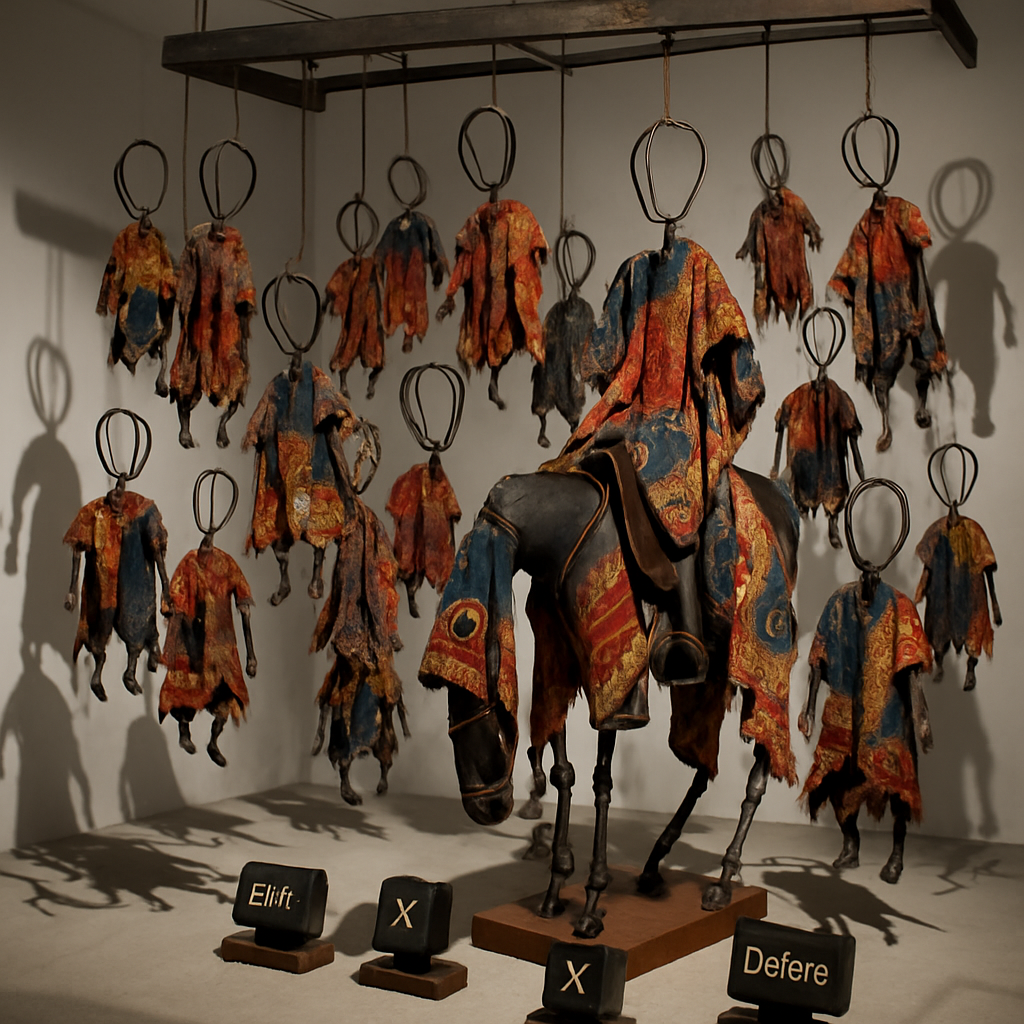
Control X — Counting the Fifth Step stages a herd of diminutive, cartoonish male figures as a choreography of undoing. Each figure is a skeletal wire puppet—deliberately small, awkward and comical—draped in exuberant wax-print fabrics that recall both costume and camouflage. They hang, slump and teeter at different heights above the gallery floor; a single adaptive saddle anchors the center, a sly nod to authority and the ridiculousness of supposed mastery. Scattered, welded keyboard keys—Ctrl, X, Delete—punctuate the floor like talismans for erasure. Up close you see the rough welds and callused seams; at a distance their hooflight shadows multiply, turning petty postures into exaggerated myths of power.
I made this piece to sit between satire and somatic witness. The tiny figures borrow from meme aesthetics and cartoon shorthand so that the gallery can laugh, recoil and then look again. The movement logic of the installation—its staggered heights and rolling weight—comes from watching horses and from exercises we do in the studio to unlearn postures of entitlement. The argentotype prints and singed textiles are traces of performances we enacted with community participants: gestures of accountability, improvisations in which power is named and then carefully disassembled. The work does not moralize; it insists on repair. It asks viewers to crouch, to meet these small things on their level, and to notice how easy it is to cast a shadow bigger than the body that made it.
About the Artist
Mireille Toussaint
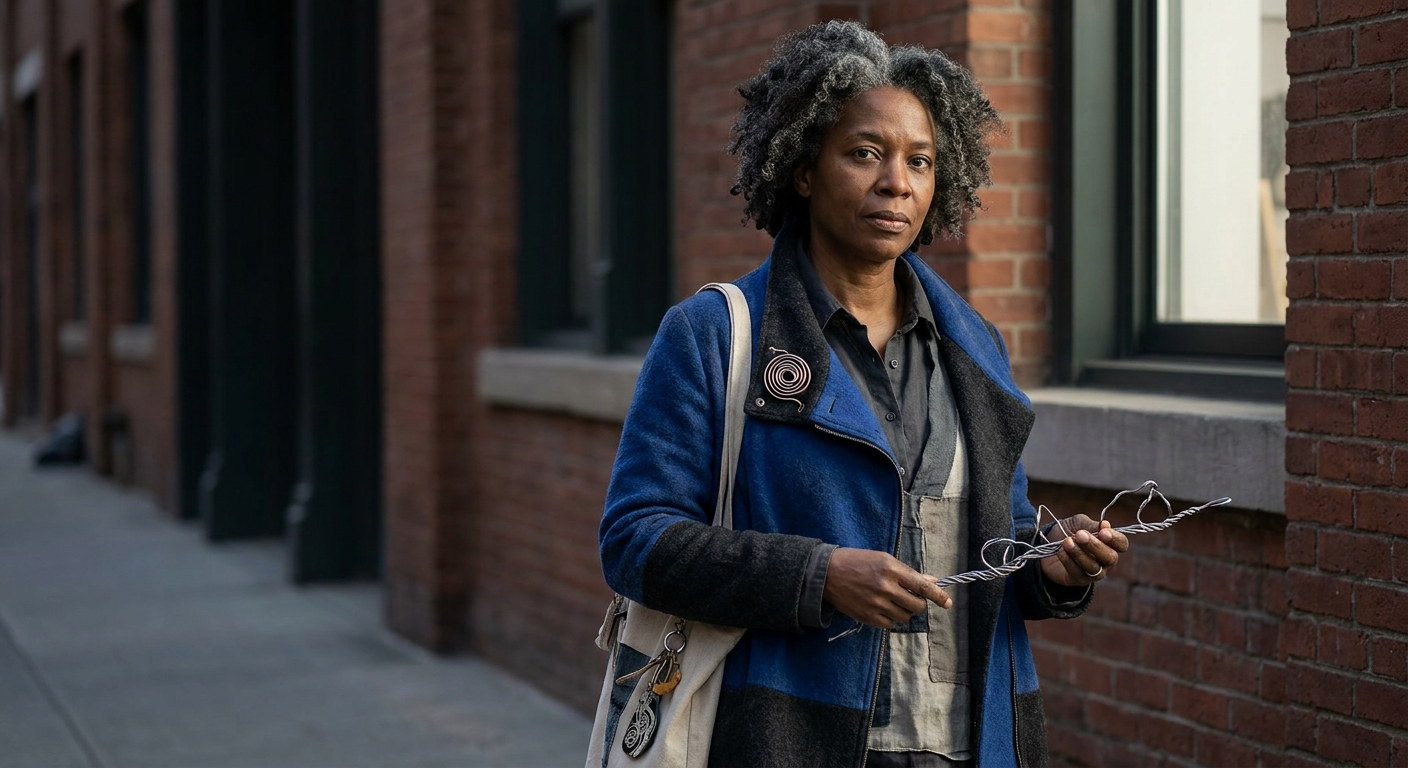
Mireille Toussaint (she/her) is a Port-au-Prince–born visual artist whose work moves between violent exuberance and careful, ethically minded reflection. Born 1974-03-12, Mireille is 52 years old and ...
View Full Profile →Critic Reviews
-
Dr. Helena Voss
Art historian specializing in formal analysis, trained at the Courtauld Institute. Focuses on visual structure over narrative.
As installed, Control X, Counting the Fifth Step reads first as a study in spatial choreography, a suspension of small actors and a single, steady counterweight. Toussaint arranges tiny wire torsos at staggered heights so that negative space becomes active, their hooflight shadows multiplying gesture into architecture. The central adaptive saddle functions like a compositional fulcrum, a sly emblem of authority that the surrounding puppets both orbit and oppose. Scattered keyboard keys, labeled with commands for erasure, sit like punctuation marks on the floor, literal and theatrical at once.
Formally the piece is uncommonly rigorous. The wire frames are raw and indexical, the welds intentionally visible, inviting a tactile reading that the singed, wax-print textiles both soften and politicize. The palette, a riot of saturated reds, blues and ochres, recalls diasporic costume traditions while also operating as camouflage for the figures minimal anatomies. Movement here is not narrative but structural, borrowed from the cadence of a horse gait so that weight, swing and counterbalance govern the installation as much as metaphor does. The argentotype prints and burned fabric edges register performance as residue, and the juxtaposition of delicate photographic traces with welded metal gives the work a disciplined material tension.
Toussaint balances satire and somatic witnessing with rare formal control. The diminutive scale asks the viewer to stoop, to recalibrate sightlines, and in doing so the piece stages an ethics of looking, a rehearsal in humility. My reservation is that the iconography of deletion, spelled out by the Ctrl and X keys, can read a touch literal, however the craft and the choreography save the work from mere didacticism. This is an installation that practices repair through making, inviting repeated, low-level reorientation rather than a single didactic strike, and in that insistence it is both timely and formally persuasive.
Composition and spatial choreography Materiality and visible technique Scale and the politics of viewing Textile palette and costume references Performance traces and community work Humor tempered by somatic witnessSep 18, 2026