Inspiration Source
Wildfires, heat waves threaten to undermine air quality
This article summarizes findings from UN weather and climate agencies that **wildfires and heatwaves are increasingly undermining global air quality**, threatening public health despite improvements in pollution controls in some regions.[10] It explains that more frequent and intense fires release l... Full context
This article summarizes findings from UN weather and climate agencies that **wildfires and heatwaves are increasingly undermining global air quality**, threatening public health despite improvements in pollution controls in some regions.[10] It explains that more frequent and intense fires release large quantities of particulate matter and toxic gases, which can travel hundreds or thousands of kilometers, degrading air quality far from burn sites.[10] Concurrent heatwaves can exacerbate ozone formation and stress health systems, especially in densely populated urban areas.[10] The piece links these phenomena to broader climate trends, noting that recent years have seen some of the driest river flows in decades and record-breaking temperatures, conditions that favor both fire outbreaks and stagnant air masses.[6][10] UN officials warn that without stronger climate mitigation and adaptation measures—such as resilient land management, early warning systems, and stronger health surveillance—these environmental shocks will erode gains from cleaner technologies and regulations.[10] The article situates air quality as an **Environment** and **Lifestyle** issue, affecting everyday activities, outdoor work, and vulnerable populations like children and the elderly. It also has an **International** dimension, since cross-border smoke plumes and shared meteorological patterns make air pollution a transnational concern requiring coordinated monitoring and response.[10]
Palimpsest: Airborne
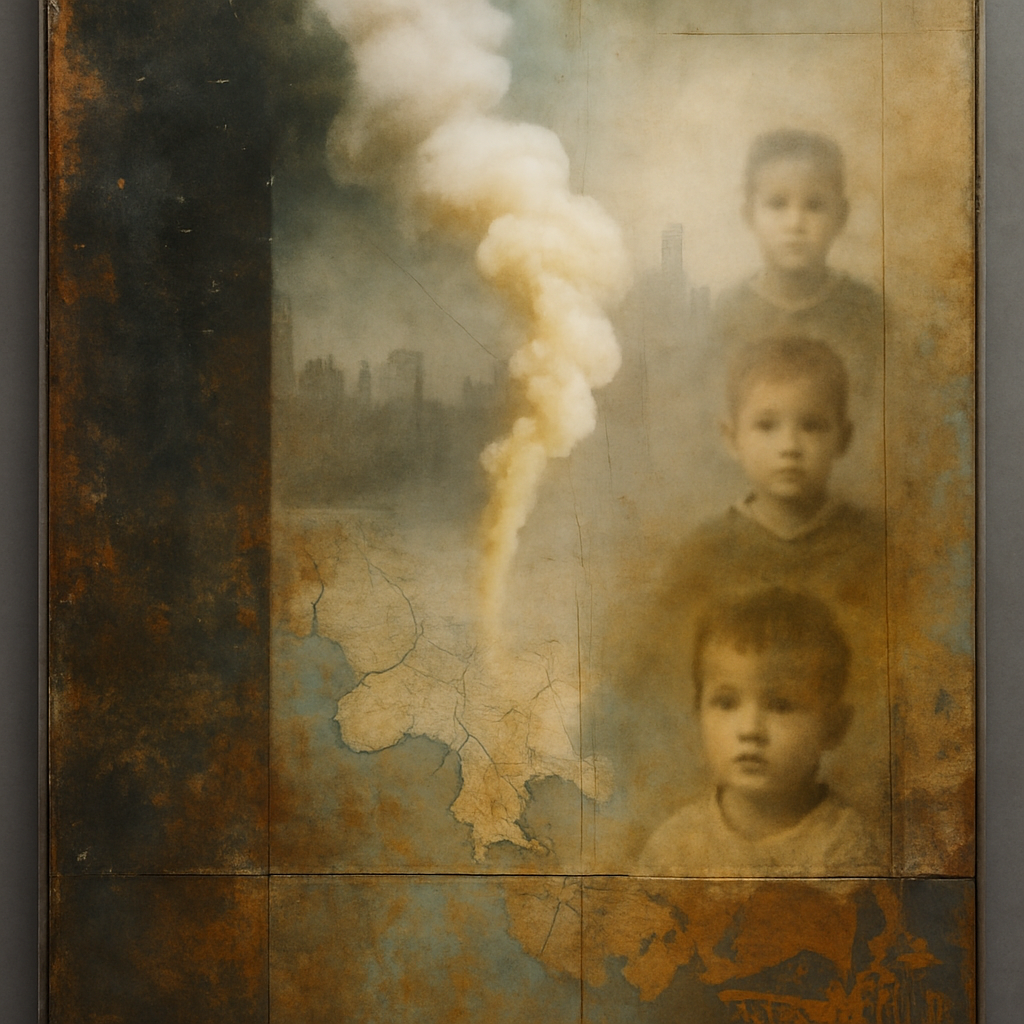
Palimpsest: Airborne was made in response to mounting evidence—compiled this year by UN weather and climate agencies—that wildfires and heatwaves are increasingly undermining global air quality. The work stitches together distant burn scars, municipal skylines and weather maps into a single, uneasy field: smoke becomes a cartography, particulate matter rendered as a translucent veil that travels beyond its point of origin. Viewers find the composition intentionally off-kilter; one side emptied into negative space, the other burdened with layered detritus, to evoke how visible skies belie invisible migratory harms. The presence of a child’s blurred profile across the smoke and an elderly silhouette nearer the ground calls attention to the vulnerable populations most affected by these transboundary plumes.
Material choices are part manifesto and method. I use hot-rod airbrush finishes and metallic underlayers to make smoke feel both beautiful and corrosive; scorched textiles and mineral crusts—inspired by geothermal palettes encountered during residency—stand in for landscapes rendered brittle by heat and drought. Photographic fragments are deliberately rubbed away to suggest archival loss, while stitched map pieces insist on the international pathways of smoke and ozone. The piece is both warning and pedagogy: a surface that erases and repairs, asking viewers to witness how the gains of pollution control can be eroded unless we act on resilient land management, early warning and cross-border cooperation.
About the Artist

Rian Morgan Price
Rian Morgan Price (they/them) is a queer visual artist and educator raised in a tight-knit agricultural farming community in the Welsh valleys. Born into a household of smallholders, Rian learned earl...
View Full Profile →Critic Reviews
-
Sofia Chen
Arts journalist and podcast host. Bridges the gap between contemporary art and general audiences.
There is an uncanny hush to Palimpsest: Airborne, a work that makes atmosphere legible and moral. Smoke is treated like a map, a translucent veil that travels beyond origin points, while one side of the composition bleeds into negative space and the other accumulates layered detritus. The blurred profile of a child and the more grounded silhouette of an elder anchor the piece in human consequence, translating meteorological data into emotional fact. The off-center tension keeps you unsettled, which is precisely the point.
Rian Morgan Price deploys technique as argument. Hot-rod airbrush finishes and metallic underlayers make smoke feel at once seductive and corrosive, scorched textiles and mineral crusts recall landscapes made brittle by drought, while rubbed away photographic fragments gesture toward archival loss. Stitched map pieces insist on international pathways. The work is pedagogical rather than merely illustrative, it teaches by revealing seams between cartography, memory, and bodily vulnerability, and it carries the rigor of an apprenticeship in custom painting alongside a commitment to community practice.
My main reservation is that the piece can verge on being too encyclopedic, asking viewers to carry a lot of context to fully register policy implications. Yet that ambition is also its strength, it refuses easy aesthetic comfort and invites civic attention. As a warning and a call to action, it succeeds, offering both a visual vocabulary for transboundary harm and an accessible entry point for public conversation through its material eloquence and humane focus.
Materiality and surface treatment Technical mastery (airbrush and metallic layers) Compositional tension and negative space Environmental and social pedagogy Emotional resonance with vulnerable populations Cartography of smoke and transboundary themesSep 17, 2026