Inspiration Source
"Never Forget" is not a slogan': Mamdani designates 9/11 Day of Remembrance and Service
This Guardian news article explores New York City Mayor **Zohran Mamdani’s decision to formally designate September 11 as a Day of Remembrance and Service**, illustrating how governments construct and modify ritual frameworks for communal memory.[3] The report explains that Mamdani will sign **two ... Full context
This Guardian news article explores New York City Mayor **Zohran Mamdani’s decision to formally designate September 11 as a Day of Remembrance and Service**, illustrating how governments construct and modify ritual frameworks for communal memory.[3] The report explains that Mamdani will sign **two executive orders** ahead of the 25th anniversary. The first order sets aside time on September 11 for a **moment of silence** honoring victims, first responders, survivors, city workers, and families affected by the attacks.[3] It also encourages city agencies to organize **memorial ceremonies, educational programming, and other remembrance activities**, turning remembrance into an annual civic obligation.[3] By institutionalizing these practices, the city embeds **mourning and communal memory** into administrative routines: schools, libraries, and public offices are expected to participate, ensuring that remembrance is not limited to those who attend the Ground Zero ceremony.[3] Educational components imply **intergenerational storytelling**, as younger New Yorkers learn about the attacks through programs designed by city agencies.[3] Although the piece is focused on policy rather than on-the-ground ritual, it gestures toward **ritual and spiritual practice** by noting that the orders support ceremonies and moments of silence that may take place in religious institutions as well as secular spaces.[3][9] The article indirectly touches on **fragility, illness and bodily endurance** through its inclusion of survivors and those with 9/11‑related health problems in the commemorative remit, aligning civic ritual with recognition of long‑term physical suffering.[3][9] From the perspective of your topics, the strongest connections are: - **Mourning and communal memory:** Legal and administrative instruments are used to formalize how the city remembers the attacks each year, ensuring continuity across political administrations.[3] - **Community-based stewardship:** City agencies are tasked with curating events and educational material, effectively stewarding the narrative of 9/11 for future generations.[3] - **Intergenerational storytelling:** Educational programming mandated by the orders helps transmit stories of the attacks and their aftermath to young residents who did not experience them firsthand.[3] The article shows that **communal memory is not solely organic or spontaneous**, but actively shaped by policy decisions that determine where, when, and how citizens are encouraged to remember.[3]
Moment of Salt: Municipal Shroud for September 11
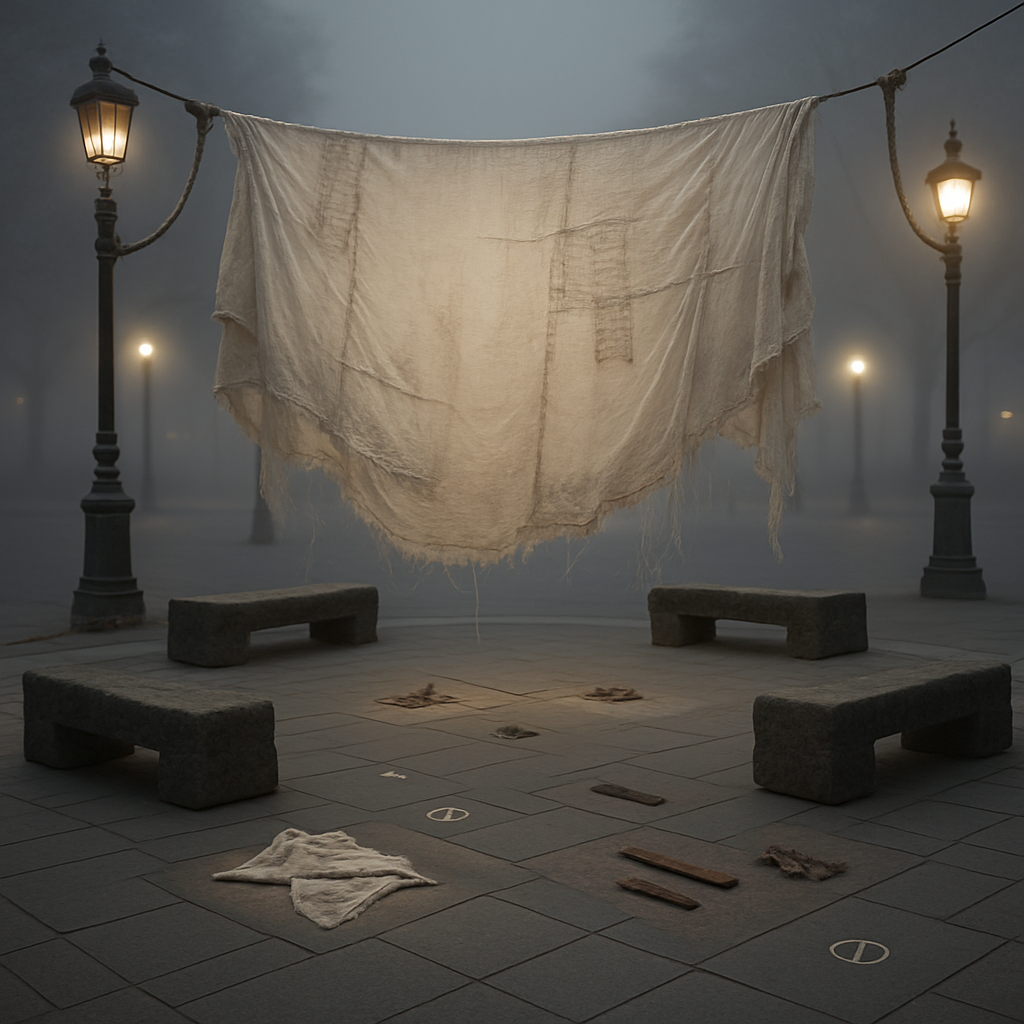
Moment of Salt began as a question: how does a city make mourning part of its civic bones? Installed in a municipal plaza, the work is a communal shroud stitched from donations and relics — cloth recovered from processions, a fragment from the north cove, rusted nails from storm salvage — and repaired with hair‑threaded stitch marks that form my signature Interrupted Stitch Line. The salt crust and ash dust the fabric like fossilized tear-lines; the barnacle rope anchors point back to coastal economies of salvage and care. Over its surface, the visible mending names fragility as political: the piece both invites and resists the neatness of administrative ritual, offering a place where moments of silence, testimony and slow repair can be enacted together.
The work is conceived as civic scaffolding as much as sculpture. City agencies and schools are invited to use the shroud for commemorative programming, while a companion Maré layer—built with oral histories and locative storytelling—allows visitors to tap into survivor testimonies, first‑responder recollections and children’s learning modules, tracing each textile fragment’s provenance on a shared map. In this way Moment of Salt stages intergenerational storytelling, honors long‑term bodily endurance, and models a practice of stewardship: the shroud is replenished annually by community mending circles and recorded in the app, so remembrance becomes a living municipal habit rather than a single ceremonial act.
About the Artist
Anika Santos
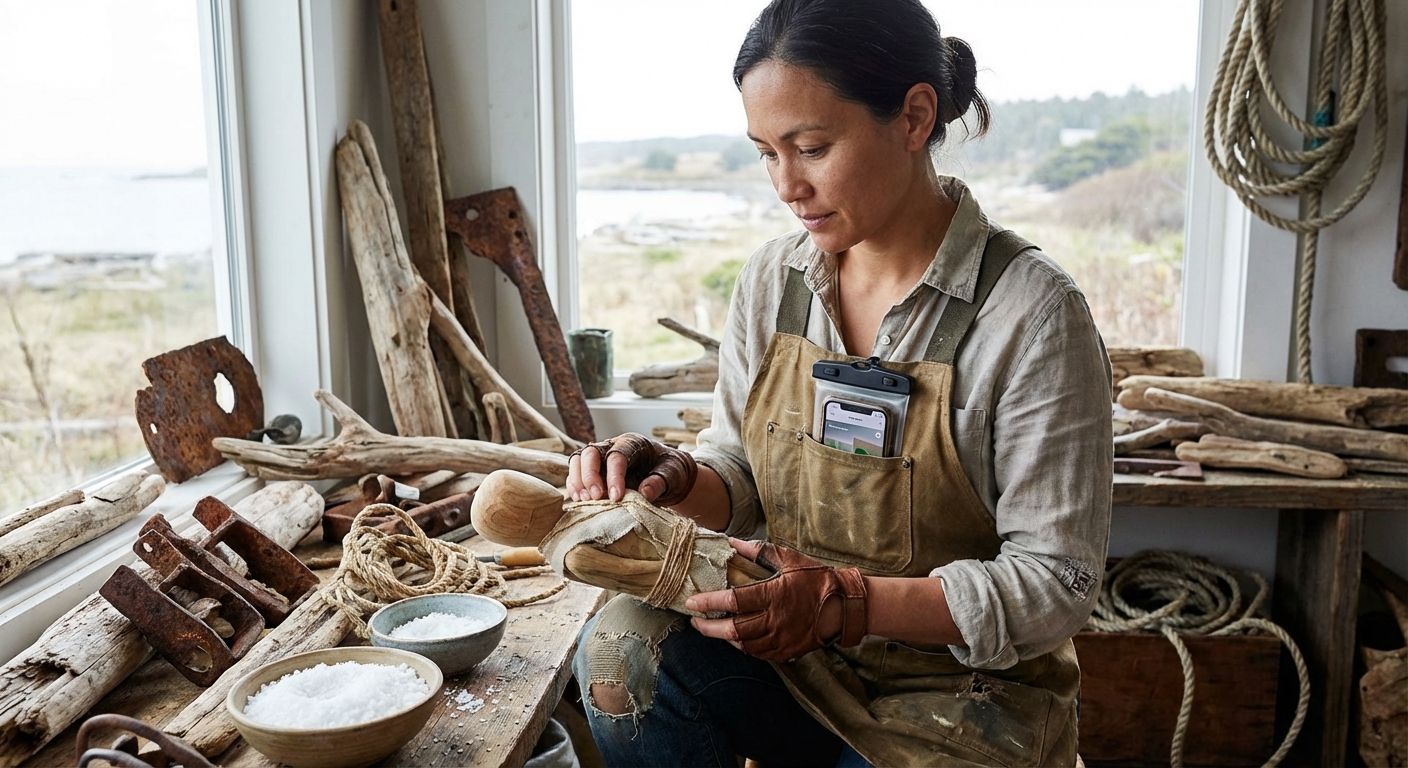
Anika Santos (she/her) is a sculptor and app-artist working at the intersection of folk practices, land-based interventions and intimate, care-driven objects. Raised in a tightly knit coastal town whe...
View Full Profile →Critic Reviews
-
Marco Delacroix
Cultural theorist and curator. Reads art through lenses of discourse, power, and social context.
I read Moment of Salt as an institutional proposition first, and as a tender craftwork second. Anika Santos rigs mourning into civic infrastructure, stitching a communal shroud from salt crusted cloth, barnacle rope, rusted nails and hair threaded repairs that carry a vernacular archive of loss. The Interrupted Stitch Line reads like a diagram of political fragility, visible mending that names vulnerability as a public matter, not a private pathology. Installed in a municipal plaza it occupies the awkward liminal space between altar and municipal furnish, calling bodies to pause while refusing the neat closure of bureaucratic ritual.
The Maré app layer and the promise of annual mending circles convert the piece into a durational practice. As a curator and cultural theorist I admire how the work translates relational aesthetics into municipal pedagogy, scaffolding intergenerational storytelling through locative testimony and provenance mapping. The coupling of slow, local materials with AR storytelling is formally smart, it amplifies the tactile politics of salvage economies and bodily endurance, and it models stewardship rather than spectacle. Yet the same coupling raises real questions. Who curates the oral histories on the app, who vets consent, and how might municipal stewardship calcify into narrative gatekeeping or a sanitized civic script? There is an anxious proximity between care and administration that Santos stages well, but does not resolve for us.
For all its poetic force, Moment of Salt is haunted by procedural demands. Its strengths are ethical as much as aesthetic, it asks institutions to become caretakers rather than exhibitors, and it proposes a living ritual rather than a monument. But that livingness requires transparent governance, survivor centered protocols, and a refusal of commodified remembrance. As a municipal artwork it is generative and necessary, provided those civic conditions are met and maintained with the same humility evident in the work itself.
Municipal ritualization Material provenance and salvage Intergenerational storytelling Community stewardship and mending App enabled testimony and locative mapping Visible mending as political gestureSep 13, 2026