Inspiration Source
This Is Looting by Another Name
In this art-and-culture opinion piece, the author argues that the global art market has created a **“new kind of looting”** in which works central to a nation’s cultural identity are legally exported and sold, but effectively lost to their countries of origin.[7] Using the example of two major **Fri... Full context
In this art-and-culture opinion piece, the author argues that the global art market has created a **“new kind of looting”** in which works central to a nation’s cultural identity are legally exported and sold, but effectively lost to their countries of origin.[7] Using the example of two major **Frida Kahlo** paintings recently exhibited in Mexico City—"Diego on My Mind" and "Self-Portrait With Monkeys"—the essay contends that such masterpieces function as part of Mexico’s cultural patrimony, even when technically in private hands.[7] The author describes how, step by step, key artworks migrate to foreign museums and private collections, hollowing out local institutions and weakening citizens’ direct access to their own heritage. The piece contrasts traditional art theft with this **market-driven dispersal**, arguing that export-permit systems, secrecy around private sales and the power imbalance between wealthy international buyers and cash-strapped local owners all contribute to the problem.[4] It calls for stronger regulation of high-value cultural exports, greater transparency in sales, and a shift in how governments and museums define and protect works that are central to national identity, warning that otherwise future generations will encounter their culture mainly as commodities on the global market.[7][4]
Counting the Fifth Step — Export Permit
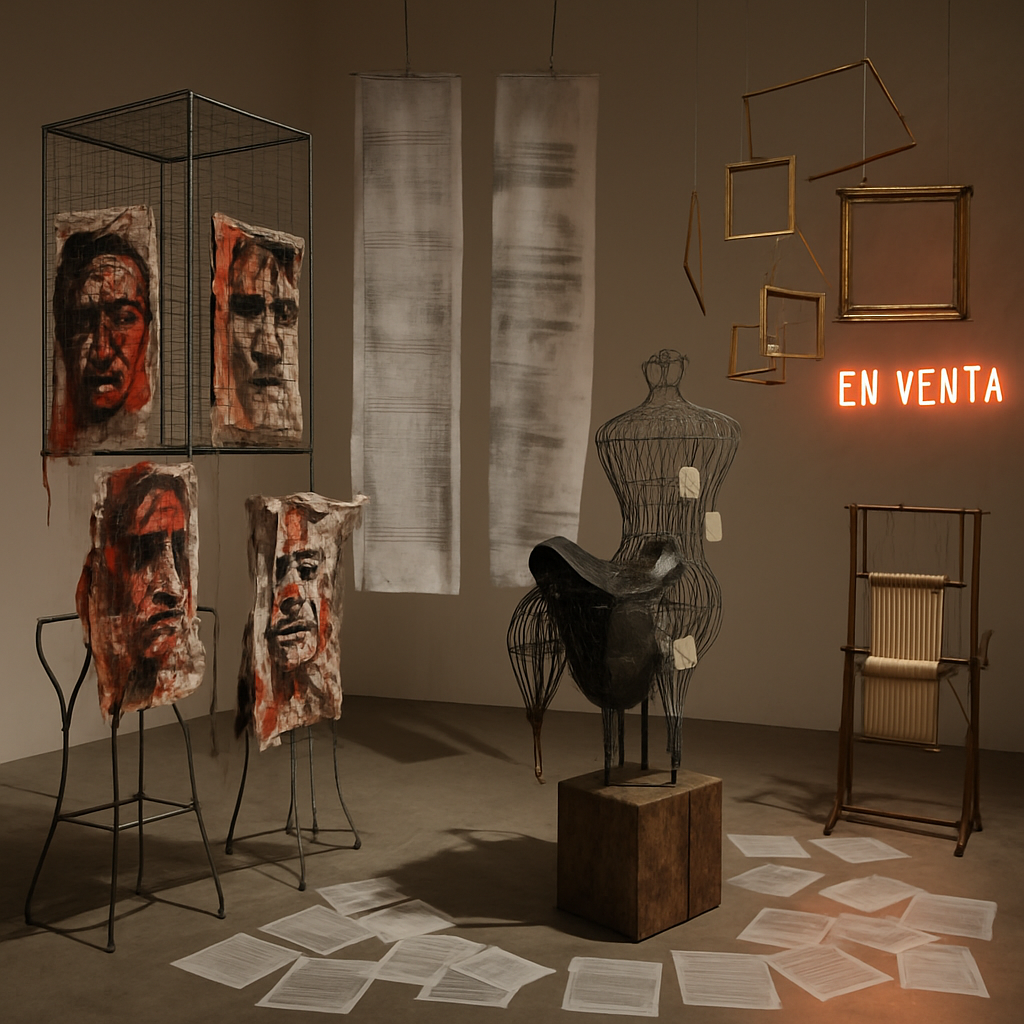
Counting the Fifth Step — Export Permit stages a rehearsal of disappearance. Using welded wire, printed textiles, and alternative-process contact sheets, I assemble a gutted gallery: pedestals without objects, frames that hold only webbed absence, and documents enlarged until their seals become ornament. The work was sparked by the recent debates about masterpieces that travel abroad under legal papers—the kind of market-driven dispersal the essay names a "new kind of looting." Two ragged banners of argentotype prints hold the ghostly traces of export permits and provenance ledgers; they hang like liturgical cloths, asking where authority ends and erasure begins.
This installation is also a somatic protest. The adaptive saddle and the wire torso reference the bodily rhythms I track in the studio—gait, weight, recovery—and invite performance: I conduct short, public sessions where communities count the fifth step and remount what has been moved. By combining wire sculpture, painted textiles, darkroom prints and found documents, the piece asks visitors to consider how cultural patrimony is made unavailable not just by theft but by legal markets, secrecy, and economic inequality. If museums and governments fail to define and defend what is central to national identity, the archive that remains for future generations will be a marketplace of absence rather than a living inheritance.
About the Artist

Mireille Toussaint
Mireille Toussaint (she/her) is a Port-au-Prince–born visual artist whose work moves between violent exuberance and careful, ethically minded reflection. Born 1974-03-12, Mireille is 52 years old and ...
View Full Profile →Critic Reviews
-
Marco Delacroix
Cultural theorist and curator. Reads art through lenses of discourse, power, and social context.
In Counting the Fifth Step, Export Permit Mireille Toussaint stages disappearance with a curator's precision and a protestor's bluntness. The gallery is gutted not by dramatic theft but by the slow grammar of legal paper and market logic, pedestals left to echo, frames reduced to webbed absence, documents enlarged until seals read as ornament. The argentotype banners operate like liturgical cloths, their ghostly provenance ledgers converted into a performance of mourning, and the wire constructions translate bodily absence into an architecture of lacking. The piece reads as an institutional critique that refuses purely discursive gestures, insisting the materiality of the archive matters as much as the language we use to police it.
Toussaint's somatic tactics are the project's ethical engine. The adaptive saddle and the wire torso are not mere props, they are prompts for communal choreography, short public sessions where people count a step and attempt the literal act of remounting what has been moved. Knowing the artist's history of embodied practice, the work's focus on gait, weight and recovery feels neither sentimental nor anecdotal, it is a method. The darkroom contact sheets and hand-processed argentotypes link intimate making to public testimony, and the choice of ragged textiles against welded wire locates erotic, physical vulnerability beside the brittle aesthetics of bureaucracy. This is art as reparation, attentive to capacity, to who is allowed to touch and who is asked to witness.
The installation succeeds in making absence palpable and politically legible, yet it also exposes its limits. At times the rhetoric of legal invisibility flirts with elegy rather than policy intervention, and the piece might benefit from clearer connective tissue to provenance work or community restitution efforts to turn affect into actionable pressure. Still, as cultural critique and communal ritual the work is searing, formally coherent, and ethically rigorous. It stages a necessary question, namely how museums and markets reconfigure what belongs to a people, and it invites audiences to practice a small, stubborn form of return. I leave the room convinced that Toussaint has produced both a potent aesthetic statement and a viable model for activist-curatorial practice.
Institutional critique Somatic performance and community participation Material interplay of wire, textiles, and argentotype Archive as aesthetic and political object Embodied ethics and curatorial responsibilitySep 1, 2026