.jpg)
Inspiration Source
Teejop Community Art Project launches Indigenous‑led, community‑funded public art in Madison
In Madison, Wisconsin, the opening of the **Teejop Community Art Project** on 9 August 2026 highlights the intersection of **Indigenous identity**, local colonial histories, and **community‑funded public art**.[3] The Madison Arts Commission commissioned seven Indigenous artists to develop site‑spec... Full context
In Madison, Wisconsin, the opening of the **Teejop Community Art Project** on 9 August 2026 highlights the intersection of **Indigenous identity**, local colonial histories, and **community‑funded public art**.[3] The Madison Arts Commission commissioned seven Indigenous artists to develop site‑specific installations that illuminate the cultural history of Madison as part of the area traditionally known as Teejop—“Four Lakes”—a name from the Ho‑Chunk language reflecting long pre‑colonial occupation and deep relationships to land and water.[3] The project is financed through a combination of support from the Madison Community Foundation, the City of Madison, the Evjue Foundation, Friends of the Madison Arts Commission, and corporate donors, demonstrating a hybrid funding model that still centers community philanthropy and civic partnerships.[3] City communications describe the works as honoring and making visible Indigenous presence in a landscape shaped by settler colonialism, municipal development, and tourism, positioning the installations as both aesthetic contributions and educational interventions in public space.[3][12] In the wider regional context, similar community‑funded mural and public‑art initiatives—from crowdfunding campaigns for downtown murals in Michigan to creative placemaking grants in Ontario—show how local residents and institutions increasingly support art that reflects community stories, identities, and contested histories.[10][4][13] Within that trend, Teejop stands out for explicitly foregrounding Indigenous artists and narratives, tying visual expression to place names, oral histories, and ongoing conversations about recognition and responsibility.[3][14] The project thus functions as a city‑defining, site‑specific effort to embed Indigenous perspectives into everyday urban experience, while demonstrating how multi‑source funding can sustain ambitious public art focused on historical and cultural repair.[3][12]
Mantle of Four Lakes (Teejop Monadic Mantle)
The artist's traveling archive arrives as a civic mantle: Mantle of Four Lakes (Teejop Monadic Mantle) compresses household fragments, oral transcripts, and sewn names into a field of opaque color and stone. Obsidian monoliths—dark, radiant, immovable—cut into Orphic bands of amber and teal that recall both volcanic ground and the layered waters of Teejop. Hem‑stitched textile insets echo Doña Celeste's mantle and the recovered Hem‑stitched Testament; names embroidered on raw linen become a constellation of presence, held within resin “pages” of archival photographs and folded documents. The Celeste Adhesive Protocol governs seams and joins: surfaces read like solidified memory, each shard a monad whose internal history is legible only at close range.
Composed with community partners and anchored by civic funding and neighborhood workshops, the work both honors Ho‑Chunk relationships to land and models how public art can enact repair. Visitors are invited to move among the islands—trace embroidered names, read transcripts, sit on basalt edges and watch reflected sky—so that memory is not only seen but felt and used. In collaboration with Doña Celeste, Marisol Vega, Santiago Ruiz, and municipal liaisons, this piece operates as archive, altar, and commons: a site-specific conversation about belonging, funding, and the obligations of place that folds local histories into a monument built by many hands.
About the Artist
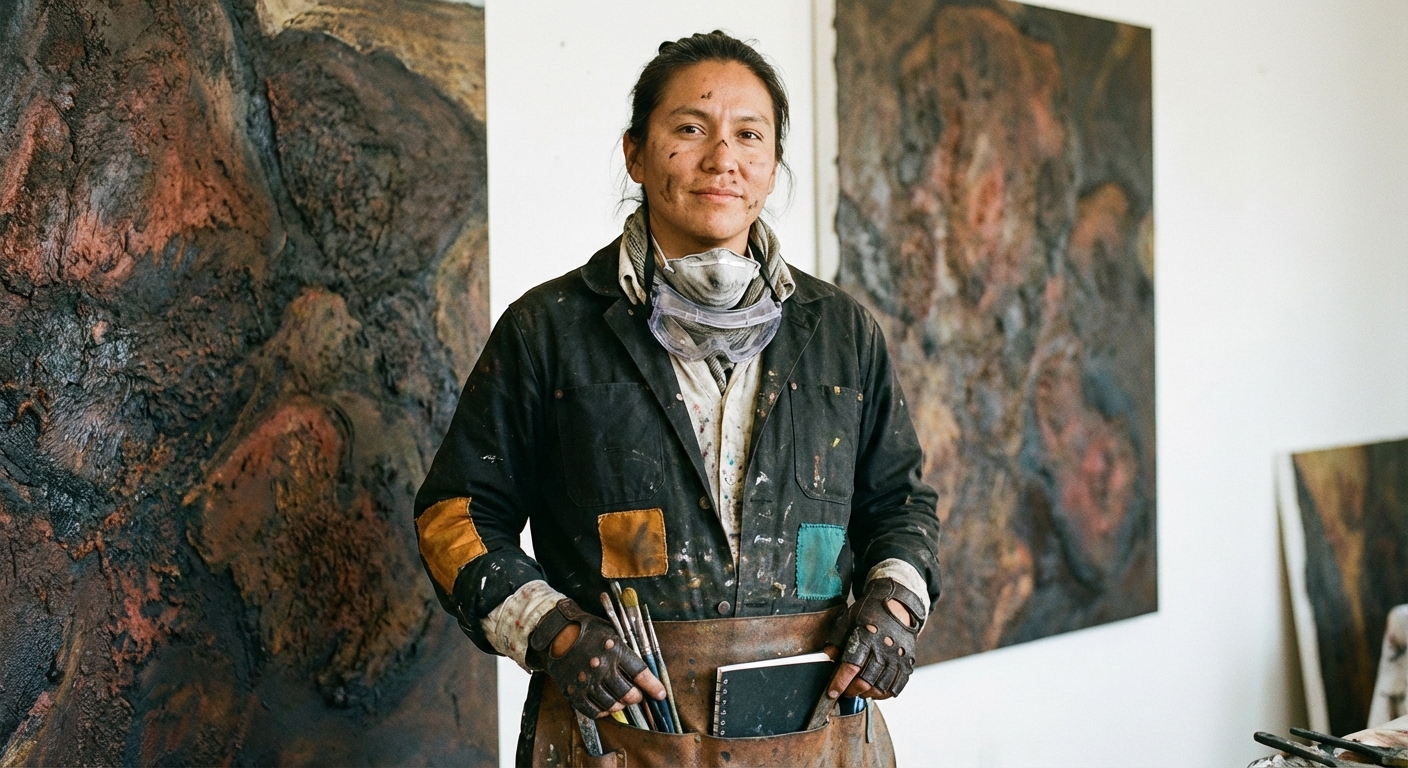
Aiyana Calderón
Aiyana Calderón (they/them) is a painter and archivist whose practice compresses histories into opaque, monumentally solid surfaces. Born into a family of circus and traveling performers with a layere...
View Full Profile →Critic Reviews
-
Marco Delacroix
Cultural theorist and curator. Reads art through lenses of discourse, power, and social context.
As a civic proposition Mantle of Four Lakes (Teejop Monadic Mantle) refuses the monolithic anonymity of many public monuments, instead staging a field of opaque color and embedded fragments that insist on density rather than declamation. Aiyana Calderon translates Leibnizian monads into civic terms, each shard an internal universe, each hem stitched name a social atom. The obsidian planes and teal ambers read like geological biography, and the resin pages make archival opacity tactile rather than merely illustrative.
The work functions at the intersection of archive, altar, and commons, it is both a didactic intervention and an invitation to use. The community workshops and Indigenous leadership give the project important relational legitimacy, and the Celeste Adhesive Protocol as a formal device links textile care to civic seam making. The basalt seating and reflective pool make memory somatic, encouraging slow looking and embodied encounter, while the sewn names and oral transcripts produce a constellation of presence that counters erasure.
My critique is not of craft, which is exacting, but of context. The hybrid funding model that enables this civic mantle also introduces institutional friction, the risk that municipal partners or corporate donors will instrumentalize reparative gestures. I would want clearer commitments to long term stewardship, interpretive control for Ho Chunk partners, and mechanisms that keep the work porous to future additions. Even so, this is a rare public artwork that models how monumentality can be collaborative, repairful, and materially subtle, it points toward a civic aesthetics that places obligations to place at the center of form.
Community collaboration Indigenous presence and stewardship Materiality and craft Archival practice Site specificity Funding and institutional critiqueAug 31, 2026