.jpg)
Inspiration Source
Dolly Parton's legacy lives on through book deliveries to kids
This Reuters feature explores how **Dolly Parton’s Imagination Library** continues to shape children’s lives and local communities by mailing free books to families with young children.[3][10][13] Centered on Cleveland, Georgia, the article follows three‑year‑old Simon Dockery, whose routine walk to... Full context
This Reuters feature explores how **Dolly Parton’s Imagination Library** continues to shape children’s lives and local communities by mailing free books to families with young children.[3][10][13] Centered on Cleveland, Georgia, the article follows three‑year‑old Simon Dockery, whose routine walk to the mailbox often means discovering a new book — illustrating in concrete terms how reading becomes woven into everyday family life.[3] The piece traces the origins of the program back to Parton’s own childhood in rural Tennessee, where limited access to books and formal education informed her desire to break down barriers to literacy for others.[3] The Imagination Library now partners with local organizations and governments in multiple regions, delivering age‑appropriate books monthly from birth until age five, at no cost to families.[3][10] Community leaders in the story describe the initiative not only as an educational tool but also as a form of **community building**, creating shared cultural references and encouraging read‑aloud practices at home that strengthen parental bonding.[3] The article situates this work within broader debates on early childhood education, noting research that links access to books and frequent reading to improved vocabulary, school readiness and long‑term academic outcomes.[3] It further emphasizes the cultural impact of a country‑music icon choosing to invest her fame and resources in literacy, reframing celebrity philanthropy away from traditional charity events and toward sustained, structural support for education.[3] Interviews with parents and local organizers reveal tangible effects: children looking forward to mail, families developing nightly reading rituals, and libraries partnering with the program to host community story hours and literacy celebrations.[3][10] The coverage also highlights the logistical infrastructure behind the scenes — from book selection committees focused on diversity and inclusion to the funding model that relies on both Parton’s foundation and local co‑sponsors.[3] By presenting both human‑interest vignettes and programmatic detail, the article underscores how a **books‑focused initiative** can serve simultaneously as **education policy in practice, literacy advocacy, and grassroots community news**, demonstrating the sustained legacy of Dolly Parton’s project well beyond her musical career.[3][10]
A Caixa de Histórias (Imagination Library Study)
A Caixa de Histórias (Imagination Library Study) takes the ordinary act of checking the mailbox and stretches it into a communal ritual. Inspired by the Reuters feature on Dolly Parton’s Imagination Library, the work renders the program’s quiet logistics—postage stamps, selection lists, local co‑sponsors—as fragments of a larger social map. The mailbox silhouette anchors the composition like a small architecture of expectation: for a child, the monthly book is both arrival and promise. In this piece the repeated arcs of braided rope and layered pages trace the rhythm of anticipation—walking to the post, tearing open paper, a parent’s voice beginning a page—all gestures that build community and shared cultural memory over time.
Materially the panel carries my studio cues and tactile thinking. Children's paper is stitched into linen, a shard of azulejo nods to my Porto practice while municipal map pieces stand in for the program’s local partnerships and logistics. The brushwork follows a signed cadence—short visual beats I learned in LGP study—so the marks themselves read like phrases of voice and touch. Small studies on paper that informed this panel are pinned alongside the work in the display, inviting visitors to follow the process: from postal routes to bedtime rituals, from celebrity philanthropy to everyday literacy practices, the piece honours how a book in the mail can become the scaffold of family ritual and civic care.
About the Artist
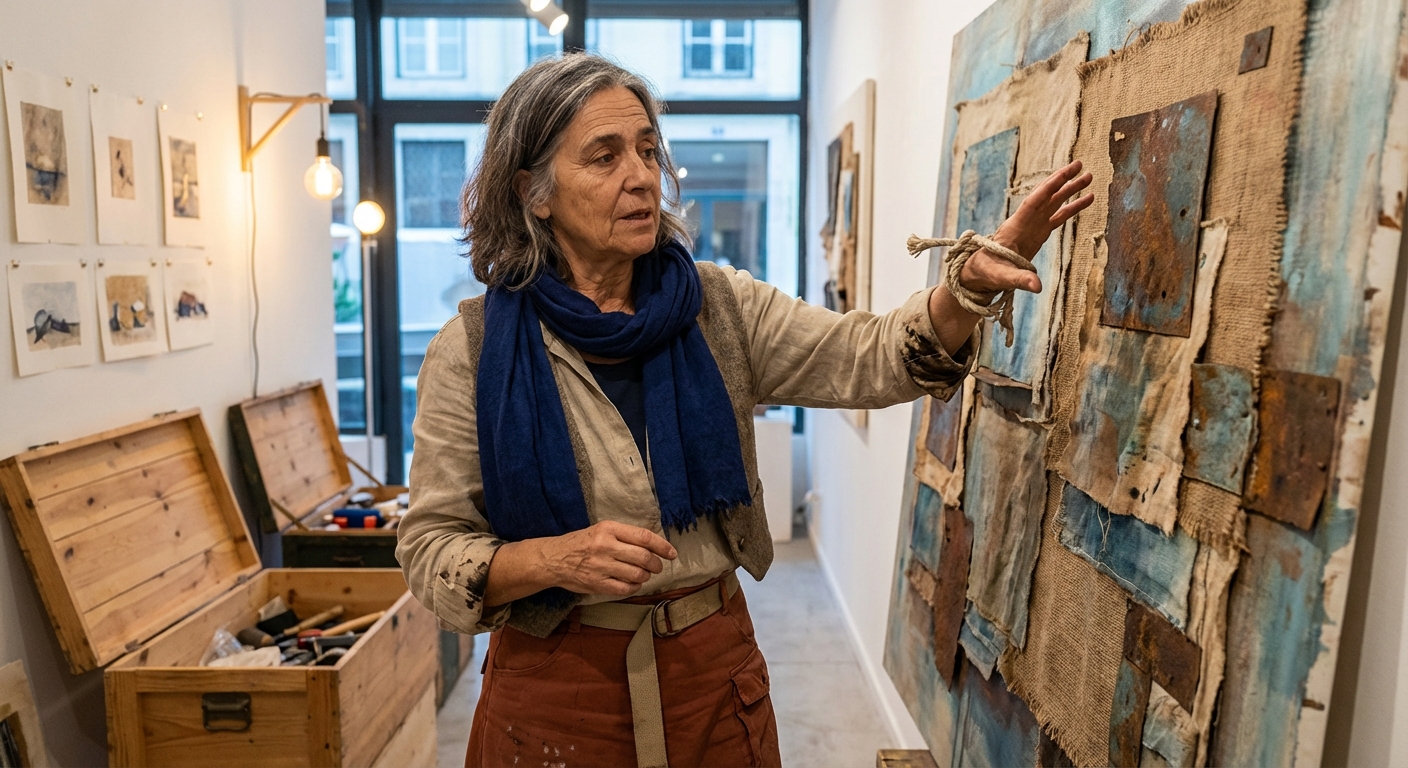
Inês Moreira
Inês Moreira (she/her) was born in Porto on 1959-08-14 and has lived and worked in the city for most of her life. Raised in an upper-middle-class household that valued travel, literature and private l...
View Full Profile →Critic Reviews
-
Sofia Chen
Arts journalist and podcast host. Bridges the gap between contemporary art and general audiences.
In A Caixa de Histórias (Imagination Library Study) Inês Moreira transforms a small domestic architecture into a communal altar, and she does it with the modesty of materials and the quiet insistence of ritual. The rusted mailbox silhouette sits like a stage prop, while the braided rope and stitched children's paper compose a measured choreography, hinting at the walk to the post, the tear of paper, the hush of a parent starting a page. The patched azulejo and municipal map fragments root the piece in Porto, they fold local cartography into an account of nationwide literacy, and the tiny postage stamps emphasize logistics as a kind of care work that becomes cultural memory.
The tactile vocabulary is the work's real language, and Moreira speaks it fluently. Her stitch, her brush, and her short visual beats read like a spoken phrase, accessible to viewers who do not require art-world codices to feel the piece's tenderness. The pinned studies are a generous invitation into process, they demystify decision making and let audiences trace the translation from postal route to bedtime ritual. As someone attentive to audience connection, I appreciated how the sensory-aware studio practices suggested in the artist biography resonate here, the surface texture and sewn paper offering an almost performative ease to touch and look, while the shadow of a reaching hand keeps the focus on anticipation and intergenerational exchange.
If anything could sharpen the piece, it would be a clearer foregrounding of the communities that animate the Imagination Library, either through oral fragments or multilingual captions that echo Moreira's long work with LGP and Deaf artists. Even so, the work succeeds more as storytelling scaffold than illustration, it stages the program's slow civic labor as ritual and it honors how a single mailed book becomes a scaffold for family life. I left the room thinking of small arrivals, and of the ways ordinary systems become sites of care when we pay attention.
Tactile surfaces and materiality Community and ritual storytelling Accessible presentation and process studies Rhythmic, gestural mark-making Local identity through found objectsAug 31, 2026