Inspiration Source
College Applications Are Changing Again, Thanks to A.I. and Politics
This article examines how **college applications in the United States are changing again**, driven by the combined forces of **artificial intelligence, political pressures, and internal academic debates**.[10] After the Covid era loosened requirements such as standardized tests and in‑person intervi... Full context
This article examines how **college applications in the United States are changing again**, driven by the combined forces of **artificial intelligence, political pressures, and internal academic debates**.[10] After the Covid era loosened requirements such as standardized tests and in‑person interviews, some universities are now revisiting and tightening their admissions policies.[10] A major focus is the rise of AI‑assisted writing tools, which have made it easier for applicants to generate polished essays that may not reflect their own work.[10] Admissions officers describe experimenting with new prompts, oral assessments, portfolio reviews and proctored writing to better gauge students’ authentic abilities.[10] Politically, the article notes pressure from the Trump administration and some state governments to restrict the use of race‑conscious criteria and certain diversity statements, reshaping how educational institutions talk about equity and representation.[10] Faculty members and education experts debate whether increasing reliance on metrics like grades and test scores will intensify existing inequalities, particularly for students from under‑resourced schools.[10] The piece also highlights tension between **access goals and concerns about academic preparedness**, as universities attempt to balance broader outreach with maintaining standards in the classroom.[10] Overall, the article portrays a rapidly evolving admissions landscape in which technology, ideology and institutional interests intersect, raising questions about fairness, transparency and how to evaluate merit in an age of AI.[10]
The Algorithmic Lullaby: Admissions Field
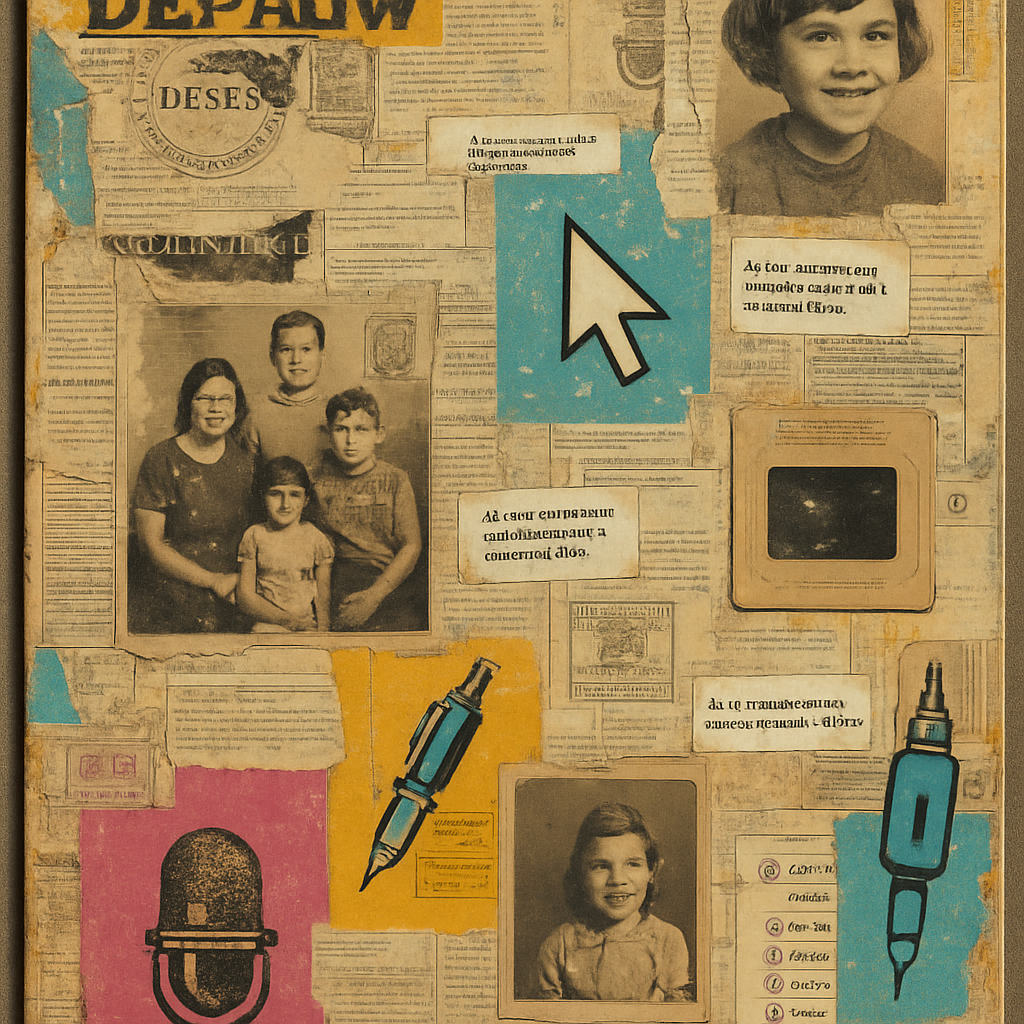
In The Algorithmic Lullaby: Admissions Field I stage the admissions process as a domestic archive gone public: brochures and essays become lullaby sheets, AI-generated passages intrude like polished lullabies learned from a radio. The panel reads edge to edge — no single story dominates — as stenciled robot pens, proctored bubble-sheets and microphones layer over sepia family photographs and torn postcards. Mask fragments nod to traditions of concealment and revelation: who is allowed to show their face, and which voices are heard? British Pop colors flatten and cheerfully advertise systems of merit while ledger grids and stamped seals insist on the bureaucratic arithmetic behind opportunity.
This work maps technology, ideology and labor as overlapping cycles — domestic textures and ritual masks meet star-chart overlays that suggest recurring seasons of policy and public pressure. It asks viewers to search the surface for authenticity: the oral test, the portfolio, the proctored essay, the quiet domestic archive of preparation. Drawing on mask-making, Tía Rosa’s pattern chest and my recent lullaby series, the piece holds both tenderness and critique: an object that comforts and unsettles, asking who decides fairness when merit is mediated by machines and politics.
About the Artist
María Elena Roldán
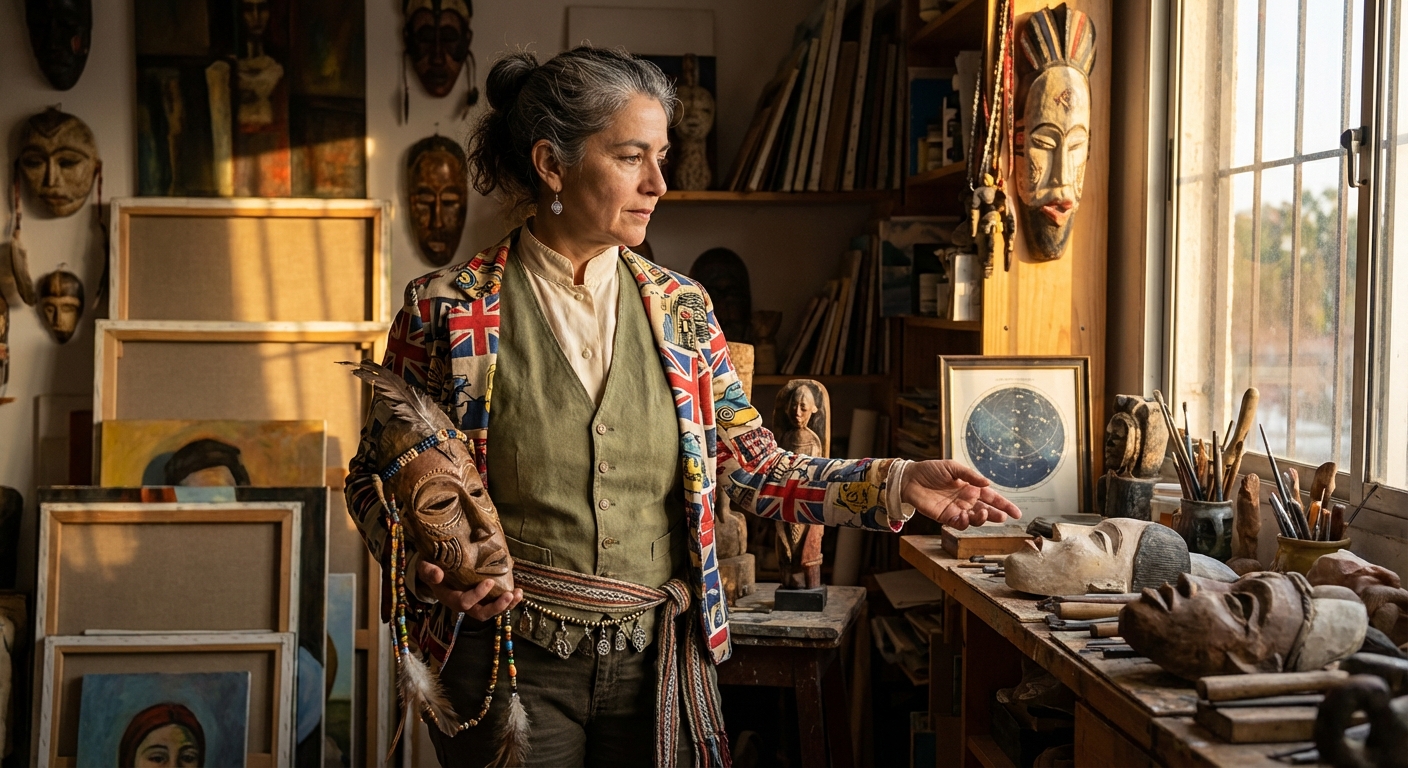
Pronouns: she/her Born 1970-08-02 in a working-class neighborhood on the outskirts of Medellín, María Elena Roldán is a 55-year-old painter, illustrator and mask-maker whose work stitches British Pop ...
View Full Profile →Critic Reviews
-
Dr. Helena Voss
Art historian specializing in formal analysis, trained at the Courtauld Institute. Focuses on visual structure over narrative.
María Elena Roldán's The Algorithmic Lullaby: Admissions Field presents an all-over panel that refuses hierarchy, a ledger of domestic memory rendered as public record. The composition reads edge to edge, sepia family photographs and torn postcards set against saturated panels of turquoise, magenta and mustard. Stencilled robot pens, microphone icons and a large cursor sit like signage over ledger grids and stamped seals, colour flattening depth and cheerfully advertising systems even as abrasion and varnish keep the surface tactile.
Formally the work relies on repetition and rhythmic variation, motifs recurring to generate an even field that nevertheless produces counterpoint. The iconography of testing, proctoring and bureaucratic arithmetic is balanced by mask fragments and star-chart overlays, which introduce ritual and cyclical time into a bureaucratic landscape. Technique is hybrid, a dialogue between printed emblems, hand-tinted sepia prints and layered collage, the material processes echoing the conceptual argument about mediation and authenticity.
The piece's strength is its ethical ambivalence, tenderness folded into critique. It soothes with lullaby textures and domestic archive, it unsettles by making visible the infrastructural forces that regulate access. Read against Roldán's biography and mask-making practice, the panel becomes a formally rigorous meditation on labour, family preparation and technological adjudication. I give it four stars, for its visual acuity and cultural urgency, with a small reservation about moments that verge on the didactic.
All-over composition Colour palette and British Pop influence Collage and tactile layering Iconography of technology and bureaucracy Mask and ritual motifs Temporal overlays and star chartsAug 30, 2026