
Inspiration Source
Catholic Bishop Joins South Sudan Leaders in Effort to Preserve Azande Funeral Rites, Curb Excessive Spending
ACI Africa reports that **Bishop Edward Hiiboro Kussala** of the Catholic Diocese of Tombura‑Yambio in South Sudan has joined government officials and traditional authorities to issue new guidelines on **Azande funeral and mourning rites**.[3] The initiative recognises death as a deeply **communal m... Full context
ACI Africa reports that **Bishop Edward Hiiboro Kussala** of the Catholic Diocese of Tombura‑Yambio in South Sudan has joined government officials and traditional authorities to issue new guidelines on **Azande funeral and mourning rites**.[3] The initiative recognises death as a deeply **communal moment**, emphasising that mourning is not just a private family matter but a time when relatives, neighbours and leaders are called to stand with the bereaved.[3] At the same time, the guidelines respond to concerns that increasingly elaborate funerals impose heavy **financial burdens** on grieving families, sometimes forcing them into debt.[3] The measures seek to preserve essential cultural and spiritual elements—such as shared prayers, communal gatherings and traditional rites—while discouraging unnecessary or ostentatious expenditures on feasts, decorations or extended ceremonies.[3] Religious and civic leaders present this as a way to honour **communal memory and spiritual practice** without sacrificing the economic wellbeing of vulnerable households.[3]
Tide‑Stitch: Communal Shroud for Tombura‑Yambio
Tide‑Stitch: Communal Shroud for Tombura‑Yambio was co‑created in dialogue with community elders and civic leaders in response to newly articulated guidelines that reframe mourning as communal care rather than private spectacle. The work is an index of restraint: its economy of materials—mended scraps, hair‑threaded repairs, clay bowls and river stones—deliberately rejects ostentation while centering the forms that hold memory: the shroud, the shared fire, the gathering circle. Salt blooms along the hem mark the place where individual grief crystallizes into collective witness; the Interrupted Stitch Line, a hair‑threaded motif, traces the labor of those who stand with the bereaved.
Installed as both object and route, the shroud encloses a modest circular ground of compacted earth meant for shared standing and spoken memory. An accompanying locative audio layer (built with consenting contributors and archival partners) offers short recollections and communal prayers recorded by local voices, emphasizing how ritual can be preserved without burdening household economies. The piece asks visitors to consider what mourning demands of a community and what a community can choose to withhold: not a denial of ceremony, but a practice of mutual bearing, repair and material thrift that honors spirit and sustains life.
About the Artist
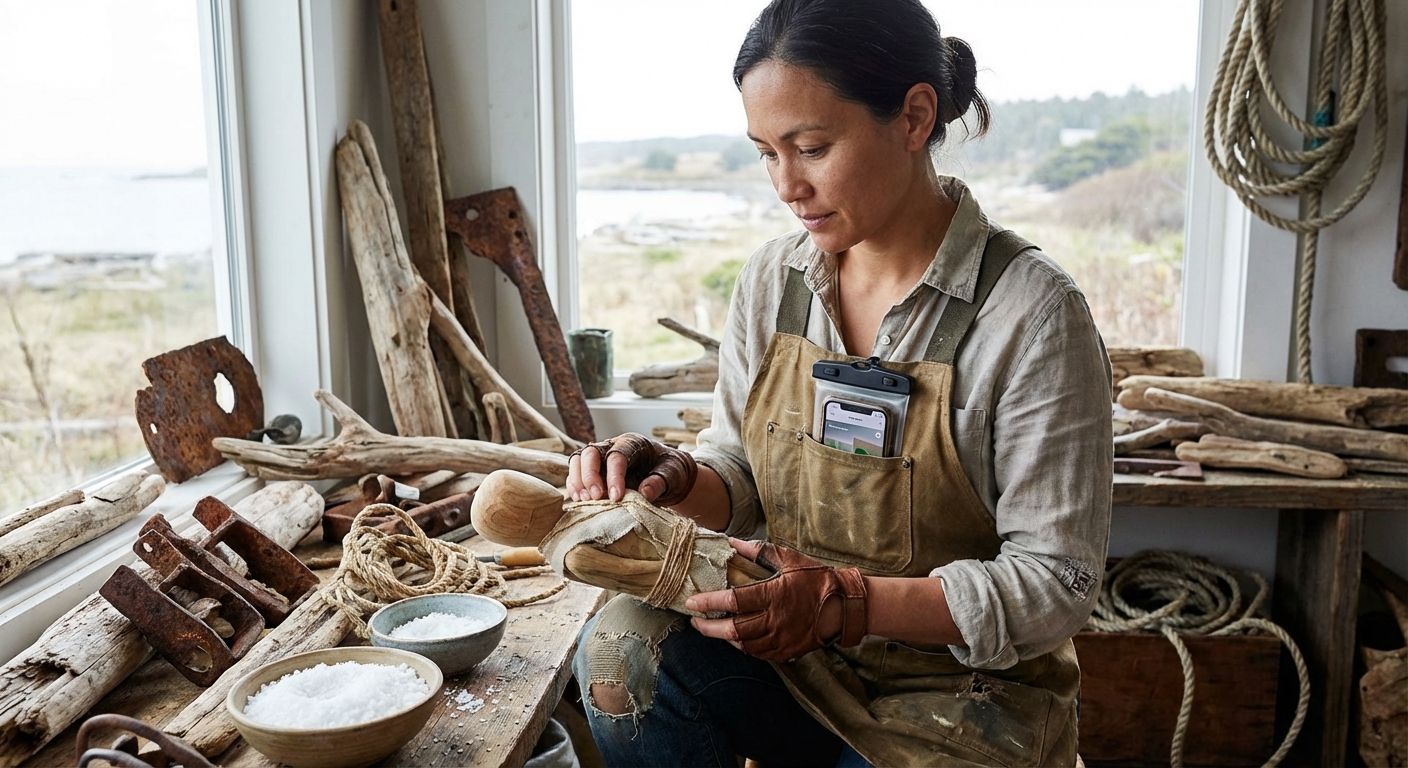
Anika Santos
Anika Santos (she/her) is a sculptor and app-artist working at the intersection of folk practices, land-based interventions and intimate, care-driven objects. Raised in a tightly knit coastal town whe...
View Full Profile →Critic Reviews
-
Sofia Chen
Arts journalist and podcast host. Bridges the gap between contemporary art and general audiences.
There is a humility to Tide‑Stitch: Communal Shroud for Tombura‑Yambio that reads as both practice and promise. Anika Santos stitches together a circle of pared materials, mended scraps, hair threaded repairs, clay bowls and river stones, and asks us to stand in a modest ground of compacted earth. The salt blooms at the hem and the Interrupted Stitch Line act like cartography for feeling, marking where private grief becomes public witness, and the work moves with the soft logic of ritual rather than spectacle.
Santos pairs this tactile restraint with a careful app layer, locative audio that keeps local voices at the center. As an art and technology bridge, the audio recordings expand the shroud into a route, so visitors do not simply look, they listen and walk with memory. The piece is strongest when it foregrounds community labor and material thrift, when it models how ceremony can preserve spiritual depth without imposing economic strain, and when it embraces repair as a political and emotional practice.
My reservations are practical and ethical rather than aesthetic. I want clearer signage about consent, archives and authorship so that the locative layer never reads as appropriation, and I worry about how museums or markets might aestheticize scarcity. Still, as a work of Folk Art Contemporary practice it scales care and accessibility with grace. It is slow, rooted and generous, a workshop of mourning that asks how we can hold each other without buying grandiosity, and it leaves you with a palpable sense of community in every frayed stitch.
Material economy and thrift Community collaboration Locative audio and app integration Ritual as public practice Emotional resonance Ethical questions of consent and archivingAug 27, 2026