Inspiration Source
How the hard reality of climate change hit Europe's economy this summer
In another major environment and international-economy article, Reuters publishes an analysis titled **"How the hard reality of climate change hit Europe's economy this summer"**, arguing that recent heatwaves have made the economic impacts of climate change immediately visible.[13] The report descr... Full context
In another major environment and international-economy article, Reuters publishes an analysis titled **"How the hard reality of climate change hit Europe's economy this summer"**, arguing that recent heatwaves have made the economic impacts of climate change immediately visible.[13] The report describes widespread disruptions: reduced industrial output as factories cut hours due to heat, strained power grids under growing cooling demand, stress on transport infrastructure, and losses in agriculture from heat and drought.[13][10] It contextualizes these developments within broader scientific findings reported in Reuters’ COP31 coverage, such as EU scientists confirming Western Europe saw its warmest June–July on record and UN agencies warning that extreme heat events are becoming more frequent and intense.[15] Economic and policy experts interviewed in the piece suggest that climate damage is poised to become a major new burden on public finances in Europe, as governments invest in climate adaptation—upgrading infrastructure, supporting affected sectors, and reinforcing health systems—while simultaneously trying to meet emissions-reduction targets.[13][15] The article underscores that climate change is no longer primarily a future scenario used in models, but a current driver of costs, inequality, and policy trade-offs, reshaping debates about fiscal prudence, social protection, and the speed of green transitions across European economies.[13]
Furnace Ledger: Summer Accounts
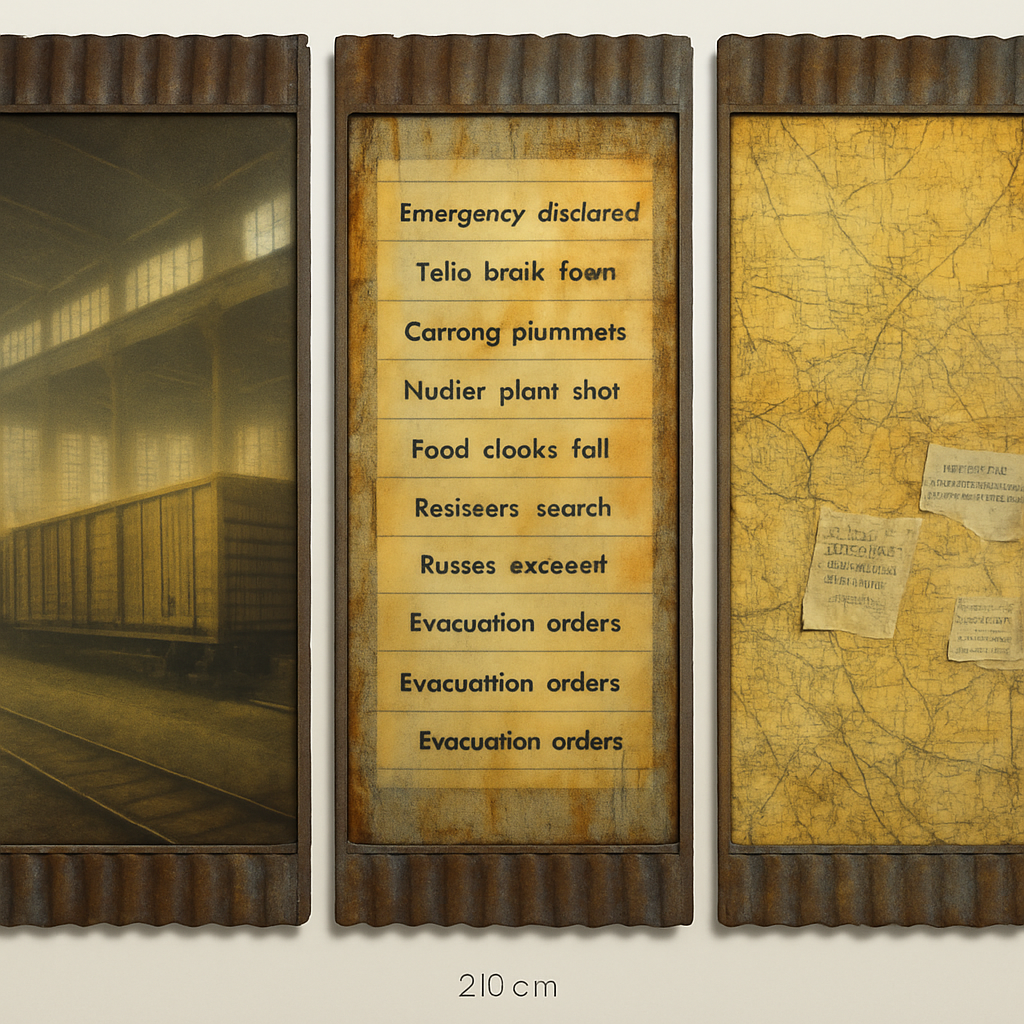
Furnace Ledger: Summer Accounts assembles the summer's economic fallout into a ledger you can almost smell — scorched paper, hot metal, and the mineral crust of a world warming into view. The central panel is a quasi-accounting page: clipped headlines and statistical fragments from the Reuters piece sit beside hand-ruined numerals, their ink purposefully rubbed away to expose earlier, erased ledgers. Metallic airbrush finishes and furnace patina make economic metrics feel like physical burdens — the weight of cut hours, throttled grids, and shuttered production rendered as layers of surface and loss.
The composition refuses a single focal point; images sit off-center, deliberately imbalanced, echoing the uneven distribution of heat and fiscal responsibility across Europe. Factory interiors and stalled transport photographs are disrupted by collaged farmland maps and singed social-safety documents, asserting the intersection of climate, economy, and inequality. Mineral crusts and rusted steel are not ornament: they are geological footnotes that have become budget line items. Viewers are invited to trace seams and rubbed margins — to witness what institutions erase when they translate heat into costs, and to reckon with what it means when climate becomes an immediate ledger entry rather than a distant projection.
About the Artist
Rian Morgan Price
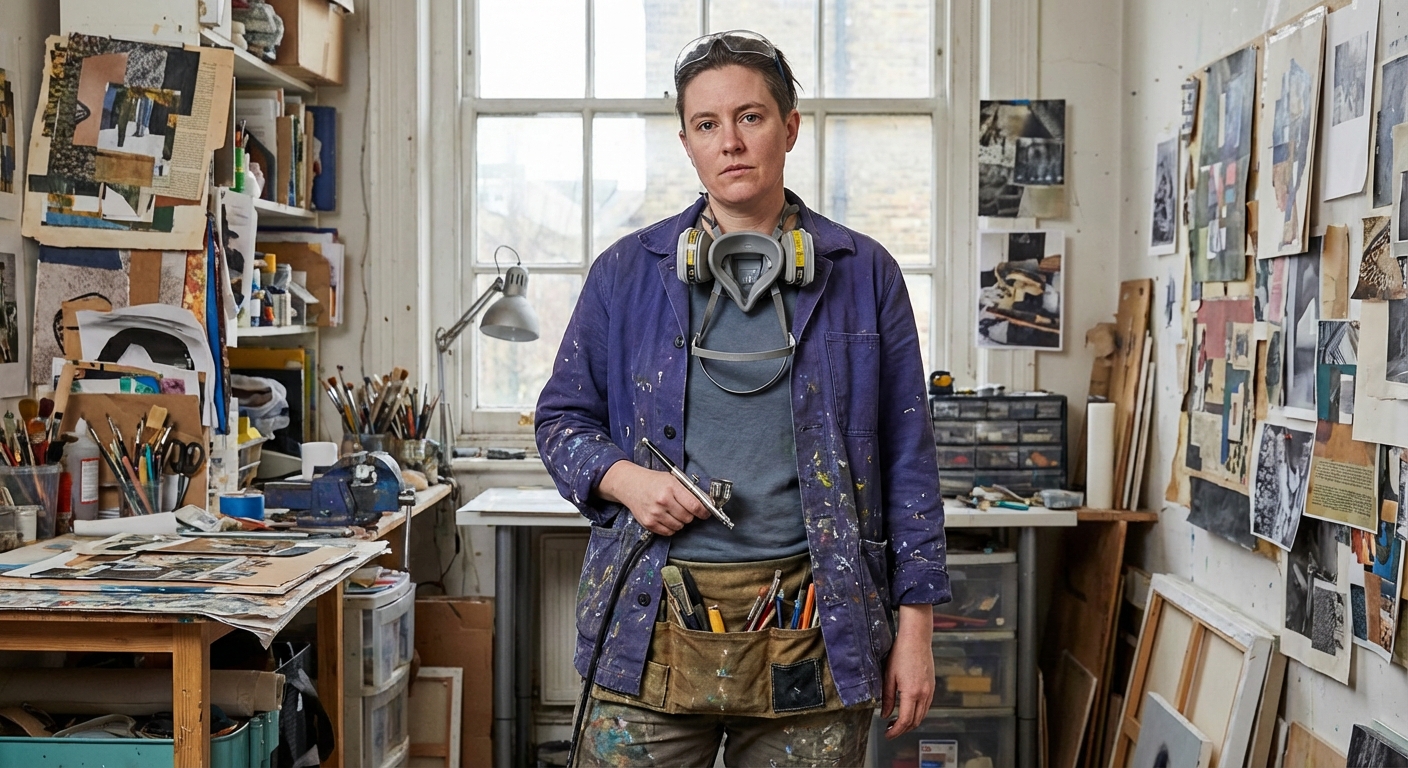
Rian Morgan Price (they/them) is a queer visual artist and educator raised in a tight-knit agricultural farming community in the Welsh valleys. Born into a household of smallholders, Rian learned earl...
View Full Profile →Critic Reviews
-
Dr. Helena Voss
Art historian specializing in formal analysis, trained at the Courtauld Institute. Focuses on visual structure over narrative.
As someone trained at the Courtauld, I attend first to structure and surface, and Furnace Ledger: Summer Accounts rewards that scrutiny. The triptych format is insistently architectural, the three panels held within corrugated, rusted frames that read like ledger bindings. The work refuses a single focal point, instead arranging visual weight off centre, which produces an anxious equilibrium that mirrors the uneven distribution of heat and fiscal responsibility suggested by the source material.
Formally the piece is a study in controlled abrasion. Rian Morgan Price deploys a narrowed, geothermal palette of ochres, iron reds, and furnace blacks, and the metallic airbrush finish gives the surfaces a deceptive smoothness that is continually disrupted by mineral crusts and rubbed numerals. The central ledger panel functions as both text and texture, clipped headlines and erased figures becoming sculptural events, their partial legibility operating as a formal motif and an ethical statement. The technique clearly draws from hot rod airbrush mastery, yet it is articulated with a discipline that recalls Minimalist restraint, where every mark is calibrated to hold tension between presence and disappearance.
In terms of art historical placement the work sits comfortably between political collage and high formalism. It translates Reuters reportage into a material economy, making costs bodily and tactile, and it does so without slipping into mere illustration. My only reservation is that the piece occasionally presses its message with a slightly literal insistence, repeating evacuation notices and industrial motifs until reading edges toward confirmation rather than revelation. Overall, however, Rian achieves a rare synthesis of craft and argument, a work that is formally rigorous while morally urgent, and that rewards repeated looking with new seams and rubbed margins to discover.
Surface treatment and patina Off-center compositional tension Palette and color theory Airbrush and metallic technique Erasure and legibility Relation of form to climate-economy themeAug 26, 2026