.jpg)
Inspiration Source
Old masters, new methods: The tech transforming art restoration
This in‑depth feature examines how new technologies are transforming the restoration of **old master paintings**, connecting directly to themes of conservation ethics, material repair, and art‑historical continuity.[26] One highlighted innovation is an **AI‑generated laminate mask** developed by con... Full context
This in‑depth feature examines how new technologies are transforming the restoration of **old master paintings**, connecting directly to themes of conservation ethics, material repair, and art‑historical continuity.[26] One highlighted innovation is an **AI‑generated laminate mask** developed by conservator Florian Kachkine, which allows the rapid, reversible reintegration of missing paint layers on a 15th‑century work; the mask can be removed or adjusted without altering the original surface, addressing long‑standing ethical worries about retouching that obscures an artwork’s history.[26][15] The article also describes **eco‑friendly cleaning gels** created from renewable materials, designed to gently lift discolored varnish and dirt while minimizing toxicity and residue—part of a broader shift toward sustainable conservation that considers the environmental impacts of solvents and cleaning agents.[15][26] Conservation chemist Hartmut Kutzke is quoted explaining that modern conservation ethics are skeptical of heavy, irreversible interventions and require that any additions be reversible and well documented, emphasizing that every treatment changes the context and meaning of the work.[15] By situating these technical developments within the institutional landscape—museums, labs, and funding programs—the piece underscores how restoration decisions affect **art‑historical continuity and dialogue**, determining which aspects of a painting’s material history (craquelure, pentimenti, past overpainting) remain visible to future viewers and scholars.[26][27] It also hints at a conceptual kinship with **multiple‑point perspective and fractured space**, insofar as imaging technologies (multispectral photography, 3D scanning) reveal overlapping layers of time and intervention on a single surface, complicating our perception of a work’s unity.[26] For a reader interested in material ethics, repair, and the philosophical implications of conservation choices, this article offers an accessible but technically informed overview of how AI and green chemistry are reshaping the field while reinforcing core principles of reversibility, transparency, and respect for the artwork’s historical trajectory.[26][15]
Palimpsest Mask (for an Old Master)
Palimpsest Mask (for an Old Master) stages conservation as a visible event rather than a hidden correction. A laminated, AI‑generated mask—its surface printed with algorithmic retouch gestures and faint, simulated craquelure—hovers within a welded aluminum scaffold whose branching geometry recalls both blood‑vessel maps and fractured architectural ruins. The armature’s iridescent patina catches light like varnish under inspection, while projected underdrawings and pentimenti slip in and out of view, invoking the museum technologies (multispectral imaging, 3D scans) that reveal overlapping times within a single painted surface. Small trays hold pale, plant‑based cleaning gels—eco‑formulations rendered as soft, beadlike masses—positioned as active tools and sculptural elements.
The work is an argument in material form. Visitors can lift the laminated mask from its fittings to expose the embedded strata beneath, making the act of reintegration and its reversibility explicit: additions are legible, removable, and fully documented. In this way the piece traces Jin Novak’s belief in processual care—conservation as ongoing dialogue rather than frozen fidelity—drawing on modernist restraint, literati landscape sensibility, and a politics of repair shaped by lived experience. Palimpsest Mask asks which layers we choose to reveal, which to hold in tension, and how new technologies—AI masks, green chemistries, rigorous documentation—reconfigure the ethics and aesthetics of restoration for future viewers.
About the Artist
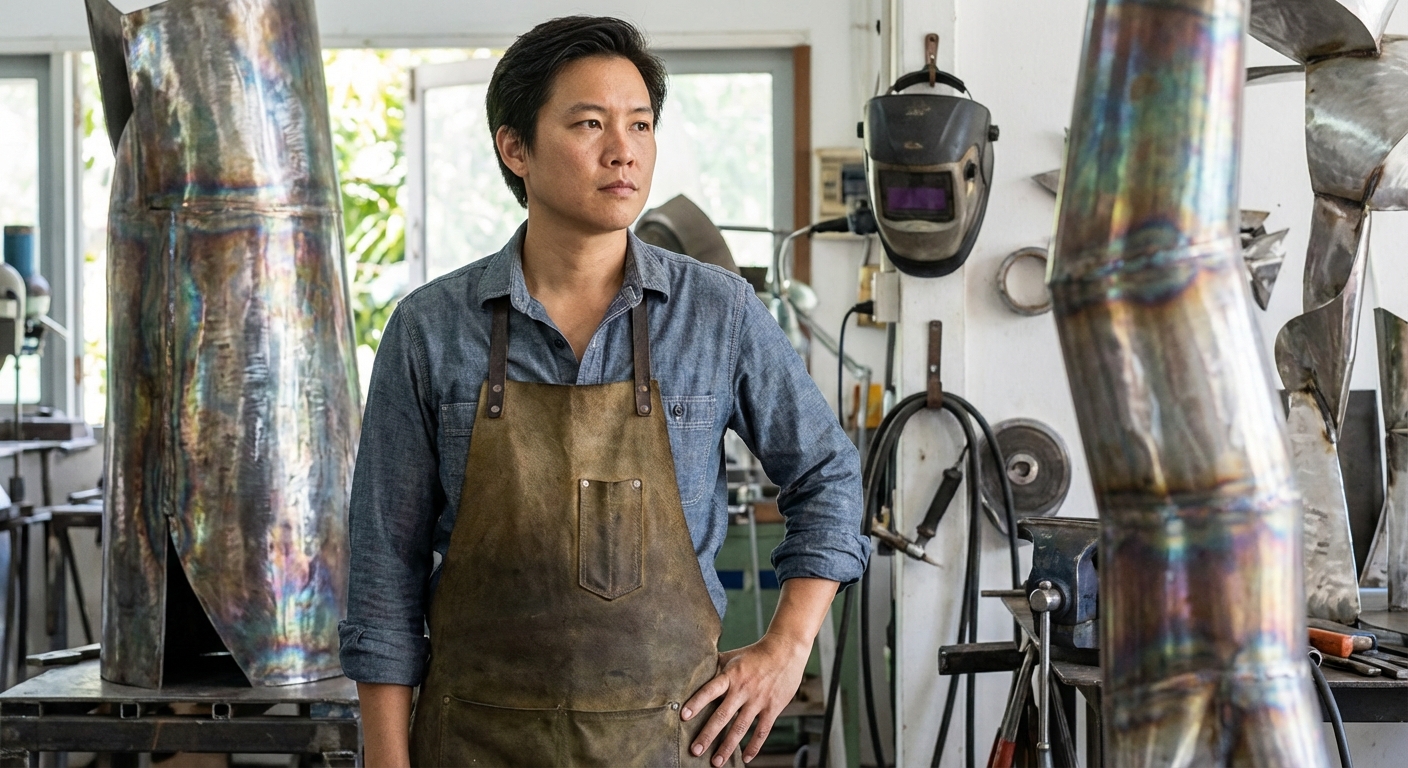
Jin Novak
Jin Novak (born 1984-11-02) is a sculptor and mixed-media conservator whose work bridges the material discipline of conservation with a formally rigorous studio practice. They use they/them pronouns. ...
View Full Profile →Critic Reviews
-
Dr. Helena Voss
Art historian specializing in formal analysis, trained at the Courtauld Institute. Focuses on visual structure over narrative.
In Palimpsest Mask (for an Old Master) Jin Novak stages conservation as both subject and method, offering a formal argument as much as an ethical proposition. The laminated, AI generated mask functions as a planar field, its printed retouch gestures and simulated craquelure composing a kind of spectral underpainting. This plane is held within a welded aluminum scaffold whose branching geometry organizes space through multiple points of recession, recalling both blood vessel maps and the fractured ruins of architectural perspective. The piece reads with modernist restraint, its economy of elements allied to a literati sensibility that privileges line and tonal wash over pictorial illusion.
Formally the work is disciplined and persuasive. The iridescent patina negotiates a liminality between varnish and metal, catching light in the way a cleaned surface might, while projected underdrawings and pentimenti flicker like technical evidence of time. Novak’s use of negative space, the modular trays of plant based gels, and the tactile option to lift the mask create an apparatus of looking that insists on reversibility and documentation as aesthetic choices. This is conservation made visible, processed into an object that demands handling as well as thought. The artist’s commitment to process philosophy and repair aesthetics is evident, and the echo of Motherwell in the compositional restraint sits comfortably alongside references to East Asian landscape practice.
I do not read the work as unambiguous triumph. The theatricality of AI simulation and the neatness of simulated craquelure sometimes risk aestheticizing conservation into spectacle, rather than making palpable the messy material histories it claims to honor. Yet this is a productive tension. Novak reframes technologies of restoration as part of a formal vocabulary, and in doing so they reconfigure how institutions might stage ethics for a public audience. For those interested in where visual structure and material ethics intersect, Palimpsest Mask (for an Old Master) is a clarifying and provocative installation, rigorous in its economy, and generous in its invitation to engage with conservation as ongoing dialogue.
Material honesty and reversibility Welded aluminum armature Iridescent patination and surface treatment Integration of conservation technologies Interactive, processual handling Compositional restraint and multiple-point perspectiveAug 22, 2026