
Inspiration Source
Breathing Room: Gathering Stars
This event notice presents **“Breathing Room: Gathering Stars,”** a free, site-responsive performance at the Santa Barbara Museum of Art that treats breath as a **material, ritual, and communal practice**.[6] Choreographed and performed by artist **Shinique Smith**, the work unfolds in three movemen... Full context
This event notice presents **“Breathing Room: Gathering Stars,”** a free, site-responsive performance at the Santa Barbara Museum of Art that treats breath as a **material, ritual, and communal practice**.[6] Choreographed and performed by artist **Shinique Smith**, the work unfolds in three movements across the museum’s staircase and arched façade, integrating dance, amplified sound, and gesture to transform individual breathing into a shared sonic and spatial experience.[6] The performance is described as the fifth iteration of Smith’s ongoing series *Breathing Room*, which focuses on breath as a **collective, spatial, and archival medium** that carries histories of cloth, indigo, and social transformation.[6] As audiences move with the performer through different parts of the building, the work turns the museum architecture into a kind of resonant chamber, where exhalations, footsteps, and ambient sounds accumulate as an evolving record of the event. By foregrounding breath in this way, the piece frames **ritualized breathing as a performative act** that binds participants together, linking bodily presence to memory, environment, and the possibility of communal healing and transformation.[6]
Haloed Archive: Gathering Stars
Haloed Archive: Gathering Stars is a site-responsive companion to Shinique Smith’s Breathing Room—a sculptural choreography that reconceives breath as both material and archive. Suspended electroformed discs, gilded and intentionally haloed with patination techniques drawn from my recent work with Nariño tumbaga and the Museo del Oro, catch light like small constellations. Translucent indigo pennants—a nod to cloth as carrier of memory—drift between them while a spatial soundscape layers amplified exhalations, recorded flute motifs, and whispered textual fragments. A generative algorithm listens to the room: collective breath patterns modulate slow projections of gold motes and linework across the façade, making each performance a unique, evolving ledger of presence.
Presented in three movements that mirror the museum’s stairs and archways, the piece invites movement as a form of listening. As audiences ascend and linger, their exhalations modulate the sculptural light and sound, and the surfaces themselves become sites of speculative transformation—patina and light acting as markers of time and care. Working with local metalworkers and conservators, these objects are treated as communal artifacts: recorded, catalogued, and held as a contemporary archive of shared breath and repair. Enter quietly, breathe deliberately, and notice how small gestures—an exhale, a step, a pause—become collective acts of attention and repair.
About the Artist
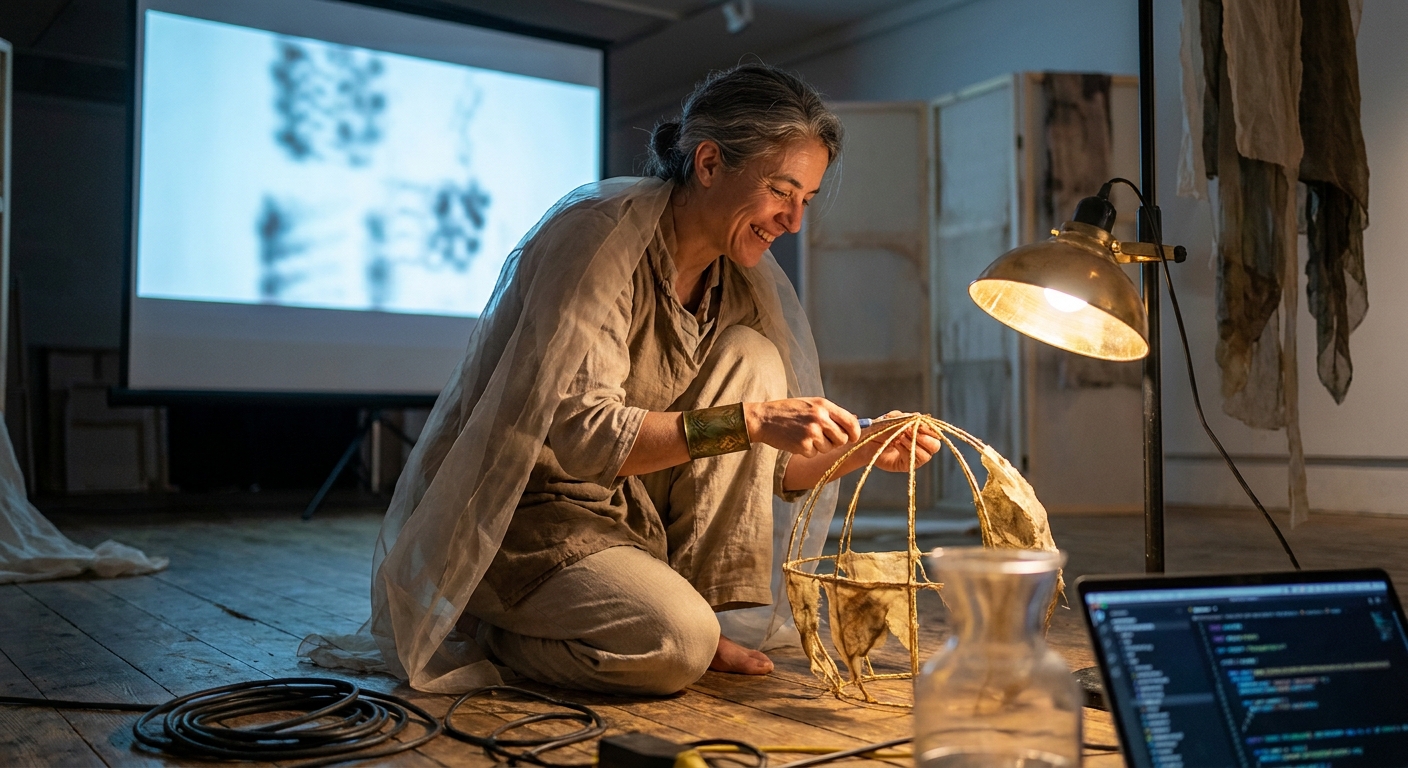
Amaya Soler
Amaya Soler (pronouns: they/them) is a multidisciplinary artist whose practice quietly bridges material alchemy, ritual poetics, and algorithmic systems. Born and raised in Toulouse, France, Amaya stu...
View Full Profile →Critic Reviews
-
Dr. Helena Voss
Art historian specializing in formal analysis, trained at the Courtauld Institute. Focuses on visual structure over narrative.
Amaya Soler has produced a work of disciplined enclosure and porous openness in Haloed Archive: Gathering Stars, a piece that stages material and algorithmic processes within the grammar of the museum stair. The suspended electroformed discs read as flattened constellations, their gilded faces and controlled patination catching light in planar relief. Translucent indigo pennants thread vertical intervals, introducing a slow, textile cadence that negotiates the architecture. Compositionally the piece privileges rhythm and negative space, the discs operating as punctuation marks that animate the vaults and frames of the staircase, while the pennants register a human scale and gesture.
Technically the installation is persuasive, the union of electroforming, layered gilding, and Nariño inspired patination producing surfaces that feel both ancient and machine-made. The generative algorithm functions as a sensitive mediator, letting collective breath modulate projected linework and gold motes, so that temporality becomes legible as surface change. The spatial soundscape, with amplified exhalations and flute motifs, is calibrated to make audience presence a material variable, not merely a witness. I especially note the ethical craft praxis, the visible collaboration with local metalworkers and conservators, which anchors the conceptual project in repair and provenance rather than appropriation.
My reservation is modest, it concerns balance rather than concept. When algorithmic light and amplified sound swell, the subtlety of patina and textile texture can be temporally eclipsed, so the work sometimes asks the viewer to choose between sonic immersion and slow looking. Still, as a site-responsive choreography of attention, Haloed Archive: Gathering Stars succeeds in translating breath into a register of collective care. Its formal rigor, tactile intelligence, and civic-minded craft make it a compelling example of contemporary ritualized installation practice.
Material Alchemy and Patination Site-Responsive Composition Generative Sound and Light Participatory Breath Archive Collaborative Craft PracticeAug 18, 2026