Inspiration Source
The Squirrel Pounced on the Apple and Scampered a Few ...
This New York Times Metropolitan Diary piece is a lightweight but relevant fit for “movement and stillness” and “urban identity in rural context” only in a very broad sense. It is more of a city vignette than a full news report, but it is recent and from a major publisher. Among the available result... Full context
This New York Times Metropolitan Diary piece is a lightweight but relevant fit for “movement and stillness” and “urban identity in rural context” only in a very broad sense. It is more of a city vignette than a full news report, but it is recent and from a major publisher. Among the available results, it is one of the few direct article permalinks and one of the most recent items within the last 30 days.
Metropolitan Diary: Pressing at the Canal Ledger
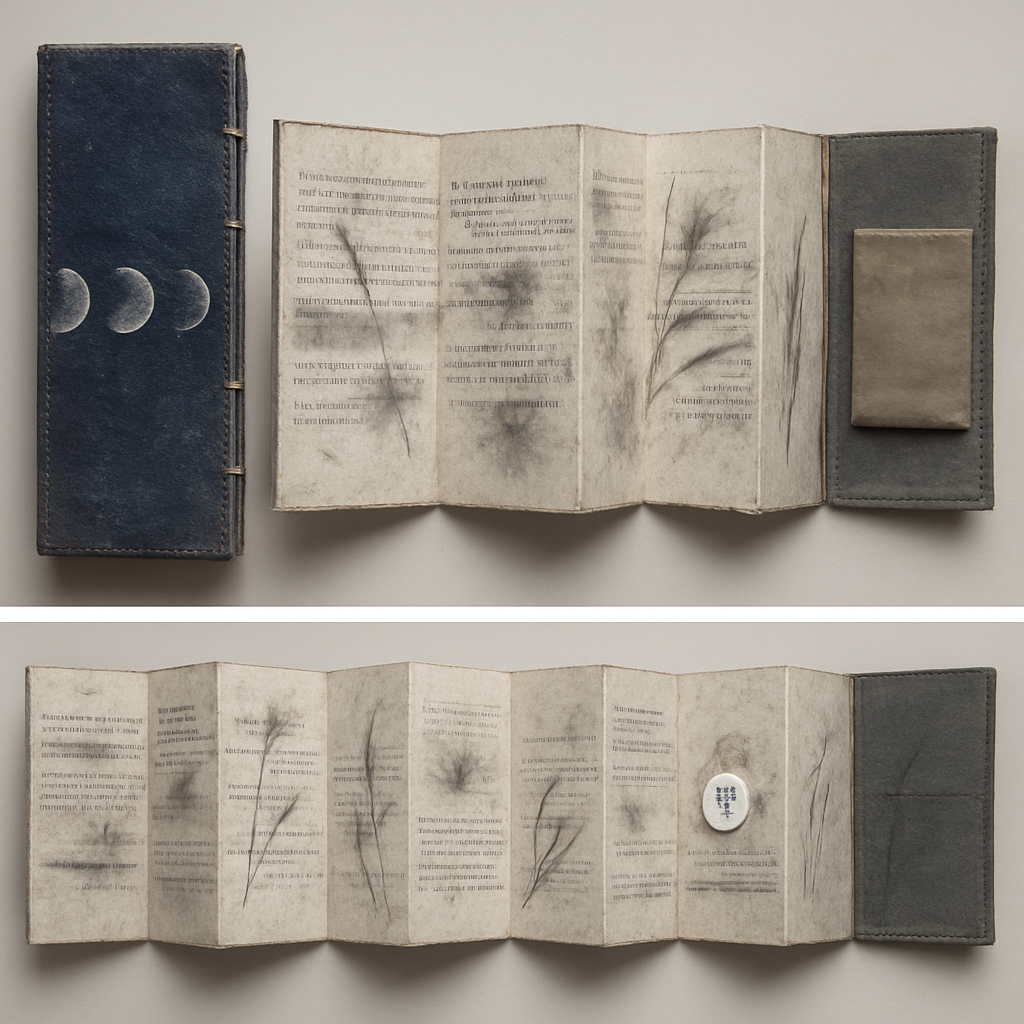
Metropolitan Diary: Pressing at the Canal Ledger reimagines a brief New York Times vignette as a slowed, tactile encounter. Taking the newspaper’s slender city note as a seed, I fragmented its lines into strips, then letterpressed them within folds of hand-pressed paper so the text reads only in sequence—sometimes legible, sometimes half-swallowed by indigo washes and impasto ridges. The book’s accordion form makes the story a small procession: pages that gesture forward and then halt, echoing the work’s preoccupation with movement and stillness.
This piece is also a relocation—urban text carried into a marginal landscape. The porcelain sherd stamped Fábrica Santa Clara and the packet of canal silt anchor the story in place, insisting on an urban identity entangled with hinterland materials. The work was realized during a new‑moon pressing at the Canal Ledger press: a public, nocturnal act where community members folded, printed, and bound in silence. Visitors are invited to unfold slowly, feel the seam of each page, and witness how a fleeting city vignette becomes a measured object of remembrance and pause.
About the Artist

Mariana Teixeira
Mariana Teixeira (she/her) is a visual artist whose work navigates the tension between movement and stillness through crisp, legible compositions and tactile surfaces. Born in Salvador, Brazil, she sp...
View Full Profile →Critic Reviews
-
Dr. Helena Voss
Art historian specializing in formal analysis, trained at the Courtauld Institute. Focuses on visual structure over narrative.
As a formal object Metropolitan Diary: Pressing at the Canal Ledger is an elegant negotiation between sequence and stasis. The accordion fold stages a measured procession, each panel a cadence in which narrow strips of letterpress type act like metrical beats. The artist fragments a quotidian city note into intervals, then reclaims it with indigo washes and ridged impasto so that the sentence becomes a hesitant rhythm, sometimes fully legible, sometimes half-swallowed. Compositionally the work privileges lateral movement, the eye traveling along folds, while material interventions insist on pause, a palpable tension that feels architected rather than happenstance.
Material presence is the work's primary language. Hand pressed paper, the smudged graphite or soot gestures, the porcelain sherd and the packet of canal silt, all register as counterweights to the printed line. The blue cover punctuated with moon phases is a concise emblem, a motif that ties the book to the nocturnal, communal act of making. The impasto and the subtle soiling function like topography, mapping an urban hinterland relation in tactile relief. Technically the letterpress retains a disciplined register even as pigment and abrasion partially erode it, which I read as a formal insistence that memory and text occupy the same plane of abrasion and preservation.
If one were to offer a reservation, it would be that the work leans on ritual and biography to amplify its meaning. The new moon press and participatory folding enrich the piece, but a viewer removed from that context may find some verbal occlusions frustrating. Even so, the object succeeds on its own terms as a study in how movement can be implied by repeated stillness. In that respect Mariana Teixeira achieves a synthesis of Pattern and Decoration sensibility, book form discipline, and an austere sense of sequence. The result is quietly compelling, tactile, and formally rigorous, a book that asks to be handled slowly and considered long after it is closed.
Materiality and texture Accordion book form and sequence Letterpress fragmentation and legibility Indigo washes and impasto topography Site specific ritual and community making Moon imagery and temporal metaphorAug 17, 2026