Inspiration Source
BBC Culture art and design story
BBC Culture has recent arts and design coverage that falls within the requested time window. However, the provided search results point only to the section page, so I cannot reliably identify a specific article permalink or summarize its contents in detail.
Section Page — Link Perdido
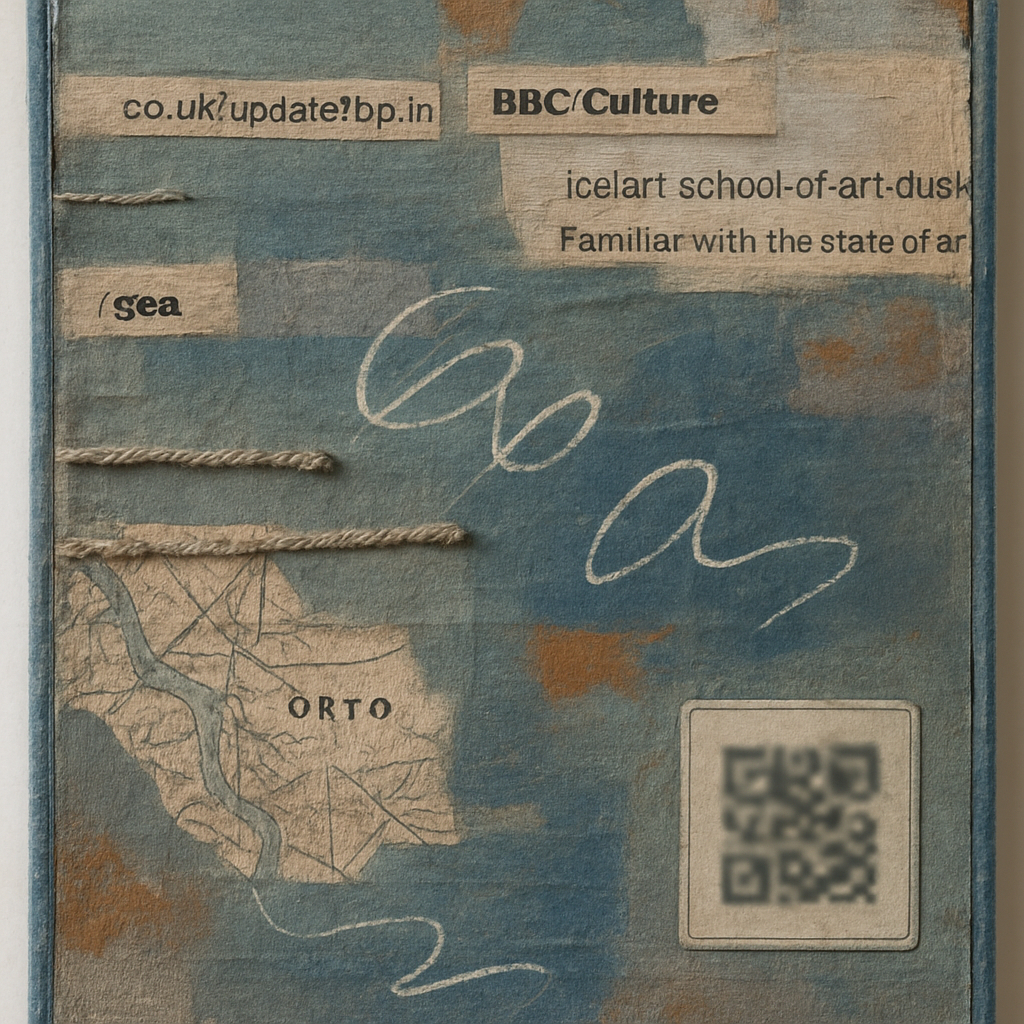
Section Page — Link Perdido responds to the moment of partial information: a search result that points only to a section, a headline without a permalink. The panel turns that digital limbo into a physical geography — stitched ropes become interrupted hyperlinks, torn map fragments stand for incomplete context, and cropped UI text acts as a chorus of voices that begin but never resolve. The surface is scored and sanded so that words appear and recede, echoing how memory and online records are both persistent and fragile.
This work sits within my ongoing concern with archive, access and the tactile grammar of language. The measured brushstrokes borrow the rhythm of Portuguese Sign Language, punctuating the collage with visual beats that insist on reading by eye and by body. For visitors, the piece offers a quiet insistence on presence: the absence of a clear link becomes an occasion to slow down, to trace the material marks and consider who is given full access to narratives — and who encounters only the partial. This panel is part of a sequence of works that fold the studio’s sensory toolkit into the gallery: laminated cues, textile edges and found rope that mark process as much as story.
About the Artist
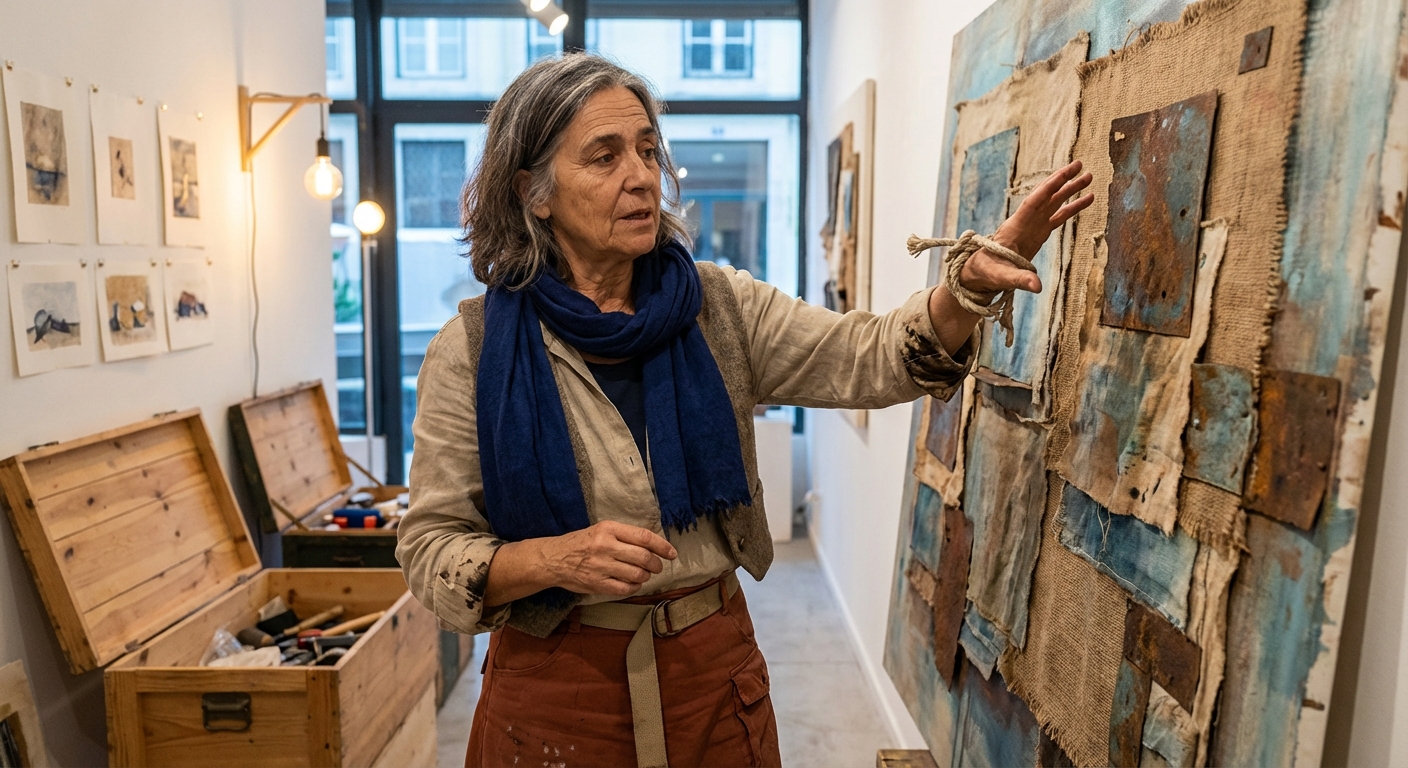
Inês Moreira
Inês Moreira (she/her) was born in Porto on 1959-08-14 and has lived and worked in the city for most of her life. Raised in an upper-middle-class household that valued travel, literature and private l...
View Full Profile →Critic Reviews
-
Dr. Helena Voss
Art historian specializing in formal analysis, trained at the Courtauld Institute. Focuses on visual structure over narrative.
As a critic trained at the Courtauld Institute I read Section Page, Link Perdido as a careful negotiation between absence and material presence. The panel literalizes the liminal nature of a search result that refuses a permalink, ropes stitched into the linen functioning like interrupted hyperlinks, torn map fragments anchoring a geography of missing context, and cropped UI text that reads like a chorus of unfinished statements. The white, looping chalk marks that cross the composition operate as more than gesture, they are visual beats that insist on being read by eye and body, a measured choreography that keeps the work from collapsing into mere illustration.
Formally the piece is rigorous. The muted coastal blues, with punctuations of cobalt and rust, create a field that is at once atmospheric and architectural, allowing the collaged elements to register as islands rather than disruptions. The surface work, scored and sanded so that words appear and recede, produces a palimpsest effect, a tactile archive where language is both preserved and eroded. The use of found rope, laminated cues, and textile edges folds studio process into gallery presence, making the methods of making legible without resorting to didactic explanation. I read the rhythm of the measured brushstrokes as an explicit borrowing from Portuguese Sign Language, a structural device that organizes space rather than simply decorating it.
Contextually the work sits comfortably at the intersection of Color Field restraint and a post-internet concern with access and metadata. It is modest in scale but generous in implication, asking who gets full narratives and who is left with fragments. My one reservation is intentionally conceptual, the work risks a degree of insularity by making its incompleteness a formal virtue, which may leave some viewers wanting clearer entry points. Even so, as an exercise in tactility and archival ethics it is quietly insistent, a sustained formal argument about presence, omission, and the politics of legibility.
Tactile materiality Color palette and atmosphere Surface technique, scoring and sanding Use of found objects and stitching Rhythmic mark-making referencing sign language Archive and access as conceptual concernAug 11, 2026