.jpg)
Inspiration Source
Circus heritage preserved through archives and live performance
The article focuses on efforts to document circus history and keep performance traditions alive through museums, archives and live interpretation. It fits the topic of circus heritage and performance by showing heritage work as both preservation and stage practice.
Mantle for the Returned Names (Caravana Reliquia)
Mantle for the Returned Names (Caravana Reliquia) is an act of binding: a monumental, opaque surface that fuses found costume fragments, ledger pages and faded posters into a single painted field. Using my Celeste Adhesive Protocol and alla prima monadic surfaces, I treat each relic as a self-contained universe—an archival monad—then compress them into dense patches of color and texture. The palette borrows the volcanic hues of place—obsidian blacks, molten ambers and cooled teals—so that memory reads as landscape and costume as strata.
Presented between museum vitrine and stage, this work positions heritage practice as both preservation and performance. The stitched huipil scraps and sequins read as archival evidence; the hidden speakers, lighting cues and trunk armature invite live interpretation and communal activation. Visitors are encouraged to move around the mantle, to trace stitches and fragments, and to join scheduled shared readings of the Ledger of the Liminal Troupe—because to keep circus traditions alive is to hold them as both object and living practice: recorded, rehearsed, and re-enacted.
About the Artist
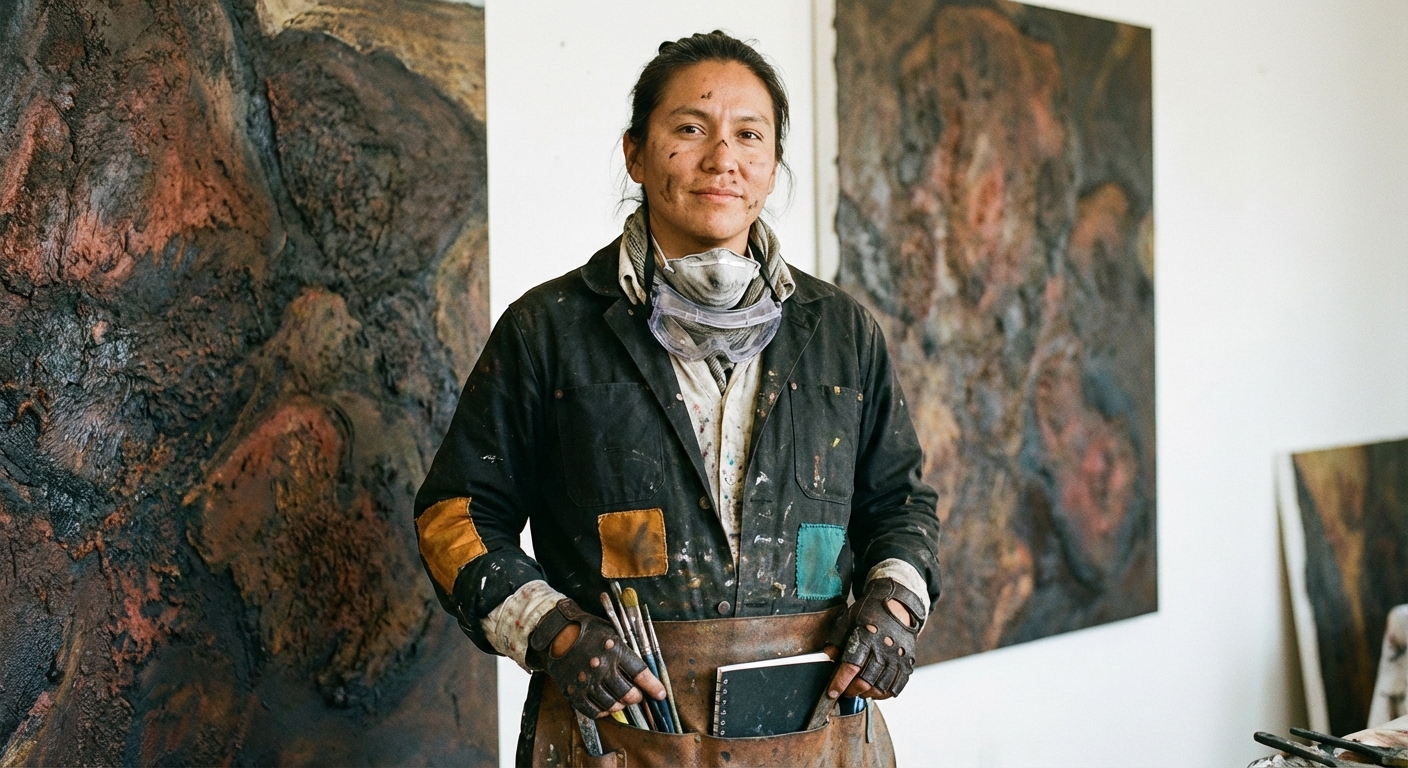
Aiyana Calderón
Aiyana Calderón (they/them) is a painter and archivist whose practice compresses histories into opaque, monumentally solid surfaces. Born into a family of circus and traveling performers with a layere...
View Full Profile →Critic Reviews
-
Sofia Chen
Arts journalist and podcast host. Bridges the gap between contemporary art and general audiences.
Standing before Mantle for the Returned Names (Caravana Reliquia) is like approaching a reliquary that remembers by compressing. Aiyana Calderon binds huipil scraps, ledger pages and faded posters into an opaque painted field using their Celeste Adhesive Protocol and alla prima monadic surfaces. The volcanic palette of obsidian blacks, molten ambers and cooled teals reads as topography, a memory landscape where costume becomes strata, and small circled portraits and sequins peek like fossils in tar.
The work lives somewhere between museum vitrine and stage, and that tension is its most powerful idea. The trunk armature, hidden speakers and scheduled Ledger readings invite communal activation, and the invitation to walk around and trace stitches turns preservation into performance. At the same time the monumental opacity risks flattening individual voices, making some archival fragments inscrutable without supplementary narration. For general audiences the sensory pull of color and texture is immediate, while the conceptual apparatus benefits from clearer entry points, signage, or programmed activations so the living practice is not only suggested, but accessible.
As an act of civic curation the mantle succeeds emotionally and formally, its surface work feeling like careful stitching of exile and return. My main wish is for more moments of tactile or oral exchange, a practice that would honor Aiyana Calderon’s refusal of spectacle and their community rooted method. The piece functions as both monument and stage, and in its best realizations it will be a workshop as much as an artwork.
Archival Collage Textile Surface Performance Activation Color Palette Community Engagement Material DensityAug 10, 2026